Forty-four years of confrontation between two superpowers — the United States and the USSR — across every continent and into outer space. No direct battles between them, but an arms race, espionage, proxy wars, and a constant threat of nuclear annihilation. It ended peacefully — and unexpectedly: one of the players simply fell apart, leaving fifteen independent states in its place.
Who fought whom
The Western bloc, led by the United States: the United Kingdom, France, West Germany (from 1955), Italy, Canada, and dozens more NATO members (from 1949). Economic model — capitalism; political system — liberal democracy; values — human rights and free markets.
The Eastern bloc, led by the USSR: Poland, East Germany, Czechoslovakia, Hungary, Romania, Bulgaria, and Albania (until 1968) — satellite states bound together by the Warsaw Pact (from 1955). Planned economy, single-party rule. Communist China (from 1949) stood somewhat apart and, after the early 1960s, broke with Moscow and pursued its own line.
The Third World — India, Egypt, Yugoslavia, Cuba, Vietnam, and others — became the arena for proxy conflicts. The Non-Aligned Movement (from 1961) tried to keep its distance from both sides.
Phases of the Cold War
The Cold War was not a single war — it was 44 years of change. We will divide it into five phases: 1947–1953 (early), 1953–1962 (escalation up to the Cuban Missile Crisis), 1962–1979 (détente), 1979–1985 (Second Cold War), and 1985–1991 (thaw and collapse). Then we will look separately at space, the nuclear arms race, espionage, the culture of the era, and proxy wars in the Third World.
1947: the Truman Doctrine and the start of the split
On 12 March 1947, US President Harry Truman spoke to Congress: the United States would take on a global role of "containing" communism wherever it advanced. The immediate issue was aid to Greece and Turkey (where communists were waging guerrilla war), but the Truman Doctrine became the foundation of the entire post-war policy of the West.
A year earlier, in March 1946 in Fulton, Missouri, Winston Churchill had already framed the situation: "From Stettin in the Baltic to Trieste in the Adriatic an Iron Curtain has descended across the Continent." The phrase became the symbol of an era. The term "cold war" itself was popularised by George Orwell in a 1945 essay. But the real Cold War began in 1947.
The Marshall Plan
Europe lay in ruins. In June 1947 US Secretary of State George Marshall proposed a programme of economic aid: about 13 billion dollars (~165 billion in today's prices) for reconstruction. The programme was formally offered to all — including the USSR and the countries of Eastern Europe. Stalin ordered them to refuse, seeing the plan as a tool of American influence. Czechoslovakia, which had initially agreed, was forced to withdraw — six months later it suffered a communist coup (February 1948).
Western Europe got the Marshall Plan (1948–1952) and rebuilt its industry within four years. This produced a robust capitalist bloc that became the basis for NATO and European integration. Stalin's refusal cemented the division of Europe and accelerated the creation of Comecon (1949) — its eastern counterpart.
The Berlin Blockade
After the war Berlin was divided into four occupation sectors (US, Britain, France, USSR). The city sat deep inside the Soviet zone — an enclave 200 km inside East Germany. In June 1948 the Western Allies introduced a single new currency in their three sectors and in West Germany — Stalin took it as a provocation.
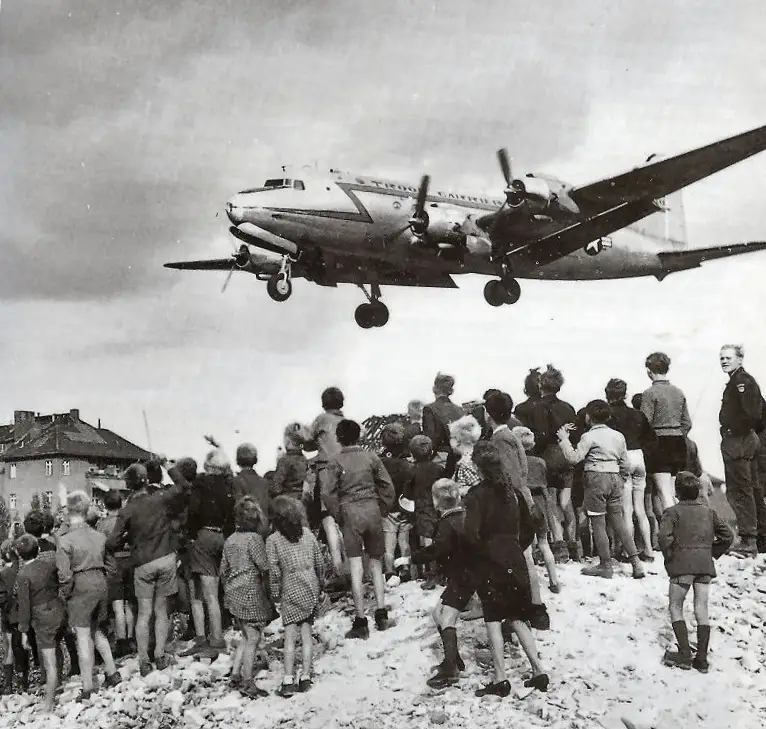
On 24 June 1948 the USSR cut off road and rail links to West Berlin — the Berlin Blockade. The 2.5 million inhabitants were left without fuel or food. The West responded with the Berlin Airlift: for 11 months British and American aircraft landed at Tempelhof almost every 90 seconds. They delivered some 2.3 million tonnes of supplies. In May 1949 Stalin backed down. The Western zones were declared the Federal Republic of Germany; the Soviet zone replied as the German Democratic Republic. Germany was split for 41 years.
NATO and the Soviet bomb
On 4 April 1949 twelve countries (the United States, Canada, Britain, France, Italy, the Benelux states, Norway, Denmark, Iceland, Portugal) signed the Washington Treaty — creating NATO. Article 5: an attack on one is an attack on all. It was the first peacetime defensive alliance in Western history.
On 29 August 1949 the USSR successfully tested its first atomic bomb at the Semipalatinsk Test Site. The American nuclear monopoly, which had lasted four years after Hiroshima, was over. The Soviet programme had been running since 1943; the key roles were played by the physicist Kurchatov, the administrator Beria, and spies — Klaus Fuchs and the Rosenberg couple. Julius and Ethel Rosenberg would be executed in the United States in 1953 — the only execution of American civilians for espionage in the entire Cold War.
The Korean War and "the loss of China"
On 1 October 1949 Mao Zedong proclaimed the People's Republic of China. Chiang Kai-shek fled to Taiwan. In the United States this was treated as a catastrophe — "Who lost China?" became a question that poisoned American politics for decades and fed McCarthyism.
On 25 June 1950 North Korea, under Kim Il-sung, attacked the South. The Korean War (1950–1953) was the first "hot" war of the Cold War: American forces under a UN flag against North Korean troops and Chinese "volunteers" (in fact regulars). The armistice signed at Panmunjom on 27 July 1953 was never replaced by a peace treaty — formally, Korea is still at war today. Around 3 million people died. The peninsula was split along the 38th parallel — and the split has held ever since.
1953: the death of Stalin and the Secret Speech
On 5 March 1953 Joseph Stalin died — after thirty years of personal dictatorship and millions of victims of political repression. His death set off a struggle for power in the Kremlin. Beria was arrested and shot in June 1953. By 1956 Nikita Khrushchev had emerged as party leader.
On 25 February 1956, in a closed session of the Twentieth Party Congress, Khrushchev delivered his "Secret Speech" — denouncing Stalin's "cult of personality". The text leaked to the West within a week. It was the first public blow against Stalinism from inside the USSR; for many communists in Europe it came as a shock. The "Thaw" began — a limited liberalisation of cultural life in the USSR and the return of millions from the Gulag.
The Warsaw Pact and Hungarian resistance
On 14 May 1955 the USSR and its satellites signed the Warsaw Pact in response to West Germany joining NATO. Formally a defensive alliance, in fact an instrument for keeping Eastern Europe in line.
On 23 October 1956 the Hungarian Revolution broke out in Budapest. Students, then workers, demanded freedom of speech, withdrawal from the Warsaw Pact, and the return of Imre Nagy as prime minister. For two weeks the country was free. On 4 November 1956 the USSR sent in tanks. About 2,500 Hungarians were killed and 200,000 emigrated. Imre Nagy was executed in 1958. The West confined itself to protests — the world was preoccupied with the Suez Crisis. It was the first precedent for the brutal suppression of dissent in the "socialist camp".
The Suez Crisis and the dawn of the Space Age
On 26 July 1956 Egyptian President Gamal Abdel Nasser nationalised the Suez Canal. Britain, France, and Israel secretly agreed to take it back by force. The military operation in October–November 1956 was tactically successful but became a diplomatic catastrophe: the United States (President Dwight Eisenhower) and the USSR jointly pressured the aggressors — the last moment when the superpowers acted in concert. Britain and France withdrew, losing what was left of their colonial influence. The age of the great empires was over.
On 4 October 1957 the USSR launched Sputnik 1 — the first artificial satellite of the Earth. The launch shocked the West: Soviet rockets, it turned out, could reach the United States. The Space Race had begun. In response the US created NASA in 1958; in 1961 President Kennedy would set the goal — a man on the Moon by the end of the decade.
Cuba: the 1959 revolution and the Bay of Pigs
On 1 January 1959 Fidel Castro and his guerrillas (including the Argentine Che Guevara) overthrew the pro-American dictator Batista. At first Castro did not look like a communist — but the American response (an embargo, retaliatory nationalisation of US business, attempts at a coup) pushed him into Moscow's arms.
On 17 April 1961 the CIA ran a covert operation — the landing of 1,500 Cuban exiles at the Bay of Pigs. The landing collapsed in three days. President John F. Kennedy backed out at the last minute from providing direct American air support. Castro took 1,200 prisoners and a year later traded them for $53 million worth of medicine. It was the United States' biggest diplomatic humiliation in a decade. Cuba became a Soviet ally in the Western Hemisphere for good.
The Berlin Wall and the Cuban Missile Crisis
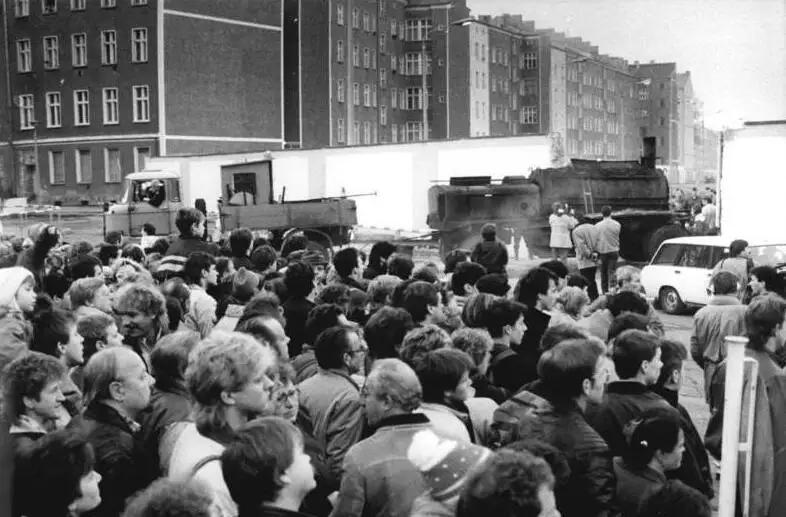
On 13 August 1961 East Germany began building the Berlin Wall — to stop the flight of three million East Germans westward through the still-open sector boundary in Berlin. The Wall stood for 28 years; about 140 people were killed trying to cross it. It became the chief visual symbol of the Cold War.
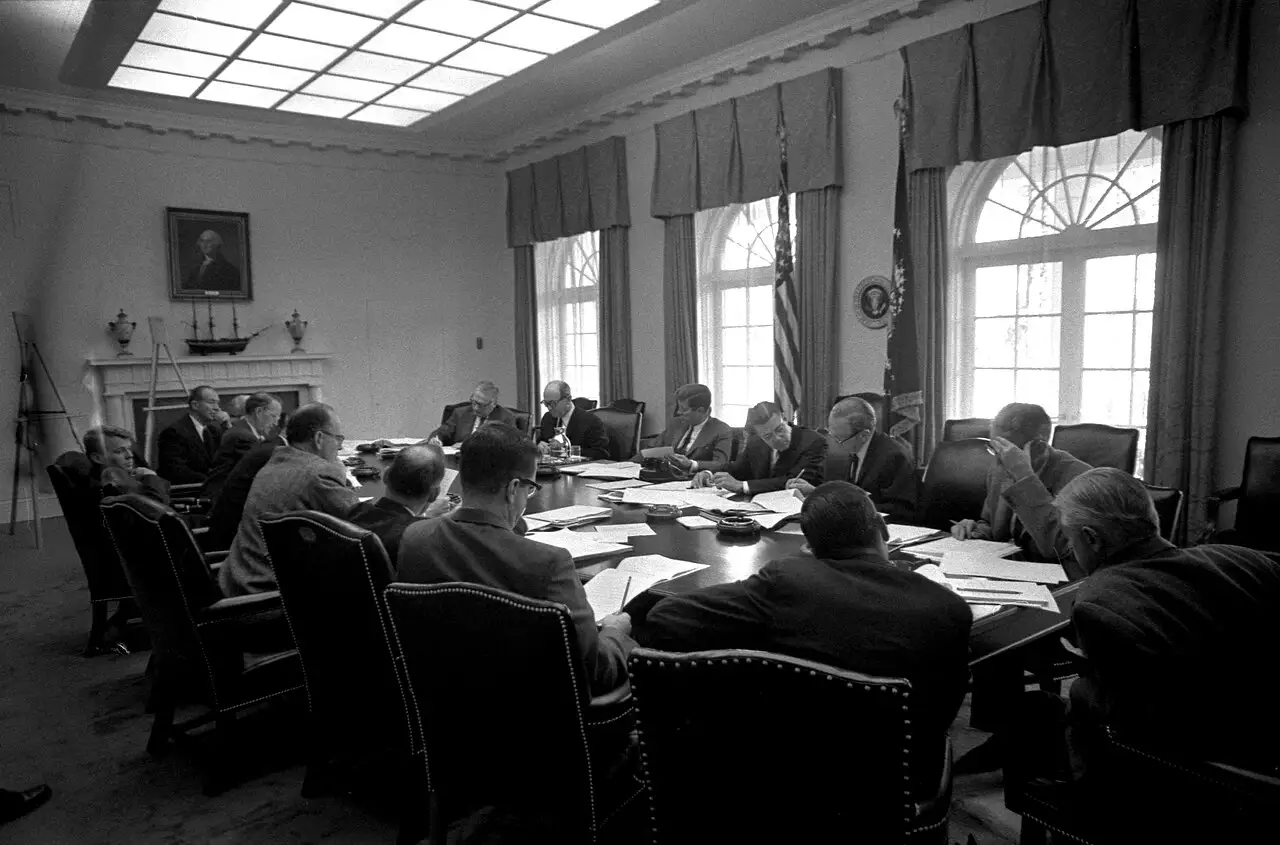
On 14 October 1962 an American U-2 spy plane photographed Soviet nuclear missiles in Cuba — placed in response to American "Jupiter" missiles in Turkey. The Cuban Missile Crisis lasted 13 days — the closest the world came to nuclear war. Kennedy declared a naval blockade of Cuba. On 28 October Khrushchev agreed to withdraw the missiles in exchange for an American pledge not to invade Cuba and a secret deal to remove the Jupiters from Turkey. The world exhaled. A year later Khrushchev and Kennedy signed the Partial Test Ban Treaty, ending nuclear tests in the atmosphere.
The Hot Line and Vietnam
On 20 June 1963 — after the Cuban Missile Crisis — Moscow and Washington set up a hot line: a teletype for direct contact between the leaders. The image of a "red telephone" is a Hollywood myth; it was a teletype, then a fax, and only from 2008 — secure email.
The Vietnam War (for the United States, 1965–1973) was the longest American war of the 20th century. President Lyndon B. Johnson committed ground forces in 1965; by 1969 there were 540,000 Americans in South Vietnam. The war became a symbol of failure: 58,000 American dead, 1–2 million Vietnamese. The 1968 Tet Offensive showed that "we cannot win" — Johnson refused to run for a second term. The United States left under the Paris Peace Accords in 1973. South Vietnam fell in 1975, and the country was reunified under a communist flag.
The Prague Spring
On 5 January 1968 Alexander Dubček became First Secretary of the Czechoslovak party. Reforms began: freedom of the press, market elements, pluralism. "Socialism with a human face" — the slogan of the era.
On the night of 20–21 August 1968, troops from five Warsaw Pact countries (USSR, Poland, East Germany, Hungary, Bulgaria) — about 250,000 soldiers and 2,000 tanks — occupied Czechoslovakia. Resistance was largely non-violent: Czechs repainted street signs to disorient the invaders. Dubček was taken to Moscow and forced to sign a capitulation. Brezhnev formulated the "doctrine of limited sovereignty" (the Brezhnev Doctrine): any socialist country that strayed "threatened the entire socialist camp" — and had to be put right by force. Western communist parties lost millions of members over it.
Détente: Brandt, Nixon, SALT I
West German Chancellor Willy Brandt (Social Democrat) pursued Ostpolitik in 1969–1974 — a policy of rapprochement with the East. In December 1970 he signed a treaty with Poland recognising its western frontier — and unexpectedly, to the shock of his own entourage, fell to his knees before the monument to the heroes of the Warsaw Ghetto. The "Kniefall von Warschau" became a symbol of German atonement. In 1971 Brandt received the Nobel Peace Prize.
US President Richard Nixon, with his adviser Henry Kissinger, introduced the policy of détente. The decisive event came on 26 May 1972 in Moscow, when Nixon and Leonid Brezhnev signed SALT I — the first treaty limiting strategic nuclear arsenals. In parallel Nixon went to China in February 1972 and met Mao — a diplomatic shock that exploited the Sino-Soviet split.
Helsinki and the cracks in détente
On 1 August 1975 in Helsinki, 35 states (including all socialist countries) signed the Helsinki Final Act. The West got recognition of post-war borders and acceptance of the socialist bloc as a partner. In return, a "third basket" was written into the document — human rights. The USSR treated this as a declarative formality; in fact it was a delayed-action bomb.
On the back of Helsinki, human rights groups began to spring up across the USSR and Eastern Europe: the Moscow Helsinki Group (1976), the Ukrainian Helsinki Group, Charter 77 in Czechoslovakia. Andrei Sakharov — the father of the Soviet hydrogen bomb, now a dissident — won the Nobel Peace Prize in 1975; in 1980 he was exiled to Gorky. Aleksandr Solzhenitsyn published The Gulag Archipelago (1973–1975) — a foundational testimony about Stalin's camps; he was expelled from the USSR in 1974.
Afghanistan: the Soviet Vietnam
On 27 December 1979 Soviet troops entered Afghanistan to support the socialist government against Islamic mujahideen guerrillas. The plan was for a few months — "to stabilise the situation". The reality was nine years and fifty days.
The United States (the Carter and then Reagan administrations), through the CIA and Pakistan, supplied the mujahideen with weapons, including Stinger missiles from 1986 — shoulder-launched anti-aircraft weapons that neutralised Soviet airpower. It was the West's largest proxy blow against the USSR. Soviet losses: around 15,000 killed, a million Afghan deaths, millions of refugees. The war broke the Soviet economy and the legitimacy of the party — Soviet television showed no fighting, but "zinc deliveries" of dead soldiers came back to every town. The withdrawal in February 1989 was the first major defeat of the Soviet Union.
Reagan and the "Evil Empire"
On 20 January 1981 Ronald Reagan became President of the United States — a former Hollywood actor, the voice of a conservative "rebirth". His strategy was "peace through strength": a sharp build-up of military spending (from 5% of GDP to 6.5%) and a new, hard-edged rhetoric. In March 1983 Reagan called the USSR the "Evil Empire" — a phrase that defined the tone of the decade.
Reagan's ally was British Prime Minister Margaret Thatcher (the "Iron Lady"). Together they embodied the neo-conservative revolution: market liberalisation, confrontation with the left at home, firmness abroad. Tellingly, Thatcher would step into the world stage with her line about the newly appointed Gorbachev: "this is a man we can do business with". Her trust opened the dialogue.
1983: the year of fear
On 1 September 1983 a Soviet Su-15 interceptor shot down Korean Air Lines Flight 007 over Sakhalin — the airliner had unintentionally strayed into Soviet airspace. 269 passengers and crew were killed. Official Moscow denied any involvement for several days. The world was shocked; the incident became a symbol of the "Evil Empire" in action.
On 23 March 1983 Reagan announced the Strategic Defense Initiative (SDI, "Star Wars") — a space-based system for intercepting Soviet missiles. Technologically the project turned out to be unfeasible on the planned timetable, but its psychological effect was huge: the USSR, whose economy was already gasping, could not afford a symmetric response.
On 26 September 1983, at a Soviet early-warning post, the duty officer Stanislav Petrov received a signal of five American missile launches. He chose not to pass the alert up the chain, guessing it was a computer error — and he was right. A little-known case that may have averted a nuclear war.
Solidarity and the Polish resistance
On 14 August 1980 a strike began at the Gdańsk shipyard. Electrician Lech Wałęsa climbed over the fence and led the protest. The workers demanded the right to an independent trade union. The government conceded — and in September 1980 the trade union Solidarity (Solidarność) was founded, the first independent labour organisation in a socialist country. By the end of the year Solidarity had about 10 million members — a third of the adult population of Poland.
On 13 December 1981 General Wojciech Jaruzelski imposed martial law and Solidarity was banned. Wałęsa was arrested. But the movement went underground — supported by Pope John Paul II (a Pole by origin) and the CIA. In 1989 Solidarity emerged from the shadows and won the elections. Poland would become the first Warsaw Pact country to peacefully break free of Soviet control.
Gorbachev: glasnost and perestroika
On 11 March 1985 Mikhail Gorbachev became General Secretary of the CPSU — at 54, the youngest leader in decades. His first watchwords: glasnost (openness) and perestroika (the restructuring of the economy and politics). This was not a change of rhetoric but an attempt to save a system that was suffocating.
On 26 April 1986 at 1:23 a.m. Reactor No. 4 of the Chernobyl Nuclear Power Plant exploded in the Ukrainian SSR. Gorbachev kept silent for 18 days (his first public address came only on 14 May). The disaster became a symbol of the failure of the Soviet system: the technology, the secrecy, the irresponsibility — all collapsed at once. Roughly 150,000 km² were contaminated. Gorbachev himself would later say: "Chernobyl may have been the main cause of the collapse of the Soviet Union" — it knocked out the last remnants of trust in the regime.
The INF Treaty and the miracle of 1989
On 8 December 1987 Reagan and Gorbachev signed in Washington the INF Treaty (Intermediate-Range Nuclear Forces) — the first treaty under which the superpowers did not merely cap but destroyed an entire category of nuclear weapons. By 1991 some 2,692 missiles had been removed.
1989 was the "Autumn of Nations". Hungary (May — opened its border with Austria), Poland (June — first semi-free elections, won by Solidarity), 9 November 1989 — the fall of the Berlin Wall (after a botched announcement by the East German party spokesman Günter Schabowski: "immediately, right now"), Czechoslovakia (the Velvet Revolution in November — Václav Havel became president), Romania (December — the overthrow and execution of Ceaușescu, the only case of bloodshed). In six months communist regimes fell across Eastern Europe. A year later — the reunification of Germany (3 October 1990).
The Malta Summit and the end
On 2–3 December 1989, in stormy weather aboard ships off Malta, Gorbachev and George H. W. Bush held a meeting that everyone called the "official end of the Cold War". No treaties were signed — only a political declaration. The Malta Summit is sometimes called "Yalta 2", except in reverse: in 1945 Europe was divided — in 1989 it was reunited.
The USSR was unravelling fast. In 1990–1991 Lithuania, Latvia, and Estonia declared independence. In August 1991 the failed coup attempt against Gorbachev was put down by Boris Yeltsin and Moscow protesters. On 1 December 1991 Ukraine voted for independence in a referendum (90.32%). On 8 December 1991 the Belavezha Accords (Yeltsin, Kravchuk, Shushkevich) declared the USSR dissolved. On 25 December 1991 Gorbachev formally resigned. The red flag was lowered over the Kremlin. The Cold War was over.
Fifteen new countries on the site of the USSR
Fifteen independent states emerged on the territory of the USSR: Russia, Ukraine, Belarus, Moldova, Georgia, Armenia, Azerbaijan, Kazakhstan, Uzbekistan, Kyrgyzstan, Turkmenistan, Tajikistan, Lithuania, Latvia, and Estonia. Most started in chaos — hyperinflation, broken economic ties, ethnic conflicts (Nagorno-Karabakh, Transnistria, Georgia–Abkhazia, Chechnya).
On 1 July 1991 the Warsaw Pact was dissolved. Comecon had gone before. One by one the former socialist countries joined NATO (Poland, the Czech Republic, Hungary in 1999) and the EU (2004 — the largest enlargement in its history). The collapse of the USSR left a nuclear arsenal in four republics (Russia, Ukraine, Belarus, Kazakhstan) — under the 1994 Budapest Memorandum, Ukraine, Belarus, and Kazakhstan gave up their nuclear weapons in exchange for guarantees of territorial integrity.
The Space Race
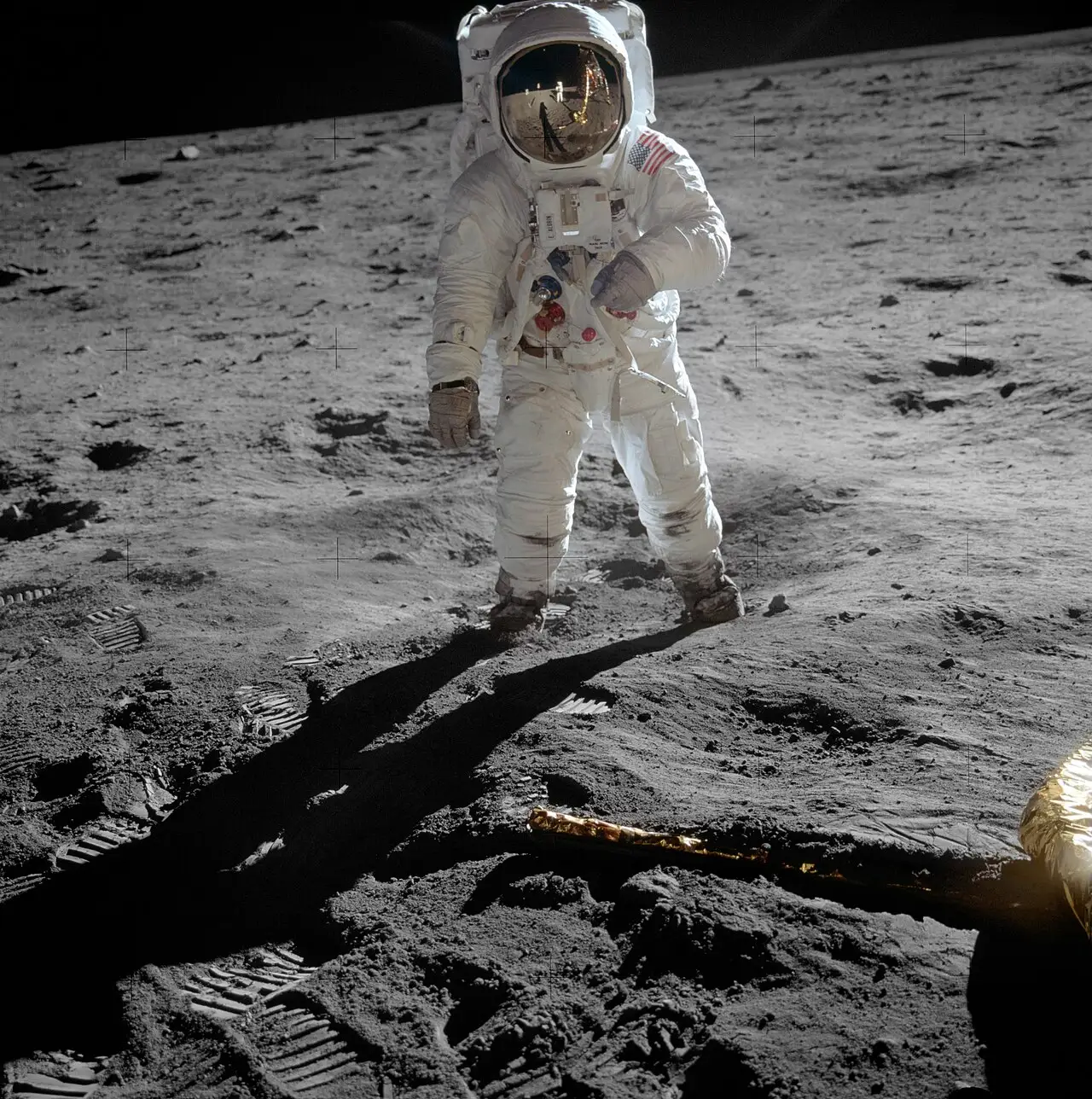
The Cold War was the greatest accelerator of the Space Age. 4 October 1957 — Sputnik 1. 12 April 1961 — Yuri Gagarin aboard Vostok 1 became the first human in space. In response, on 25 May 1961 Kennedy set the goal: a man on the Moon by the end of the decade. 20 July 1969 — Apollo 11. Neil Armstrong and Buzz Aldrin set foot on the Moon. "One small step for a man, one giant leap for mankind." The United States won that round.
The USSR bet on stations — Salyut, then Mir (1986–2001) — and on automatic probes (Venera, Luna, Lunokhod). The joint Apollo–Soyuz flight (July 1975) became a symbol of détente: Americans and Russians shaking hands in space. The technologies that grew out of the space race — from satellite communications and GPS to the internet (ARPANET in 1969, also a Pentagon product) — are all by-products of the Cold War.
The nuclear arms race
At the peak of the Cold War (1986) there were about 70,000 nuclear warheads in the world — overwhelmingly held by the two superpowers. Enough to destroy civilisation many times over. The doctrine of mutual deterrence — MAD (Mutually Assured Destruction): neither side can start a nuclear war, because the retaliatory strike will surely destroy the attacker.
Tests: the Tsar Bomba (USSR, 30 October 1961) — 50 megatons, the largest nuclear explosion in history, thousands of times more powerful than Hiroshima. Radioactive fallout (strontium-90 in milk) prompted the 1963 Partial Test Ban Treaty. SALT I (1972), SALT II (1979, never ratified because of Afghanistan), the INF Treaty (1987), and START I (1991) gradually cut the arsenals. Today there are about 12,000 warheads in the world — fewer, but still enough.
Espionage and intelligence
The Cold War produced names everyone knows: the CIA (from 1947) against the KGB (from 1954, the successor of the NKVD/MGB). High-profile cases: the Rosenberg couple (executed in the United States in 1953 for passing atomic secrets to the USSR); Kim Philby and the "Cambridge Five" — British upper-class men who worked for Moscow for decades (Philby defected in 1963); Oleg Penkovsky, a GRU colonel who passed the Americans information about Soviet missiles that helped during the Cuban Missile Crisis (executed in 1963).
In Berlin after 1961 — secret tunnels, prisoner swaps on the Glienicke Bridge. Espionage was everyday — from the high-tech (the U-2 spy plane over the USSR; Gary Powers shot down in 1960) to the mundane: bugs in embassies, "bugs" hidden in carved wooden panels, exchanges of microfilm. The Cold War spawned an entire genre — from Ian Fleming (Bond) to John le Carré ("The Spy Who Came in from the Cold", "Tinker, Tailor, Soldier, Spy").
Culture of the era: rock, dissidents, samizdat
The Cold War was not only nuclear — it was cultural. In the West it was a battle for souls: Voice of America, Radio Liberty, and the BBC broadcast into the USSR in Russian, Ukrainian, Lithuanian. Jamming stations tried to drown them out — listeners caught the signal at night. Orwell's 1984 was banned in the USSR; Pasternak's Doctor Zhivago was published in Italy in 1957 — Pasternak won the Nobel Prize in 1958 but had to refuse it under Khrushchev's pressure.
In the USSR samizdat emerged — typewritten copies of forbidden texts. The Beatles in the 1960s — banned; instead, officially approved "VIA" (vocal-instrumental ensembles) were promoted. Rock music became a form of protest: Mashina Vremeni, Aquarium, Kino in the 1980s. Western jeans and records were the currency of cross-cultural exchange. In 1989, with the fall of the Wall, cultural reunification began: David Hasselhoff sang "Looking for Freedom" on the breaches of the Wall on New Year's Eve 1989/1990.
Proxy wars: Africa, Latin America, the Middle East
The two superpowers did not fight each other directly — but they "played" actively in third countries. Africa: Angola (from 1975, Cuban troops against South Africa and UNITA), Mozambique, Ethiopia–Somalia, the Congo (Lumumba, killed in 1961 with CIA involvement). Latin America: Chile (September 1973, Pinochet's coup against the socialist Allende, with CIA involvement), Nicaragua (Sandinistas vs. the "Contras" in the 1980s), El Salvador, Guatemala (1954 — the CIA toppled the reformist Árbenz), and Cuba as its own case. The Middle East: Iran (1953 — Operation Ajax by the CIA and MI6 returned the Shah; 1979 — the Islamic Revolution as the end of American influence), the wars between Israel and its Arab neighbours (1956, 1967, 1973).
The casualties of the proxy conflicts ran into the millions. Dictatorship, repression, juntas — these too were by-products. Western critics called it "the long peace" — for the West. For Angola, Chile, and Nicaragua it was a perfectly hot war.
Why the USSR lost
The Soviet economy was built on cheap oil — and the oil crisis of the 1970s initially helped. But that golden age ended in the 1980s. Military spending devoured 15–20% of GDP (the US figure was 5–7%); the Soviet economy could not match every new American project (SDI, "Stealth", cheap personal computers) symmetrically. Gorbachev's perestroika tried to save the system — but the reform, once launched from below, dismantled the party's levers of control.
Ideologically, communism as a project lost its appeal. Helsinki 1975 made human rights a norm any dissident group could appeal to. Chernobyl 1986 publicly proved that the official truth could not be trusted. The fall of the Wall in 1989 was not Soviet tanks but a free flow of people across an open border. The USSR was not toppled from outside — it decomposed from within. The United States may not have won — but the USSR certainly lost.
What was left behind
The Cold War shaped the world of the 21st century. NATO still exists (32 members in 2024). The European Union grew out of post-war Western European cooperation. The internet, GPS, and microchips are all by-products of the Pentagon and its contracts. The Apollo programme provided a technological base for decades. Korea is still divided; the Taiwan–China question is still unresolved; Cuba is still under a US embargo.
The USSR is gone — but the "post-Soviet space" turned out to be less stable than people had hoped in 1991. The wars across the post-Soviet space (Chechnya, Georgia in 2008, Ukraine since 2014) are a continuation of an unfinished collapse. Russian rhetoric in the 2020s about the "lost great power", "encirclement by the West", and NATO is in many respects an echo of the arguments of the 1950s. The Cold War formally ended in 1991. Its shadows — not entirely.
Now you have the general picture. Try a question session — you will see how it all fits together.