Thirteen years in which a 20-year-old king of small mountainous Macedon destroyed the largest empire of the age and marched with his army as far as the Indus. Alexander III ascended the throne in 336 BC after the assassination of his father Philip II, and died in 323 BC at Babylon, not yet 33. In between came roughly 22,000 km of marches, from the Balkans to the Punjab; four great battles against the Persians (Granicus, Issus, Gaugamela, Hydaspes), none of them lost; the death of Darius III, King of Kings; and more than twenty cities founded under the name of Alexandria. Alexander fused Greek culture with the East and opened the age of Hellenism, which would last until Cleopatra and the Roman conquest of Egypt in 30 BC.
Who was fighting whom
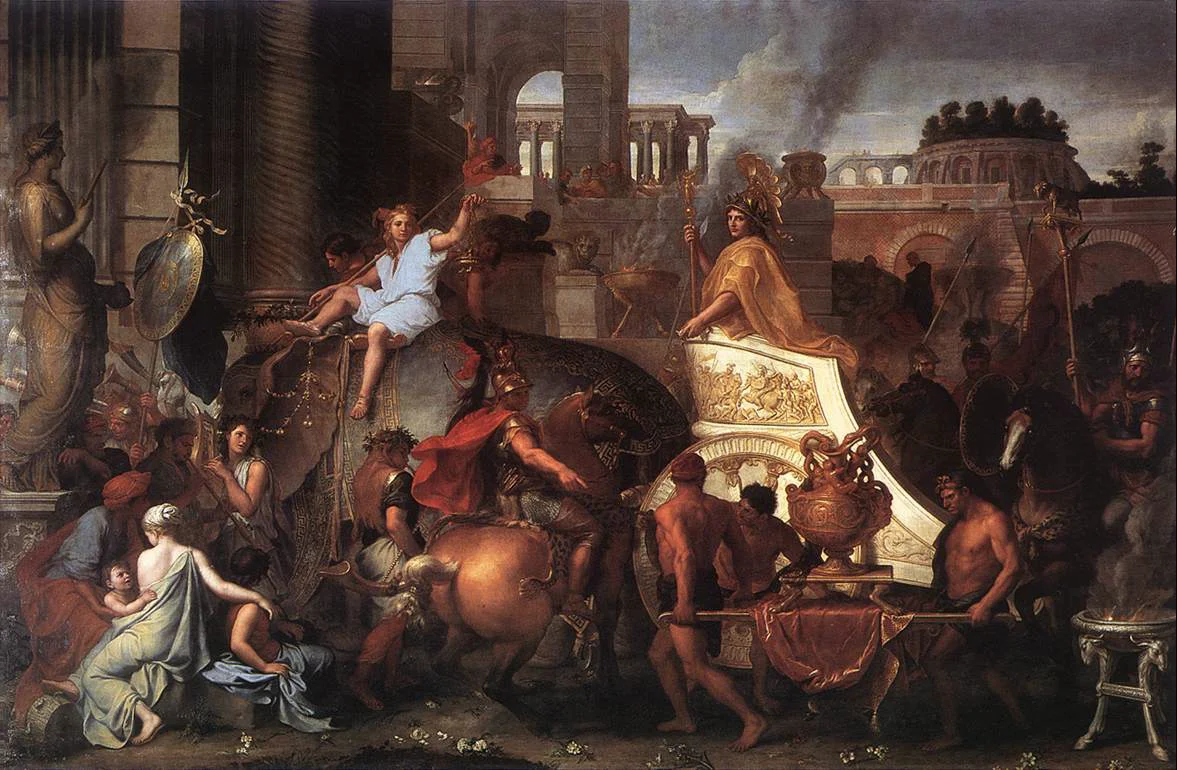
On one side — Macedon, a mountainous kingdom in the north of Greece that fifty years earlier had still been considered half-barbarian. Alexander's father, Philip II, had turned it into the most formidable military machine in the Hellenic world. The army's backbone was the Macedonian phalanx — infantry six ranks deep, armed with 16-foot sarissas — and the heavy cavalry of the Companions (hetairoi), who delivered the decisive blow. In 338 BC Philip crushed the combined armies of Athens and Thebes at Chaeronea and founded the League of Corinth: every Greek city except Sparta recognised Macedonian hegemony and declared a joint war on Persia in revenge for Xerxes' invasion in 480 BC.
On the other side — the Persian Empire of the Achaemenids, the largest state of the age: from the Balkans to the Indus, from the Caucasus to the Nile, with some 50 million subjects. King Darius III Codomannus came to the throne in 336 BC, the same year as Alexander. He had inexhaustible reserves of gold, the fleet of the Phoenician cities, Greek mercenary hoplites, and a mobilisation potential of hundreds of thousands of men from 20 satrapies. But central power was weakening, the provinces were in revolt, and the army itself was an unwieldy mosaic of peoples with no single doctrine. Alexander had about 40,000 infantry and 7,000 cavalry, plus around 5,000 Greek allies. The disparity in forces was striking — and Alexander won four battles in a row.
Phases of Alexander's campaign
Alexander's campaigns can be conveniently divided into five phases. The accession (336—335 BC): the assassination of Philip and the crowning of the 20-year-old Alexander, the suppression of revolts in the Balkans, the destruction of Thebes, the Congress of Corinth. The conquest of Asia Minor (334—333 BC): the crossing of the Hellespont, the victory at the Granicus, the Gordian knot at Gordium, the great victory over Darius at Issus. Egypt and the Levant (332—331 BC): the seven-month siege of Tyre, the founding of Alexandria, the oracle of Ammon at Siwa, where the priests called Alexander the son of a god. The destruction of the Persian Empire (331—328 BC): the rout of Darius at Gaugamela, the entry into Babylon, Susa and Persepolis, the burning of the palace of Xerxes, the death of Darius, the hard war in Bactria and Sogdiana, the marriage to Roxana. The Indian campaign and death (327—323 BC): the crossing of the Hindu Kush, the victory over Raja Porus at the Hydaspes, the mutiny of the army on the Hyphasis River, the terrible march through the Gedrosian desert, the death of his beloved Hephaestion, and finally Alexander's own death at Babylon. The page closes with a section on his legacy and a short epilogue on why it all still matters.
Phase 1. The accession (336—335 BC)
Two years in which a 20-year-old boy had to prove to Greece and to the world that he was not just an accidental heir to his father's throne but a king and a commander in his own right. Within months of Philip's assassination Alexander crushed the Thracian and Illyrian tribes to the north, returned in a lightning march to the south, and destroyed one of the greatest cities of Greece — Thebes. The Greek city-states that had been raising their voices against Macedon went silent for good. By 335 BC Alexander was ready for what his father had already conceived: a great campaign against the Persian Empire.
The death of Philip and the coronation
In the summer of 336 BC, at his daughter Cleopatra's wedding to the Molossian king at Aegae (the old capital of Macedon), Philip II walked at the head of the procession into the theatre with only a minimal guard — he wanted to appear fearless before his Greek guests. One of his bodyguards, a young aristocrat named Pausanias, threw himself on the king and drove a dagger into his chest. Philip died on the spot. Pausanias fled and was struck down as he ran. Whether the Persian court, the court party of Alexander and his mother Olympias, or some private vendetta lay behind the assassination, historians still argue. Philip was 46 and had been planning to lead the Macedonian army against Persia the following year.
Alexander was 20. His tutor had been Aristotle — the most influential philosopher of the age, who had taught the boy for three years and instilled in him a love of Homer, especially the Iliad, which Alexander would later sleep with under his pillow. The Companions and the phalanx proclaimed him king with one voice. Within months Alexander had all possible rivals to the throne killed — cousins, potential pretenders — and travelled to Corinth, where the Greek congress that his father had convened recognised him as hegemon of all the Greeks and supreme commander in the coming war on Persia. The Greek poleis held quiet — until they heard that the king was now fighting Thracians a thousand kilometres to the north.
The destruction of Thebes
In the spring of 335 BC Alexander led his army north to put down a revolt of Thracian and Illyrian tribes on the Danube. The campaign took several months and ended with a brilliant crossing of the Danube by the Macedonian phalanx into the enemy's rear on inflated leather sacks. While the king was fighting in the mountains, a false rumour reached Greece that Alexander had been killed in battle. The old city of Thebes — the same Thebes that under Epaminondas had crushed Sparta at Leuctra and dictated terms to all of Greece two generations earlier — rose in revolt, massacred the Macedonian garrison in the Cadmea citadel, and called on the other Greeks to join.
Alexander came back from the Danube in 13 days — about 500 km through mountains. Thebes did not believe it was him; they assumed it was some weak commander bearing his name. The walls were stormed straight off the march. The Macedonians and their Boeotian allies poured inside. The city was wiped off the face of the earth: about 6,000 Thebans were killed, 30,000 sold into slavery. Every building except the temples and the house of the poet Pindar (a Theban by birth) was levelled. It was an exemplary punishment — Athens, Sparta and Corinth at once sent embassies with apologies. By the end of the summer of 335 BC the whole of Greece was quieter than the sea. The road to Persia lay open.
The Congress of Corinth and the war plan
In the winter of 335/334 BC Alexander once again summoned the delegates of the Greek poleis to Corinth and confirmed the joint war on Persia. The official justification was revenge for Xerxes' campaign of 480 BC, when the Persians had burnt Athens and destroyed Greek sanctuaries. The real goal was to redistribute the vast wealth of the Persian Empire and to gain the prestige of the conqueror. According to Plutarch, it was at this same Corinth that Alexander met the Cynic philosopher Diogenes, who was lying in the sun. Alexander asked whether there was anything he could do for him. Diogenes replied: "Stand a little out of my sunlight." Alexander is said to have told his companions afterwards: "If I were not Alexander, I would wish to be Diogenes."
As regent of Macedon and Greece Alexander left the seasoned Antipater, with an army of 12,000 infantry and 1,500 cavalry — enough to keep the Greek cities in check and cover his rear. He himself assembled some 32,000 infantry and 5,100 cavalry (other counts give up to 47,000 in total) and in the spring of 334 BC marched east to the Hellespont. In his treasury he had only 70 talents in cash and provisions for 30 days. His first empire was being born literally with empty pockets. Alexander staked everything on a single throw — and won.
Phase 2. The conquest of Asia Minor (334—333 BC)
Two years in which Alexander travelled 2,500 km along the coasts of present-day Turkey and Syria, won two great battles against Persian armies, and forced Darius III to flee the field, abandoning his own family. In 334 BC at the Granicus the Persian defence of Asia Minor collapsed; in 333 BC at Issus the Persian Empire's confidence that the Macedonians could still be dealt with collapsed too. By the winter of 333/332 BC the whole western part of the empire — about a third of all Achaemenid lands — belonged to Alexander.
The crossing of the Hellespont and the Granicus
In the spring of 334 BC Alexander's army crossed the Hellespont (today's Dardanelles) on 160 triremes. According to tradition, before stepping onto the Asian shore Alexander hurled a spear from his ship into the ground — a symbol that Asia was now his, won by the sword. His first stop was Troy — he sacrificed at the altar of Athena and exchanged his shield for an ancient weapon said to come from the Trojan War. He was deliberately casting himself in the role of Achilles, the hero of the Iliad; his closest friend Hephaestion took the part of Patroclus in the ritual.
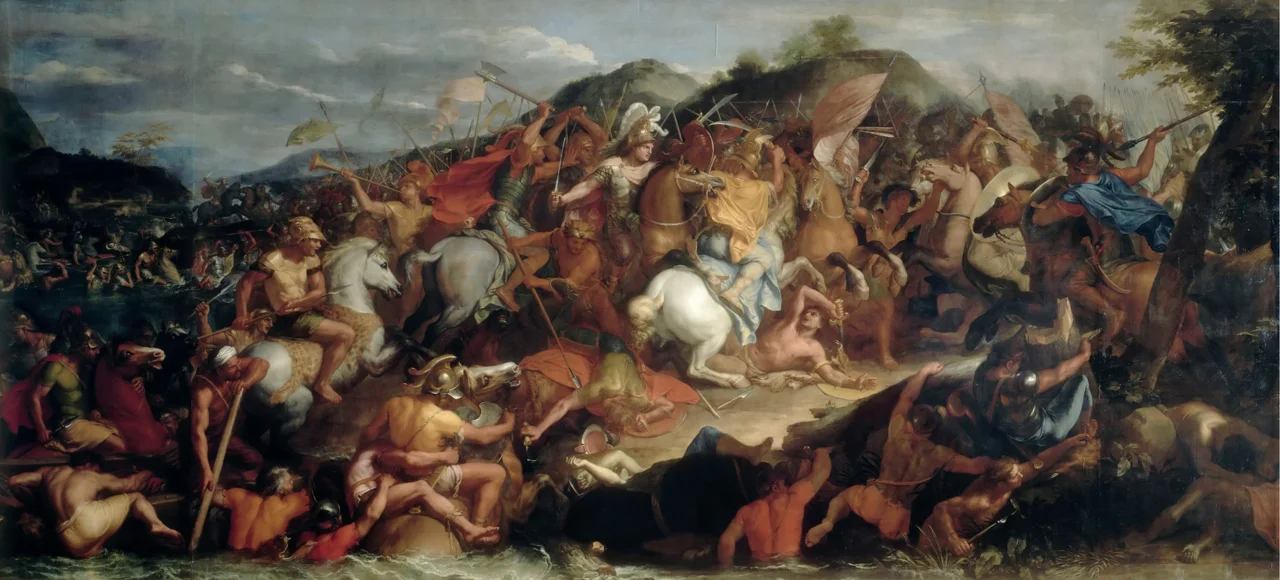
A few days later, in May 334 BC, the Macedonian army met a Persian force at the river Granicus in the north-west of Asia Minor. The Persians, with about 20,000 cavalry and as many Greek mercenary hoplites, drew up on the high east bank. Against the advice of old Parmenion to wait for morning, Alexander ordered an attack straight from the march. The Macedonian cavalry crossed the river under fire and climbed the steep bank. Alexander led the charge himself at the head of the Companions and almost died: the Persian satrap Spithridates had already raised his axe above his head, but Cleitus the Black at the last moment cut off the satrap's arm. By the end of the day the Persian army was broken; the Greek mercenary hoplites were cut down as traitors to their own people. Macedonian losses were about 100 men. The Granicus opened up the whole of Asia Minor: one after another the Greek Ionian cities — Ephesus, Miletus, Halicarnassus — went over to Alexander's side.
The Gordian Knot
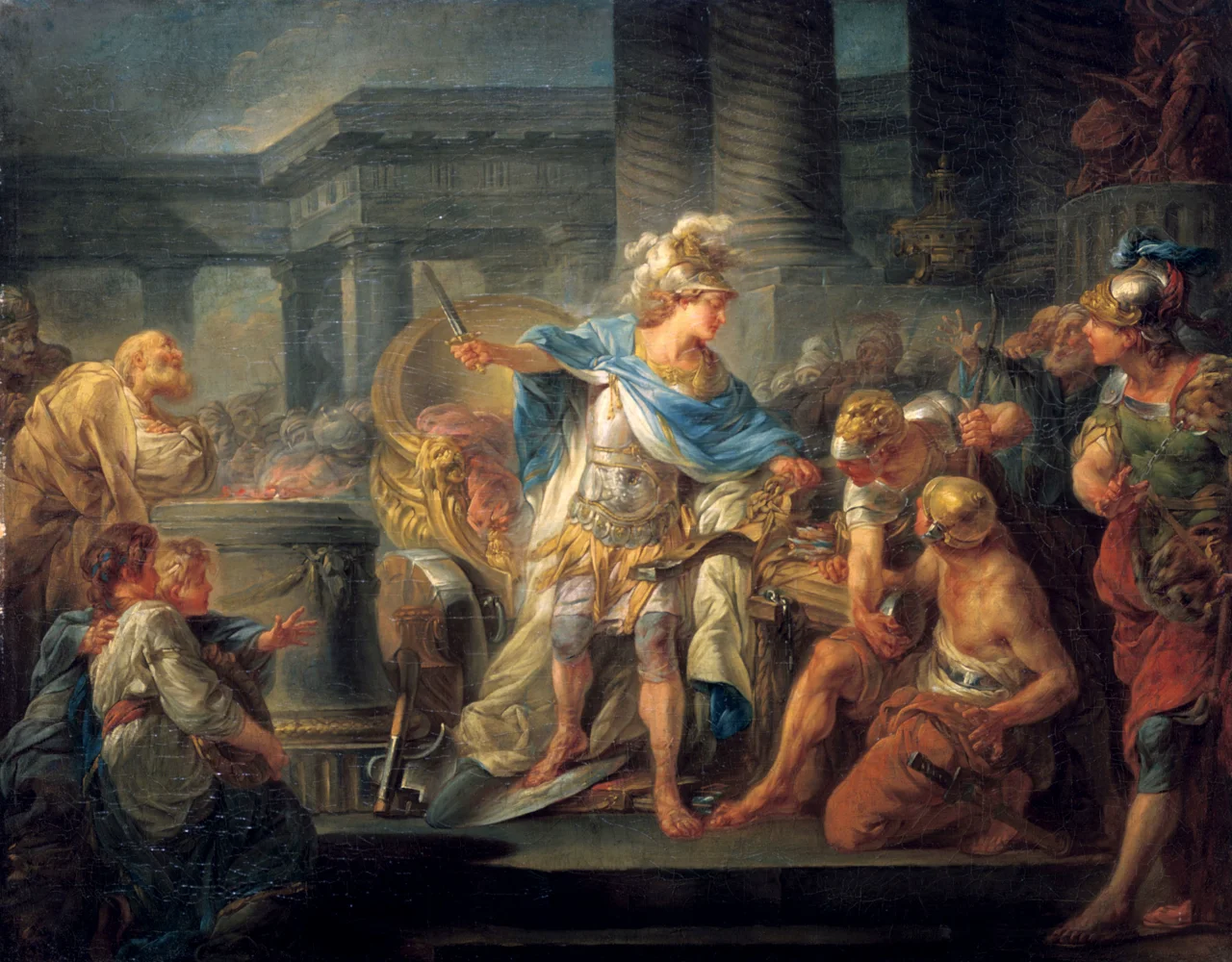
In the winter of 334/333 BC Alexander occupied the ancient Phrygian city of Gordium in central Asia Minor — the old capital of King Midas. On the acropolis stood a sacred chariot tied to its yoke by an extraordinarily complicated knot made from the bark of a wooden root. According to local oracle, whoever undid this Gordian Knot would become lord of all Asia. Hundreds of priests, scholars and travellers had tried over the centuries — none could even find the ends.
Alexander studied the knot and did what no one before him had done. In the version of Aristobulus, he simply pulled the pin out of the yoke and the yoke fell apart by itself; in the more popular version he cut the knot with his sword. After a short silence the priests declared the prophecy fulfilled. The scene entered European culture as the archetype of the "Gordian solution": when an intellectual answer is impossible, the problem has to be destroyed by force. That same spring of 333 BC a violent thunderstorm passed over Gordium; the priests read it as the gods' approval. Alexander marched on east, towards a meeting with Darius himself.
The Battle of Issus
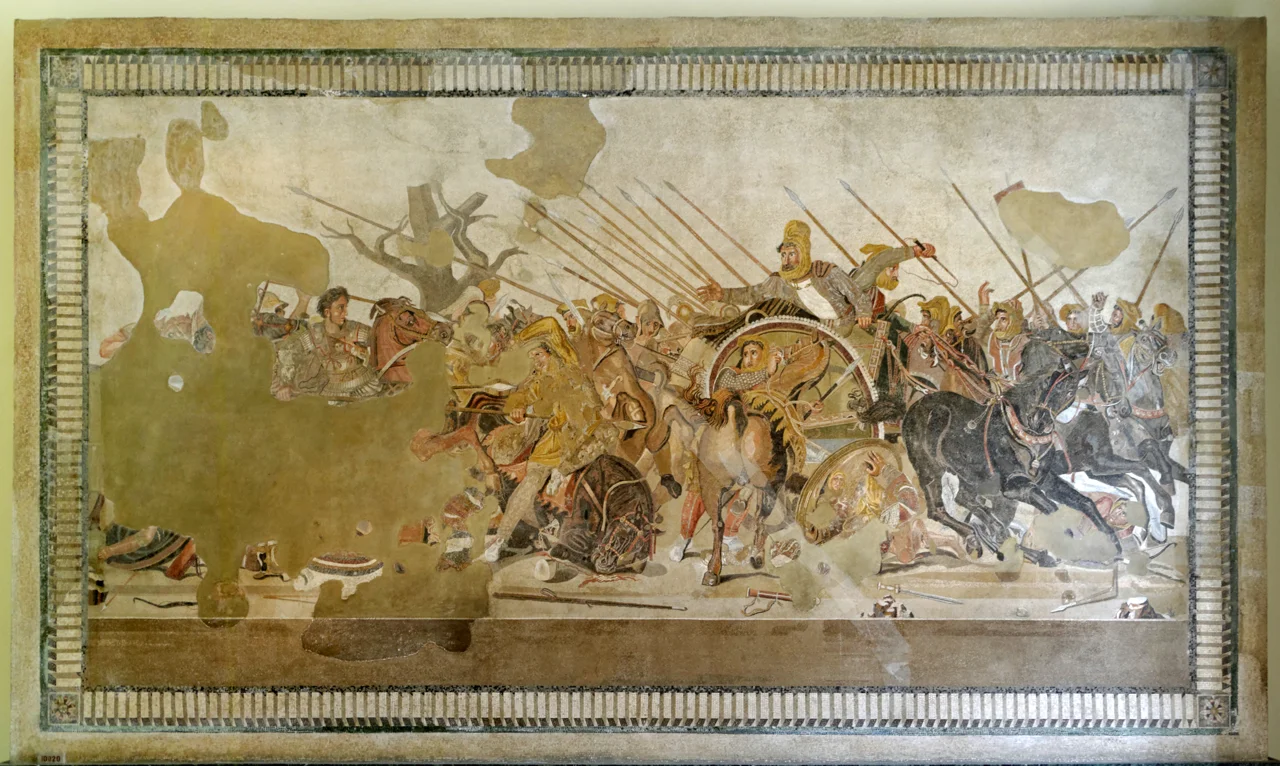
In the autumn of 333 BC Darius III, finally aware of the scale of the threat, personally took command of his army — about 100,000 infantry and 11,000 cavalry by sober modern estimates (ancient figures reached half a million) — and moved west from the inner provinces to cut Alexander off. The two armies missed each other: Darius emerged in Alexander's rear, on the coast at Issus (in present-day south-eastern Turkey, near the modern town of İskenderun — a city named after Alexander). Darius captured the Macedonian camp and slaughtered the wounded who were lying there. On hearing this, Alexander wheeled his army 180 degrees.
On 5 November 333 BC, on the narrow plain between the mountains and the sea, 30,000 Macedonians faced a Persian army three times larger. The terrain did not allow Darius to use his numerical advantage. Alexander, at the head of the Companions, personally cut a path through the Persian left flank straight to Darius's chariot. Seeing a Macedonian charging at him sword in hand, the Persian king lost his nerve and fled. The whole army ran after him. The Macedonians captured the royal tent, the royal harem — Darius's mother Sisygambis, his wife Stateira and three of his children. Alexander treated the captive queens with marked respect — something that struck even the Persians. Darius fled far east, to Babylon, and sent Alexander one peace proposal after another: first 10,000 talents and half the empire, then his whole empire as far as the Euphrates. Alexander refused. He was going to Egypt.
Phase 3. Egypt and the Levant (332—331 BC)
Two years in which Alexander took from the Persian Empire its richest province and founded a city that six hundred years later would be the largest in the Mediterranean. Instead of chasing Darius into the heart of Asia, Alexander turned south — down the Levantine coast, through a seven-month siege of impregnable Tyre, through the short and bloody storm of Gaza, into Egypt, where he was met as the liberator from a hated Persian rule. At the oasis of Siwa the priests of the god Ammon called him the son of a god — and that left a mark on Alexander's self-image for the rest of his life.
The Siege of Tyre
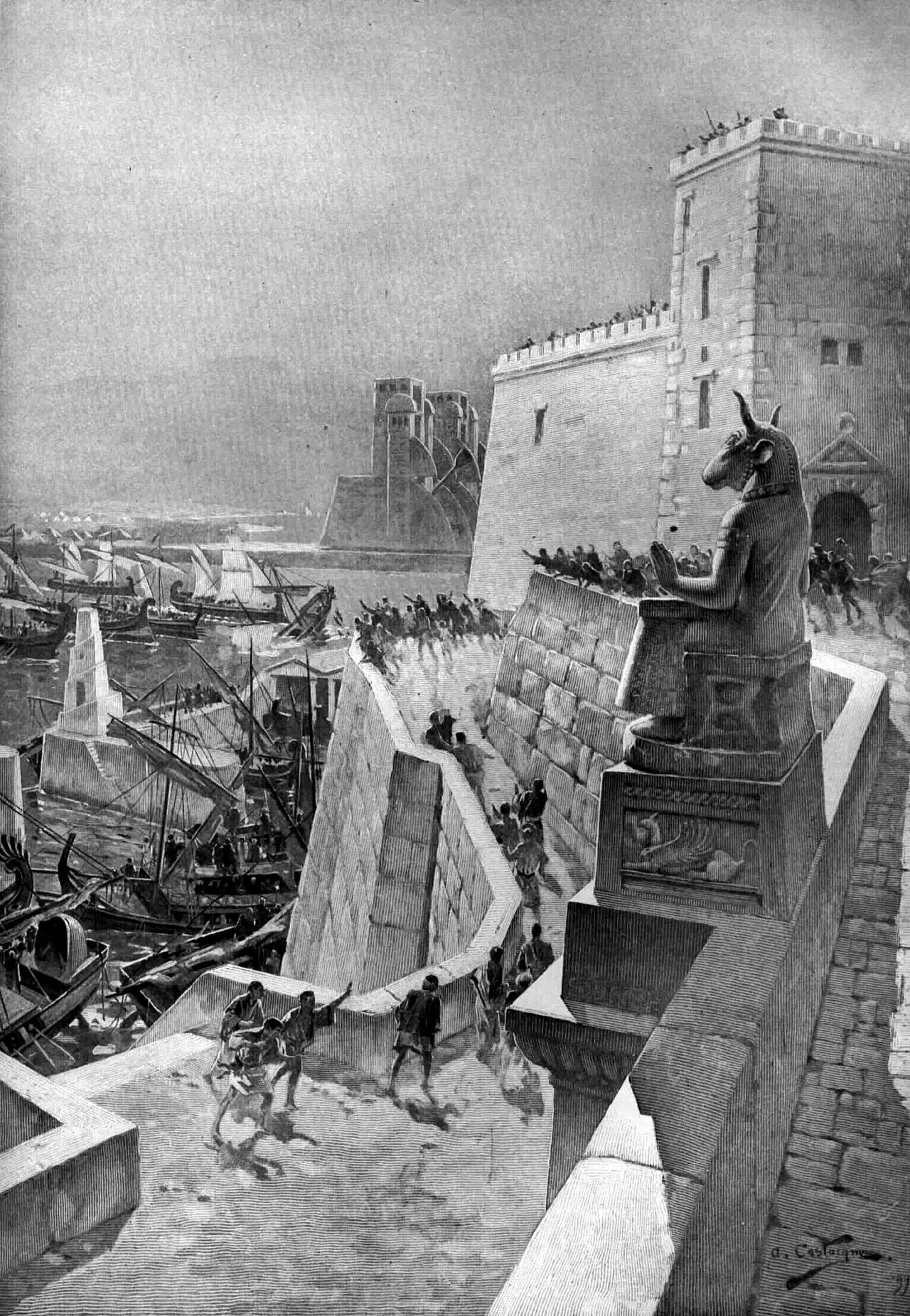
In the winter of 333/332 BC Alexander went south down the Syrian coast. Most of the Phoenician cities — Sidon, Byblos, Arvad — surrendered without a fight. But Tyre, the most important Phoenician port, the capital of seaborne trade and the mother city of Carthage, refused. It stood on an island 800 metres offshore, ringed by walls 50 metres high, with the finest fleet in the world and food stocks for years. The Tyrians reckoned Alexander would give up.
Alexander began to build a causeway across the sea. The Tyrians shot at it from catapults, attacked the workmen from ships, even sent blazing fireships against it. Alexander summoned the fleets of Sidon, Cyprus and Rhodes — about 200 ships — and blockaded Tyre from the sea. The siege lasted seven months, from January to July 332 BC. It was probably the most demanding engineering operation of the ancient world. In July 332 BC, after a battering ram broke the wall, the Macedonians poured inside. About 8,000 Tyrians were killed, 30,000 sold into slavery. The city was burnt. The causeway Alexander built has never been washed away — that is why Tyre is today a peninsula and not an island. Two months later Gaza fell after another hard siege, and the road to Egypt was open.
The founding of Alexandria
In November 332 BC Alexander entered Egypt without a fight. The Persian satrap Mazaces handed over the keys of Memphis and a treasury of 800 talents. The Egyptians, who had lived under Persian rule for some two centuries and hated it, welcomed the Macedonians as liberators. The priests of Memphis crowned Alexander pharaoh — that is, the living incarnation of Horus and son of the sun god Ra. This was not only a political gesture but a religious sensation: for the first time in two hundred years Egypt had a real pharaoh of its own.
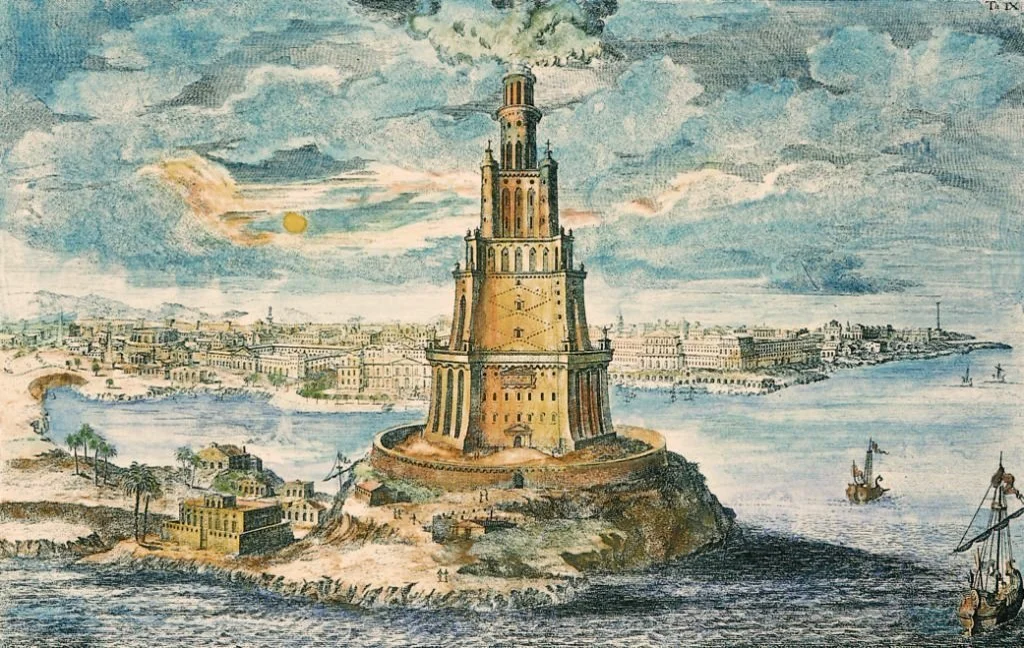
In the winter of 331 BC, riding around the Nile delta, Alexander chose a site on the Mediterranean coast — a small fishing village called Rhakotis, opposite the island of Pharos. The place had everything: a sheltered harbour, fresh water from a subterranean spring, the Nile delta for supply, the Mediterranean for trade. Alexander himself marked out the plan of the city — the main avenue, the market, the temples, the palace — and according to legend, having no chalk, he sprinkled the lines on the sand with grain. Seagulls flew down and ate the grain — the priests were at first frightened by the omen, then decided it meant that this city would feed the whole world. Alexandria of Egypt, fifty years after Alexander's death, would become the capital of the Ptolemies and the greatest city of Hellenism; three hundred years later, the largest city in the Mediterranean, with nearly a million inhabitants; the home of the Library of Alexandria, the Pharos Lighthouse, Euclid, Archimedes (who studied there), and Cleopatra. Alexander founded more than twenty cities bearing the name Alexandria across his march from Egypt to Afghanistan, but it is this one that has stayed in history under the simple name "Alexandria."
The Oracle at Siwa
In the winter of 331 BC, instead of going straight after Darius, Alexander made an unexpected 600-km journey across the Libyan desert to the oasis of Siwa, where stood the ancient temple of the god Ammon (whom the Greeks identified with Zeus). The journey took several weeks. According to legend the expedition lost its way in the desert and was saved by two ravens that flew ahead and led the caravan to the oasis. Siwa was a sanctuary of international fame — wagons of pilgrims came there for prophecies from as far as Syria and Greece.
Alexander entered the temple alone, without an escort. What exactly the high priest said to him, no one knows — Alexander refused to share it even with his closest friends. Outside it was officially announced that the oracle had acknowledged Alexander as the "son of Ammon" — that is, the living son of a god. This was not quite a Greek concept ("son of Zeus" was a stock epithet for hero-kings in the East), but it had a profound effect on Alexander himself. From this point on he began at solemn ceremonies to wear the horns of Ammon on his helmet — they can be seen on later coins. His close friends began to mutter privately that the king "was forgetting he was a man." The claim to divinity that would later cause a clash with the Macedonian nobility began here at Siwa.
Phase 4. The destruction of the Persian Empire (331—328 BC)
Four years in which Alexander stopped being merely a Greek commander and became King of Asia. In 331 BC at Gaugamela he finally destroyed Darius's field army. Within months Babylon, Susa and Persepolis fell — the three great capitals of the Achaemenids. In 330 BC Darius III was killed by his own satrap, and Alexander declared himself the lawful successor to the Persian kings. The last three years of the phase he spent in a draining guerrilla war in Bactria and Sogdiana (today's Afghanistan and Uzbekistan), where he set the seal on his rule by marrying a local noblewoman — Roxana.
The Battle of Gaugamela
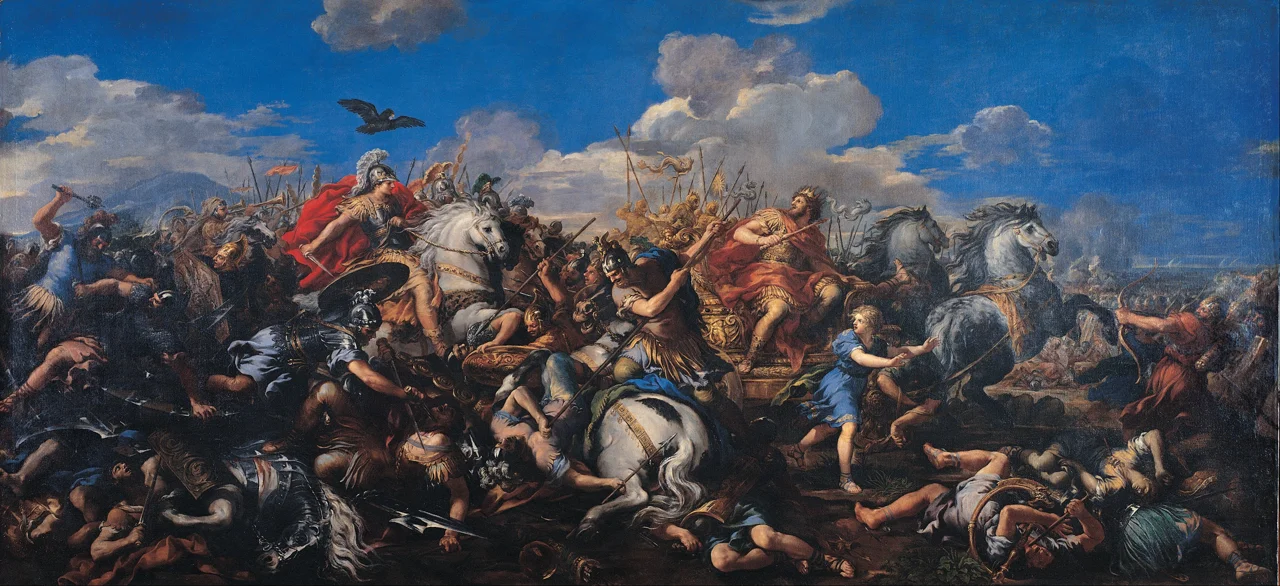
On 1 October 331 BC, on the plain near the village of Gaugamela (in present-day northern Iraq, not far from Mosul), Alexander met Darius in the decisive battle. This time Darius had chosen the field himself — a broad plain where he could deploy his whole army. In sober modern estimates the Persian army had about 100,000 infantry and 35,000 cavalry, including Indian elephants, Scythian horsemen and the famous scythed chariots with blades on the wheels. Alexander had 47,000 men. Darius had even had the field levelled for his chariots.
Alexander used a brilliant manoeuvre. He led his whole line obliquely to the right, forcing the Persian left to stretch after him until a gap opened in the Persian centre. Into that gap he then threw his main blow — a wedge of Companions led by the king in person. Alexander broke straight through to Darius's chariot. As at Issus, the Persian king fled first. Darius's Greek mercenary hoplites fought to the end, but the cause was lost. By evening about 40,000 Persians had been killed or captured; the Macedonians lost about 1,000. Gaugamela decided the fate of the Persian Empire. Within weeks Alexander walked into Babylon — the richest city in the world, with its hanging gardens and the Tower of Babel; Susa surrendered with the whole of Darius's treasury — about 50,000 talents of silver, the largest single prize in the history of the ancient world.
The Burning of Persepolis
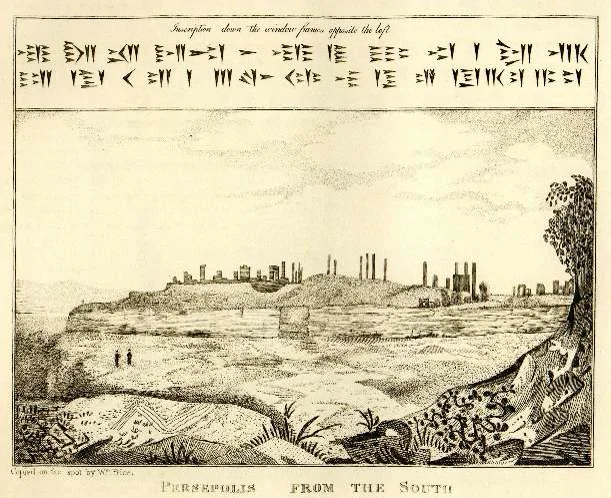
In the winter of 330 BC Alexander crossed the Zagros mountains and entered Persepolis — the ceremonial capital of the Persian Empire, the city built by Darius the Great and Xerxes, with its colossal palaces, the reliefs of "The Audience of the King of Kings," and the colonnade of a hundred columns. In its treasury he found another about 120,000 talents — at the time beyond all imagination of wealth. To transport the treasure, it is said, he had to gather 10,000 pairs of mules and 5,000 camels.
Alexander stayed in Persepolis for four months. In May 330 BC, at a feast at which the Athenian hetaera Thaïs was present, it was decided in a drunken state to burn the palace of Xerxes — in revenge for the Persian invasion of Greece in 480 BC and the burning of the Athenian Acropolis. In Plutarch's version, the idea came from Thaïs herself, and Alexander threw the first torch. The huge palace burnt, its cedar columns collapsed. Modern excavations confirm the fire and the layers of ash. Alexander later, it is said, regretted it — burning down the shrine of the empire he was inheriting did not fit his new role as "King of Kings." It was the last great Hellenic revenge for Xerxes. A week later Alexander was already racing east — Darius III had fled into Bactria.
The death of Darius III
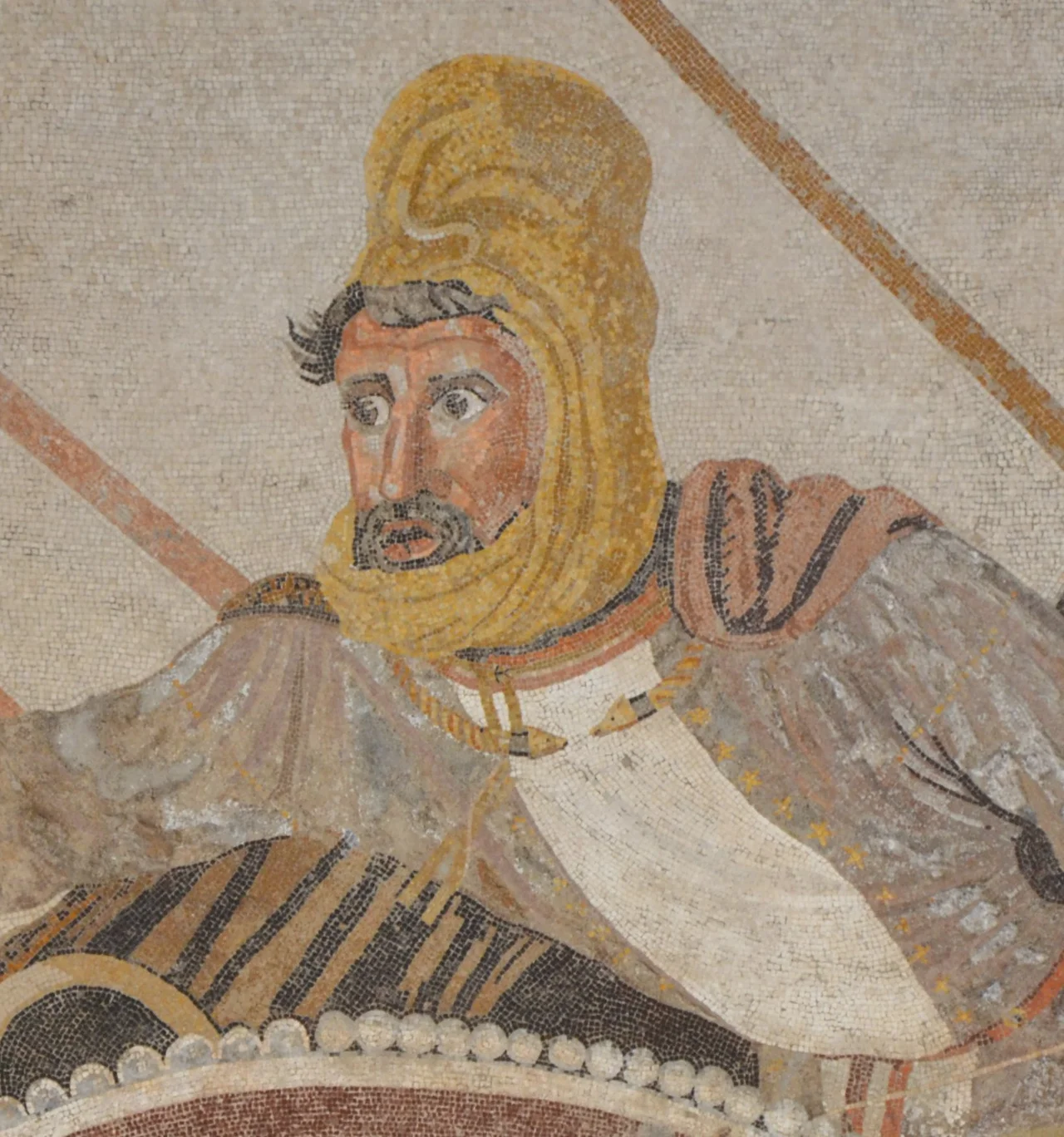
In the summer of 330 BC Alexander chased Darius across the highlands of present-day Iran with a small fast-moving cavalry detachment — some 800 km in a fortnight. Darius was moving with a convoy of his loyalists and also as a prisoner: the Bactrian satrap Bessus, Darius's cousin, together with several other satraps had already decided that the defeat was the king's own fault, and was preparing to depose him. In July 330 BC near the town of Hecatompylos (in present-day northern Iran), Bessus and his fellow conspirators tied Darius up, threw him onto a wagon and dragged him on.
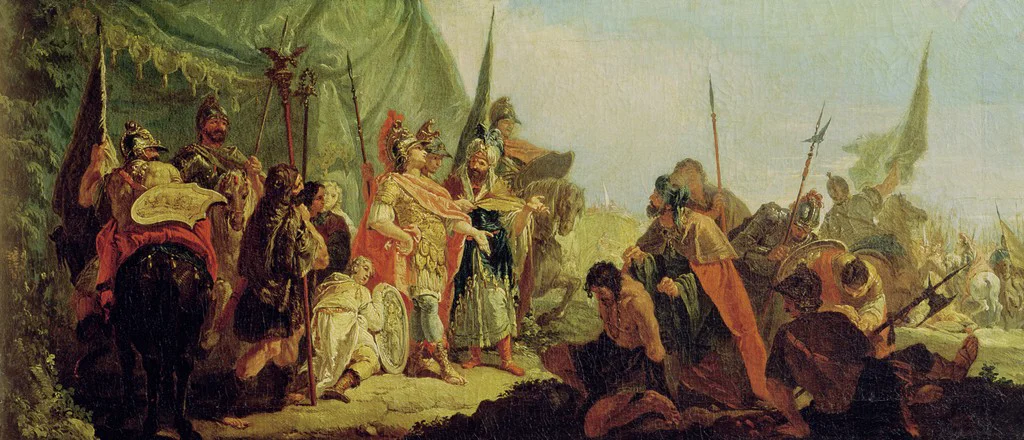
Alexander caught up with the wagon at dawn with a small advance party. Seeing the Macedonian horsemen, the satraps thrust spears at Darius through the wagon's awning and fled. A Macedonian named Polystratus, in the pursuit, stopped over the wounded Darius in the wagon. Darius, it is said, asked him for water and asked him to convey to Alexander his thanks for the good treatment of his family and a request to avenge him. By the time Alexander arrived, Darius was dead. Alexander took off his cloak and covered the body; later he gave Darius a royal funeral at Persepolis. From this moment Alexander declared himself the lawful successor of the Achaemenids and began to wear Persian royal dress — a wide purple cloak and a diadem. Bessus, who had proclaimed himself King "Artaxerxes V," was caught a year later, mutilated and sent for execution by a Persian court.
Bactria, Sogdiana and Roxana
Three years — 329, 328 and part of 327 BC — Alexander spent in a draining war in Bactria and Sogdiana, in present-day Afghanistan, Tajikistan and Uzbekistan. It was a wholly different war from the one in Persia: mountain tribes, steppe Scythians to the north, endless fortresses on rocks. The Bactrian aristocrat Spitamenes raised a revolt that went on for two years and cost the Macedonians thousands of men. Alexander planted garrison cities — Alexandria of the Caucasus, Alexandria Eschate ("the Farthest") at modern Khujand (Tajikistan) — and for the first time systematically recruited local Iranian youths into his army.
In 327 BC in one of the last fortresses, on the Sogdian Rock, his troops captured the family of a local aristocrat, Oxyartes — among them his daughter Roxana. According to legend Alexander saw her and at once decided to marry her. The marriage was not only love but a political move: by marrying a local princess, Alexander turned conquest into a legitimate dynastic union. His Macedonian friends and generals — especially Philip's old comrades — were cool about it: they could see the king "Persianising" himself ever faster — wearing Persian clothes, demanding the proskynesis (the prostration the Persians performed before their king), surrounding himself with Persian courtiers. In 328 BC at a banquet in Samarkand, Alexander in a drunken rage ran his old companion Cleitus the Black through with a spear — the very man who had saved his life at the Granicus. For a month afterwards he nearly died of grief and remorse. The king and his companions understood each other less and less.
Phase 5. The Indian campaign and death (327—323 BC)
Five years in which Alexander, in search of "the end of the earth," led his army across the Hindu Kush into India, won one more great battle — against Raja Porus at the Hydaspes — and reached the banks of the river Hyphasis (today's Beas in north-west India). Here his soldiers, worn out by nine years of campaigning, refused to go any farther. Alexander turned back in bitterness. The way home across the Gedrosian desert cost him about a quarter of his army. In June 323 BC, at Babylon, while preparing a new campaign — probably towards Arabia — Alexander fell ill and died at the age of 32 years and 8 months. His empire did not survive him by even three years.
The Hydaspes and Porus
In the spring of 326 BC, having crossed the Hindu Kush and the Khyber Pass, Alexander descended into the Indus valley. On the eastern bank of the river Hydaspes (today's Jhelum, Pakistan), the Indian raja Porus was waiting for him: 30,000 infantry, 4,000 cavalry, 300 chariots and — above all — 200 war elephants, a formidable weapon Macedonians had never faced. It was the monsoon season, and the river was in spate.
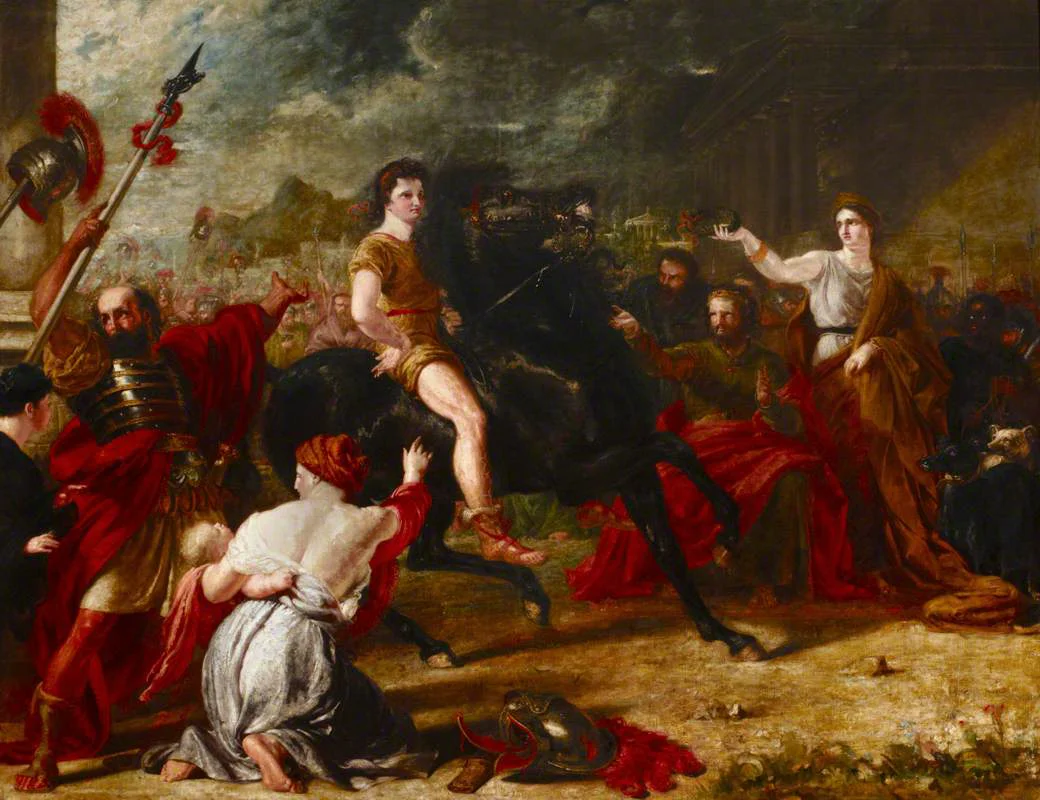
On the night of 10—11 May 326 BC, in a thunderstorm, Alexander crossed the Hydaspes at a narrow point with 11,000 men (he left another 60,000 behind as a feint). The battle went on all day. The elephants did damage to the Macedonian phalanx at first, but the Macedonians learned: archers concentrated on the mahouts, and sarissas were used to stab the elephants in the belly; wounded elephants charged back into their own ranks and trampled the Indian troops. Porus, a giant king almost two metres tall, fought to the last from his own elephant and took nine wounds. When Alexander asked the captive how he wanted to be treated, Porus answered: "Like a king." Alexander was so impressed that he left him his kingdom (and added neighbouring lands besides) and made him an ally. Here, on the battlefield, died Alexander's old war horse Bucephalus, who had carried him since he was sixteen. In his honour Alexander founded the city of Bucephala on the banks of the Hydaspes.
The mutiny on the Hyphasis
A few months later Alexander reached with his army the river Hyphasis (today's Beas, in the Punjab). Scouts reported great Indian kingdoms beyond the river — and large armies with thousands of elephants. Alexander was ready to go on; the Macedonians were not. The army had been marching for nine years; many veterans had covered more than 17,000 km from their homes; their armour was worn out, their clothes in tatters, the rains had been pouring down for six weeks, and the jungles were full of unknown tropical diseases.
The old general Coenus, the most respected man among the Macedonian infantry, stepped out before the troops and said to the king: "Let the gods be content with what you have conquered. Let us go home, and see our parents and children." Alexander withdrew to his tent and for three days did not come out, waiting for the soldiers to change their minds. They did not. It was the only time Alexander's army refused to obey his order. In September 326 BC the king declared the campaign over. On the bank of the Hyphasis he ordered the building of twelve giant altars — a symbolic mark of the farthest limit of his conquests. Modern archaeologists have never found them. The army turned west, to the Indus, where Alexander built a fleet and set off down the river to the Arabian Sea.
The Gedrosian desert
In the autumn of 325 BC, after sailing down the Indus and a series of short campaigns against Indian tribes (during one of which Alexander was hit in the chest by an arrow at the city of the Mallians and was on the brink of death for weeks), the army turned west, towards Persia. Alexander divided his forces: Nearchus with the fleet was to sail along the coast, while the king himself led the main army overland through Gedrosia (the Makran desert, in present-day southern Pakistan and Iran). This was an absolutely waterless, sun-scorched strip of sand and rock about 1,000 km long. No large army had ever crossed it.
The crossing lasted 60 days in the hottest part of the year. Wells were either filled in or gave brackish water; supplies ran out; the women and children who marched with the army died first; horses and mules fell in their thousands. Sandstorms buried whole camps in a single night. Alexander held the army together by his own example: when a soldier brought him a helmet full of water, the king poured the water out into the sand in front of the troops — he would not drink, he said, while his army was dying of thirst. By various estimates only about a quarter of those who had entered the desert came out on the Persian coast — tens of thousands dead, mostly civilians. It was the worst moment of the whole campaign. Herodotus had once written that the only man to come back from the East by such a road was Cyrus the Great — Alexander later said he had taken that road precisely to outdo Cyrus.
The death of Hephaestion and the death of Alexander
In the winter of 324 BC, at Ecbatana, Hephaestion died — Alexander's closest friend from childhood, his "alter ego" as contemporaries called him. The doctors diagnosed typhoid. Alexander was crushed: he did not eat for three days, ordered the manes of every horse in the army cut as a sign of mourning, ordered a colossal monument to Hephaestion to be built in Alexandria, and even sent an embassy to the oracle of Ammon asking it to recognise his friend as a god. Contemporaries felt that Alexander had lost part of himself with Hephaestion.
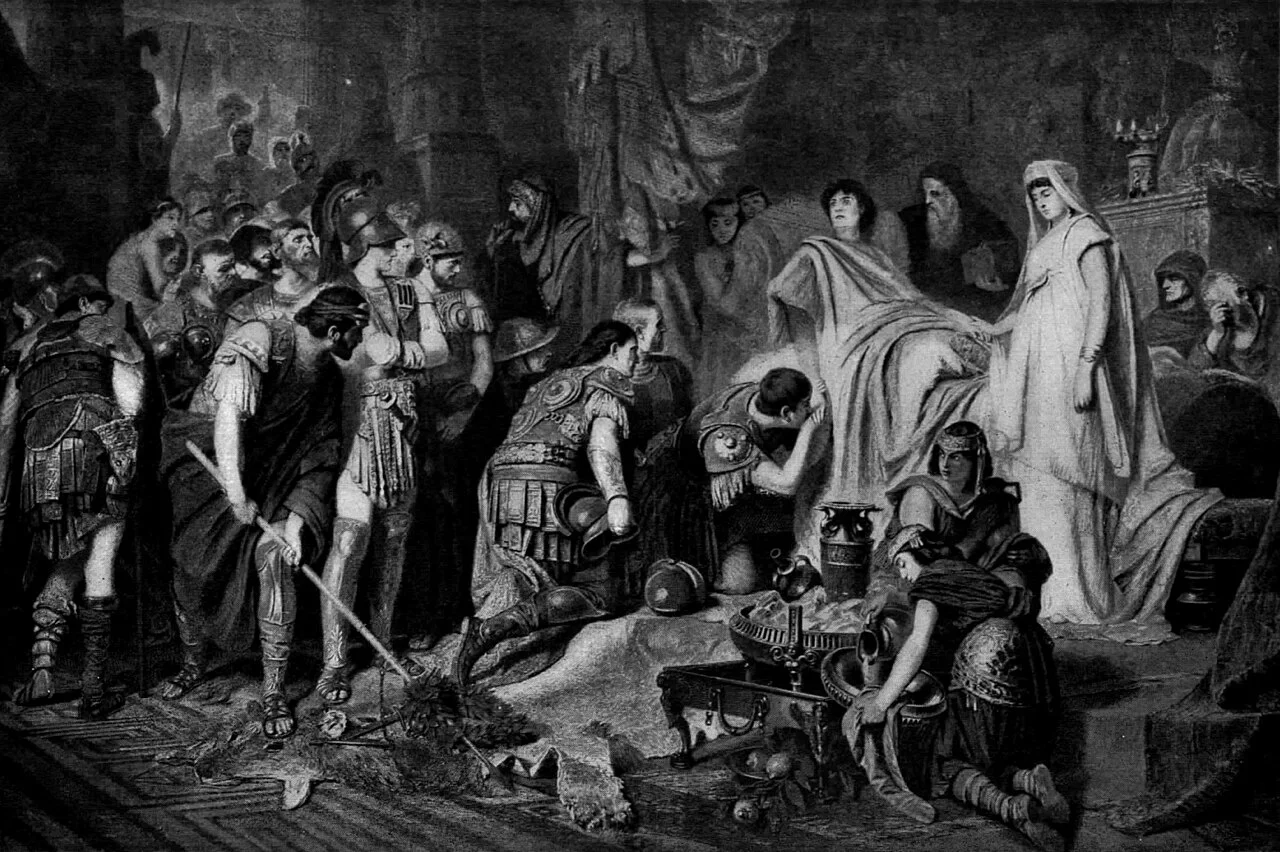
Seven months later, at Babylon, Alexander was preparing a new grand campaign — south, around Arabia, with plans to reach Carthage and the western Mediterranean afterwards. On 29 May 323 BC, after a ten-day feast at the house of Admiral Medius, he came down with a fever. The fever did not break for ten days. He could no longer speak; the regiments of his Macedonian veterans filed past his couch, and the dying king said goodbye to each man with a look. On 10 June 323 BC Alexander III of Macedon died at Babylon at the age of 32 years and 8 months. Modern hypotheses about the cause of death include malaria, typhoid, complications of alcoholism, acute pancreatitis, even poisoning. None has been proved. Asked on his deathbed to whom he left his kingdom, Alexander is said to have whispered: "To the strongest." So began the wars of the Diadochi — his former companions, who tore the empire into several great Hellenistic states. Alexander's son by Roxana, Alexander IV, was murdered a few years later; so was Roxana herself. Alexander's dynasty ended with him.
Alexander's legacy
Alexander lived for 32 years and conquered the world — and then the world fell apart. But after him there remained the Hellenistic age, which lasted nearly 300 years, until in 30 BC Rome conquered the last of the Hellenistic kingdoms — Cleopatra's Ptolemaic Egypt. Alexander's empire was divided by his Diadochi into three great parts: the Ptolemies in Egypt, the Seleucids in Syria and Mesopotamia, and the Antigonids in Macedon and Greece. All of them governed in Greek, in Greek dress, with Greek gods and Hellenistic cities. Local elites — from Egyptian priests to Bactrian aristocrats — learned Greek en masse to be admitted to power.
The Greek koine — a simplified variant invented for the soldiers and merchants of Alexander's multinational army — became the international language from Spain to the Indus. It was in koine that, 300 years later, the New Testament would be written; 600 years later, the laws of late Rome. More than twenty cities named Alexandria, founded by Alexander, became new cultural centres: Alexandria of Egypt with its library; Alexandria Eschate (Khujand) in Tajikistan; Alexandria in Aria (Herat) in Afghanistan; Kandahar (from "Iskandar," the Arabic form of Alexander's name). In Bactria and Sogdiana there arose the Greco-Bactrian kingdom, which lasted until 130 BC, and Indo-Greek kings in the Punjab, who minted coins in Greek showing the Buddha — the first example of a synthesis of Greek sculpture with Indian Buddhism, which gave rise to the Gandharan school of art. The first statues of the Buddha, now known across Asia, arose under the influence of Greek models brought by Alexander's soldiers.
Why it still matters
Alexander not only built an empire — he built the template of what a world-conqueror looks like. Every great commander of later history looked over his shoulder at him. At 33, on seeing a statue of Alexander at Cádiz, Julius Caesar wept: "At my age he had already conquered the world, and I have done nothing." Pompey the Great took the nickname "the new Alexander" and even did his hair "in the style of Alexander." The emperor Trajan, on reaching the Persian Gulf in AD 116, wept that he was no longer young and could not go on — "like Alexander." Napoleon in 1798, on his Egyptian campaign, carried biographies of Alexander with him and consciously repeated his route, entering Alexandria and then heading east. In the 20th century General Patton read Arrian's Anabasis of Alexander in the field. Without Alexander there would be no Caesar, no Napoleon, no genre of "biography of the great conqueror" at all.
In the East, Alexander turned into a legendary figure with a life of his own. In the Islamic tradition he is Iskandar Dhul-Qarnayn ("the Two-Horned Alexander," after the horns of Ammon on his coins) — a prophet and a righteous king mentioned in the Qur'an (Sura 18, verses 83—98), who builds a wall against the peoples of Gog and Magog. In Ferdowsi's Shahnameh, the Persian national epic of the 10th century, Iskandar is the son of a Persian king and a hero of local lore. In the medieval European Roman d'Alexandre and dozens of other texts, he rises into the sky in a chariot drawn by griffins, and goes down to the bottom of the sea in a glass barrel. In modern popular culture — from Oliver Stone's Hollywood Alexander to Japanese anime and the Civilization video games — Alexander remains the type of the hero who refuses to acknowledge any limit: geographical, political or his own. A king who at 32 asked whether there was anything left to conquer, and what answer he expected to hear — that question is still there, and that question is what makes Alexander one of the very few human beings who became a myth in their own lifetime.