In just about 120 years — between the first Portuguese expedition pushing south along the African coast in 1419 and the fall of the last Inca capital, Vilcabamba, in 1543 — a small handful of Europeans in wooden ships literally stitched the planet together. Before 1419 Europe, Africa, Asia and the Americas lived apart: no inhabitant of Lisbon had ever in his life seen a potato, a tomato or a pineapple; no inhabitant of Tenochtitlan had ever seen a horse, a cow or a wheel. A hundred and twenty years later Spanish galleons were crossing the Pacific, Portuguese trading posts ran from Malacca to Nagasaki, potatoes were growing in Ireland, maize in Italy — and tons of silver from Potosí were arriving every year in the port of Seville. This is the epoch in which the first real global empires were born, in which the first transatlantic capitalism appeared — and at the same time the Atlantic slave trade and the demographic catastrophe of the native peoples of the Americas. If you want to understand why the world looks the way it does today, this page is about how it came to look that way.
Why Europe and why then
At the start of the 15th century Europe was not the centre of the world but its distant western fringe. Wealth, spices, silk, porcelain — all of it came from China and India, by caravan through Central Asia and the Middle East, through Arab and Venetian middlemen. In 1453 the Ottoman Turks took Constantinople, and gradually they took control of the whole old Silk Road. Europe found itself in a kind of "trade blockade": peppercorn, clove, nutmeg and cinnamon, which were as good as gold, now passed through Muslim middlemen at a triple mark-up. To find a way around — by sea — to India became a question of money.
Second, Europe acquired the technology. From the Arabs — the astrolabe and the compass; from China — gunpowder; from its own shipyards — a new kind of vessel, the caravel, which could sail against the wind on lateen sails. Third, money: the Italian banks of the Medici and the Fugger were ready to finance risky expeditions. Fourth, ideology: the Spanish Reconquista had just ended in 1492 with the taking of Granada, and thousands of armed, ambitious and unemployed Castilian noblemen (hidalgos) were looking for somewhere new to apply the sword and the faith. All of this — appetite, technology, money and people — converged on a single point around the 1480s. And then the planet was opened up.
Phases of the Age of Discovery
The story of the Age of Discovery breaks naturally into five phases. The birth of Portuguese expansion (1419—1487): Prince Henry the Navigator and his school at Sagres, the invention of the caravel, the slow push down the west coast of Africa, the rounding of the dreaded Cape Bojador, the gold and slave trade in Guinea. Breakthrough to India and the New World (1488—1499): Bartolomeu Dias rounds the Cape of Good Hope, Columbus in 1492 stumbles onto America (thinking it is Asia), the Treaty of Tordesillas divides the world between Spain and Portugal, Vasco da Gama reaches Calicut. Filling in the map (1500—1518): Cabral "accidentally" finds Brazil, Balboa from a mountain in Panama sees the Pacific Ocean. Magellan and circumnavigation (1519—1522): an expedition of 5 ships sails from Seville, passes through the Strait of Magellan, Magellan is killed in the Philippines — and a single ship, the Victoria, with 18 exhausted men on board, returns by way of the Indian Ocean to Spain. The conquista of the Americas (1519—1543): Cortés and 600 Spaniards bring down the Aztec empire, Pizarro with 168 soldiers seizes the Inca emperor Atahualpa and destroys the largest empire of South America. The page closes with sections on the legacy of all this and an epilogue on the present day.
Phase 1. The birth of Portuguese expansion (1419—1487)
The first country to put to sea systematically was not Spain and not England but tiny, poor Portugal, with a population of barely a million. She had no land route to the East — Spain blocked the whole Iberian peninsula. But she had a long Atlantic coast, fishermen who knew how to sail in heavy weather, and a single visionary prince who decided that the sea was the way out.
Prince Henry the Navigator and the school at Sagres
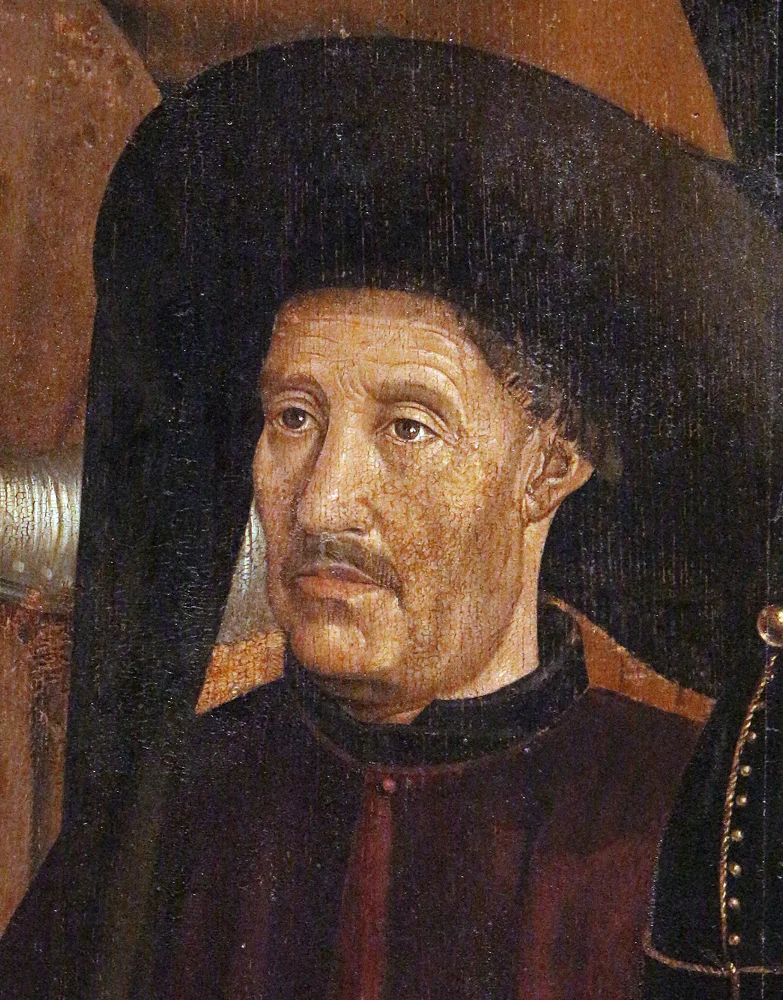
Henry the Navigator (Infante Dom Henrique, 1394—1460) — the third son of King John I of Portugal — barely went to sea himself. But he did something else, far more important: at the extreme south-western tip of Europe, at Sagres, he gathered together the best cartographers, astronomers, navigators and shipbuilders — Arabs, Jews, Italians, Portuguese — and organised what was effectively history\'s first scientific centre for maritime expansion. Here new kinds of ship were designed, the so-called portolan charts were drawn up, the astrolabe and the quadrant were perfected, and young captains were taught how to read the stars. From Sagres, beginning in 1419, the expeditions went out southward.
First came the discovery of Madeira (1419) and of the Azores (1427—1431). That alone was already a tremendous achievement: in those days the Atlantic was thought of as the "Sea of Darkness," a place where sea monsters lived and rivers of boiling water flowed. Henry proved that one could live in the Atlantic, plant sugar cane there, and come home again. But his real target was Africa — and gold.
The caravel, Cape Bojador and Guinea
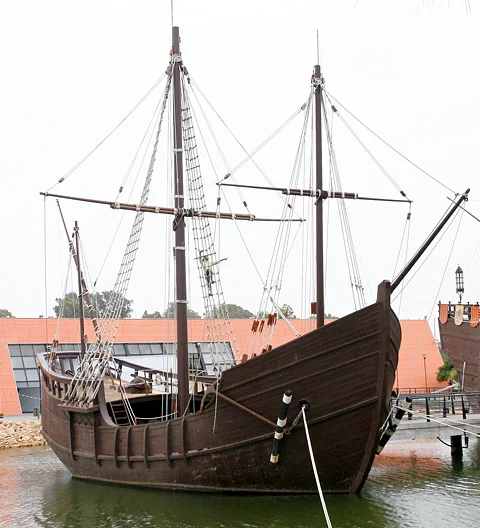
The chief technical innovation of the Portuguese was the caravel — a small (20—30 metres long), light, manoeuvrable ship with lateen (sloping, triangular) sails, which let it sail close to the wind. With a caravel a crew of twenty could work along an unknown coast, put out into the open ocean and — most important — come back again, against the northeast trade wind. Without the caravel there would have been no discoveries at all.
The first obstacle southward was Cape Bojador, on the coast of what is now Western Sahara. In medieval tradition this was the "end of the world": beyond it, supposedly, hell began, where the ocean boiled and white sailors turned black and died. Dozens of expeditions had turned back. In 1434 Henry\'s captain Gil Eanes finally rounded Bojador — and discovered that on the other side there was just another dull stretch of sand. The psychological barrier was broken. After that the Portuguese moved south as if on a string: 1444 — Cape Verde; 1471 — the equator; 1482 — the mouth of the Congo. Along the way they set up factories (fortified trading posts): Elmina, on the coast of present-day Ghana, where one could trade cloth and trinkets for gold; the island of São Tomé to grow sugar; and — sadly — the European slave trade began here too: as early as 1444 the first 235 slaves from West Africa were brought back to Lisbon. It was a small thing compared to what would happen a century later, but it was the beginning.
Phase 2. Breakthrough to India and the New World (1488—1499)
The decade between 1488 and 1499 is the moment when the previous sixty years of preparation finally pay off in an explosion. Inside eleven years Europeans round Africa, cross the Atlantic, legally divide the world in half and reach India. This is the real hinge of the story.
Bartolomeu Dias rounds the Cape of Good Hope (1488)
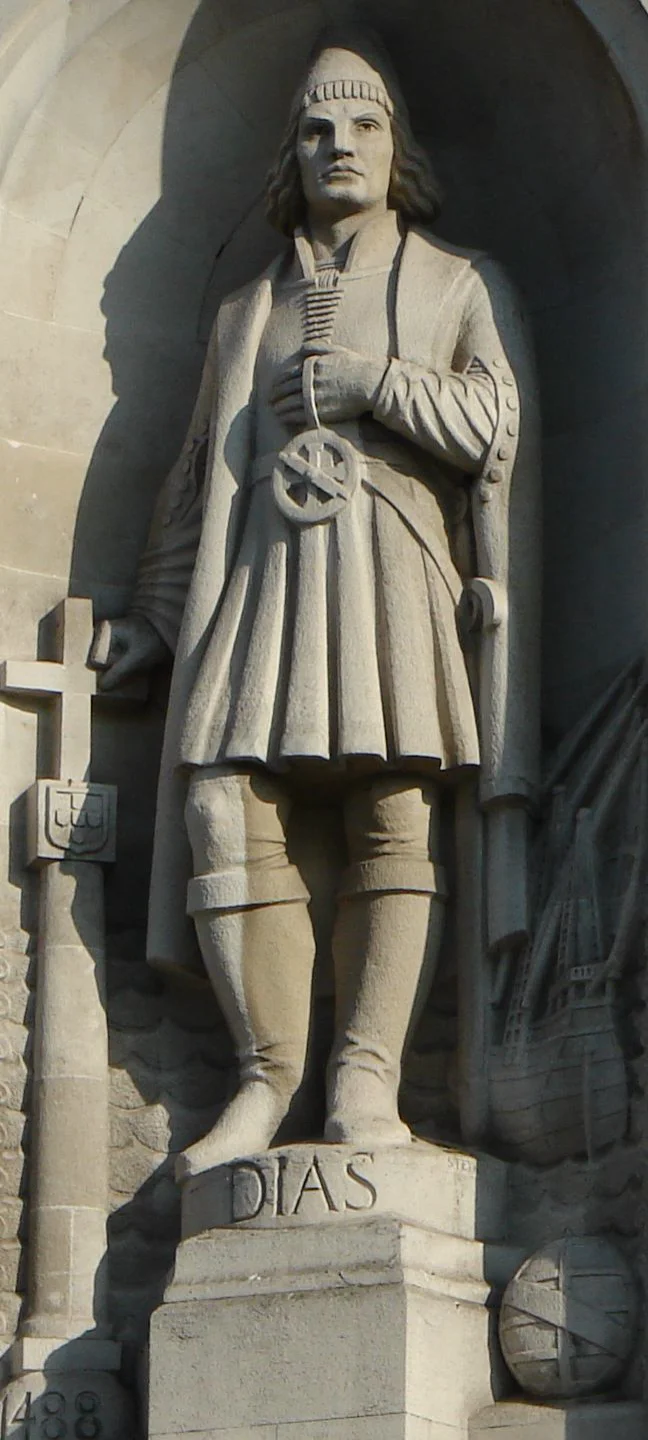
In August 1487 the Portuguese captain Bartolomeu Dias left Lisbon with two caravels and a small supply ship. His mission was to find the southern tip of Africa. Off the coast of present-day Namibia a storm carried his ships far to the south, out into the open ocean. When the sailors saw land again a few weeks later, it was already the east coast of Africa — without any visible turning point. So in February 1488 Dias discovered that Africa had an end: he had rounded a cape that, because of the terrible storm, he first called the Cape of Storms (Cabo das Tormentas). King John II renamed it to something more cheerful — the Cape of Good Hope (Cabo da Boa Esperança) — because now it was clear: a sea route to India existed. The crew were exhausted and refused to go further, so Dias himself never reached India; that would be done by another man, ten years later.
Columbus and his mistake about Asia (1492)
Christopher Columbus (Cristóbal Colón, 1451—1506) — a Genoese sailor in Spanish service — had one obsessive idea: that Asia could be reached more quickly by sailing not east but west across the Atlantic. For many years he had been miscalculating the size of the Earth: he thought it was about 4,000 km from the Canaries to Japan, when in fact it is about 20,000. Had he known the real distance, his expedition would have been suicidal. And had there been no America between Europe and Asia, he would simply have starved to death in the middle of the Pacific.
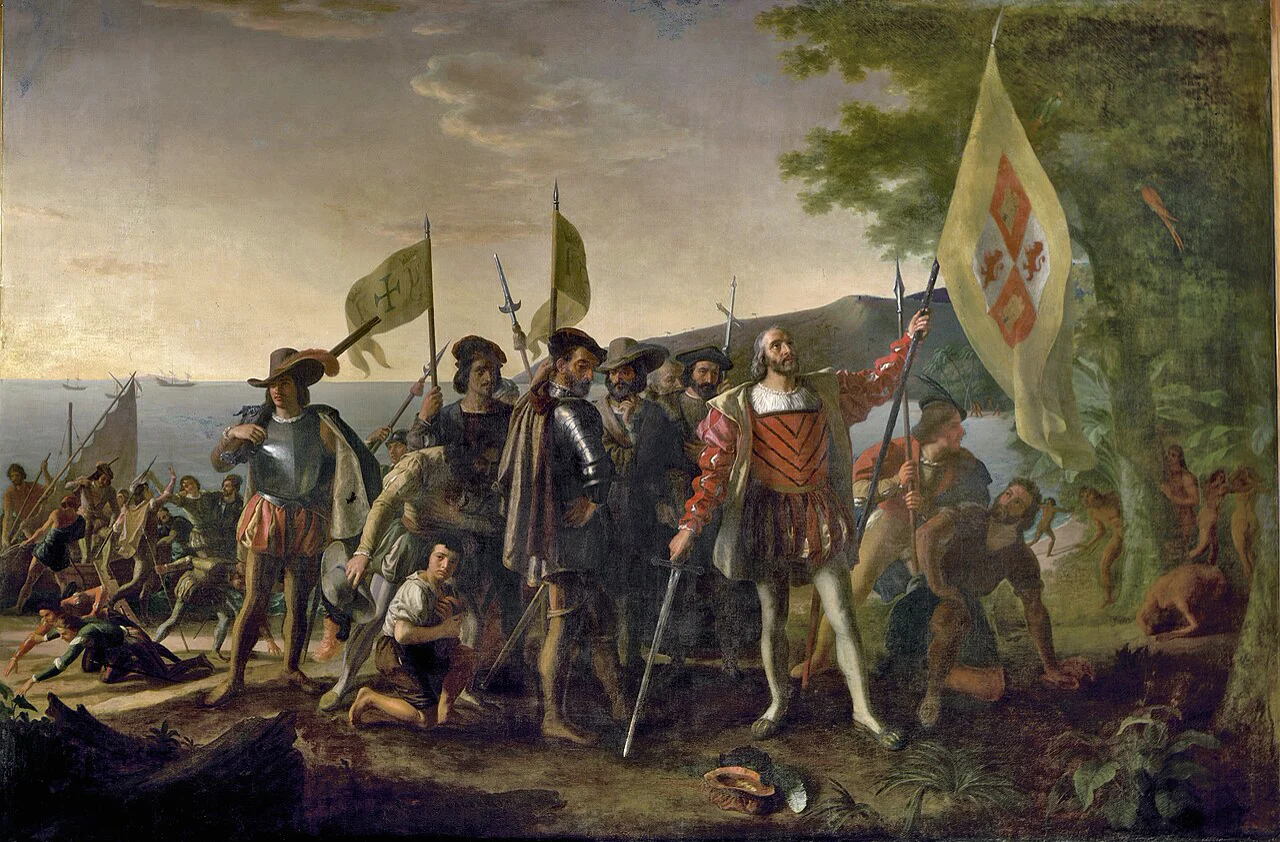
After eight years of rejections, first from the Portuguese and then from the Spanish court, in 1492 Columbus was finally given backing — by Isabella of Castile and Ferdinand of Aragon, in the very year in which they had just taken Granada and finished the Reconquista. On 3 August 1492 Columbus left the port of Palos with three ships — the Santa María, the Pinta and the Niña. Thirty-three days later, on 12 October 1492, the lookout on the Pinta cried "Tierra! Tierra!" — it was an island in what are now the Bahamas (Columbus called it San Salvador). Until his death in 1506 Columbus was convinced he had reached Asia — which is why he called the natives "Indians." He made three more voyages and discovered Cuba, Hispaniola, Jamaica and the coast of Venezuela, but he never of course reached Asia. The continent he had found was named instead after another Italian, the cartographer Amerigo Vespucci — America.
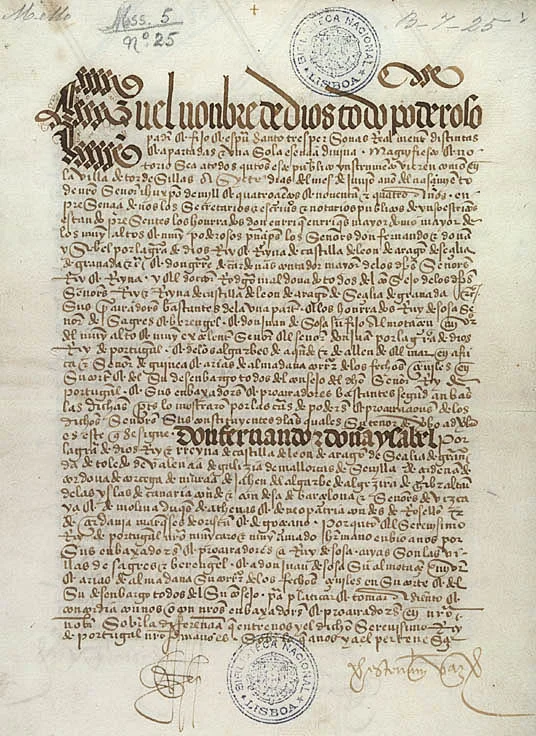
The Treaty of Tordesillas — dividing the world between two kingdoms (1494)
The moment Columbus came back from his first voyage in March 1493 with a little gold and a few Indians, Spain and Portugal were on the edge of war: both wanted the "new lands." Pope Alexander VI Borgia handled the question — and then, a year later, in the town of Tordesillas, the two countries signed in 1494 what is one of the most extraordinary treaties in history. They drew an imaginary line along a meridian on the chart of the Atlantic, roughly 1,770 km west of the Cape Verde islands. Everything west of the line went to Spain; everything east of it, to Portugal. Two European states, having barely seen most of the planet, simply divided it in half between themselves. This treaty explains why six years later Brazil, just barely sticking out on the eastern side of the line, became Portuguese, while the rest of South America became Spanish. And why in Brazil people still speak Portuguese, and in Peru, Spanish.
Vasco da Gama at Calicut (1498)
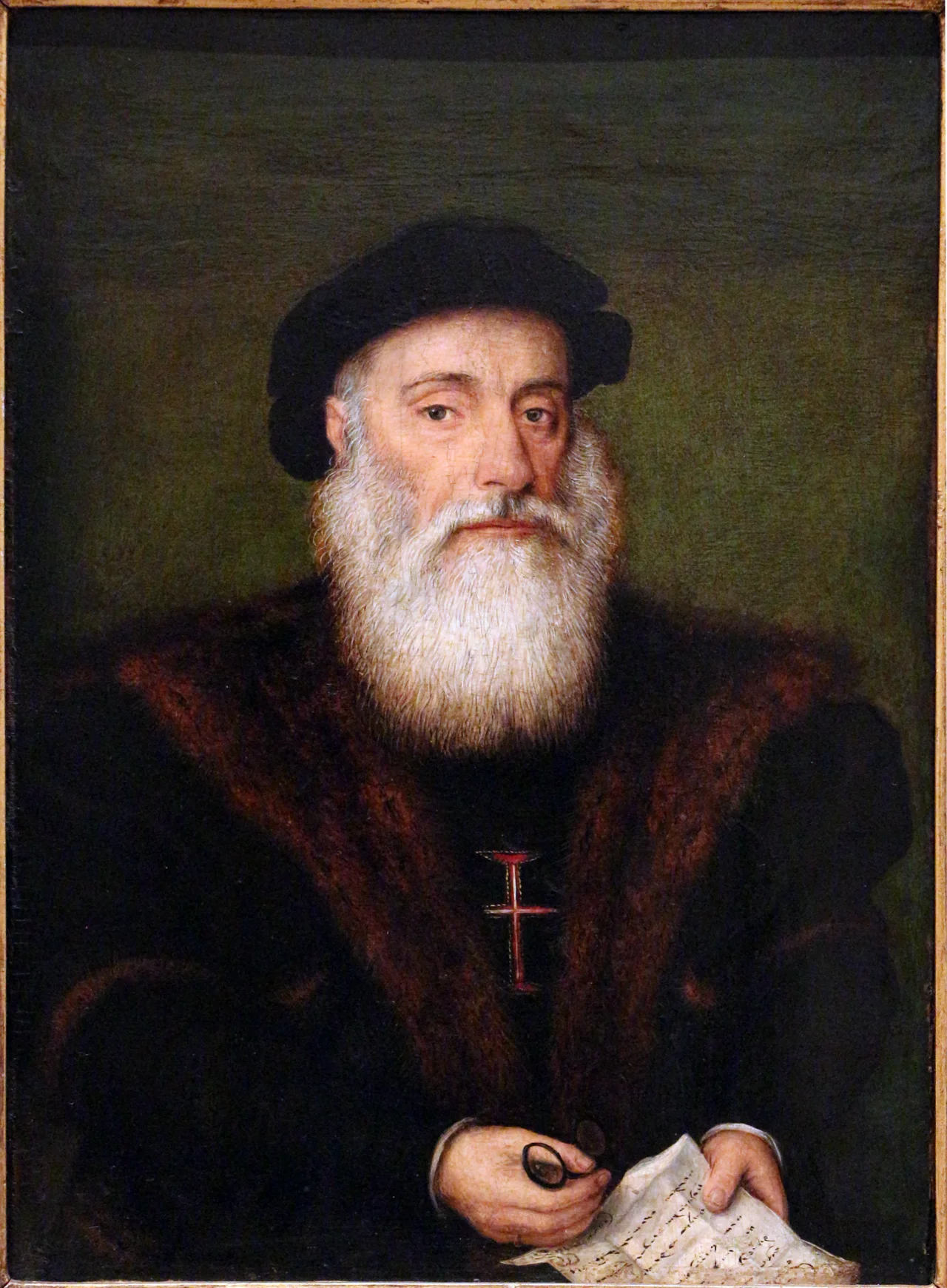
In July 1497 a small expedition of four ships under Vasco da Gama sailed from Lisbon. Its route was already mapped out: down the west coast of Africa to the Cape of Good Hope (as Dias), then north along the east coast of Africa and across the Indian Ocean to India. The voyage took almost two years. After an inhumanly hard passage — scurvy, starvation, storms and hostile reception in the Muslim ports of East Africa (Mombasa and Mozambique) — da Gama, with the help of a hired Arab pilot, on 20 May 1498 dropped anchor off the city of Calicut (Kozhikode, Kerala, India).
This was the very sea route to India for the sake of which the whole thing had been started. The first trading session went badly: the cargo da Gama had brought — cloth, little bells, honey — was thought by the Indian ruler to be pitiful and laughable compared with the gold and silk of the Arabs. But back in Lisbon da Gama brought home so much pepper, cinnamon and clove that it paid for the whole expedition sixty times over. Of the 170 sailors only 55 came home, but the deed was done: the monopoly of the Venetians and the Turks on the spice trade had been broken, and for the next half-century Portugal became the richest maritime power in the world.
Phase 3. Filling in the map (1500—1518)
The first two decades of the 16th century are the time when the map of the world began to fill in. Columbus had been convinced he had reached Asia; Magellan had not yet been heard of. In these years Europeans slowly grasped that between the Atlantic and India lay a whole new continent, and beyond it, a whole new ocean as well.
Cabral and "accidental" Brazil (1500)
In March 1500 a second great expedition for India sailed from Lisbon — 13 ships under Pedro Álvares Cabral. He followed Vasco da Gama\'s instructions: to avoid the doldrums off the Guinea coast, you had to swing in a wide zigzag far to the west before turning south toward the Cape of Good Hope. This zigzag turned out to be a little too wide: on 22 April 1500 the sailors saw a green shore to the west. This was the coast of what would become Brazil — and it just happened to lie on the Portuguese side of the Tordesillas line.
Modern historians argue about whether this "zigzag" was really an accident, or whether the Portuguese already had some scouting data. Either way, Cabral landed briefly, formally took Brazil for the crown, sent one ship back to Lisbon with the news — and pressed on to India. In the decades that followed Brazil, at first an uninteresting country without much obvious gold, became the world\'s main place for growing sugar cane — and it was here that millions of African slaves would be brought: over 350 years more people would be carried into Brazil through the Atlantic slave trade than into all the other countries of America combined.
Balboa sees the Pacific (1513)
Down to 1513 no European yet knew that America was not the edge of Asia but a separate continent, with another ocean behind it. This idea was demolished by the Spanish conquistador Vasco Núñez de Balboa. Leading a small force of 190 Spaniards and a few hundred local guides, he crossed the Isthmus of Panama through jungle, through mountain ranges, through impassable swamps. On 25 September 1513 he climbed a high peak, saw an immense gleaming surface to the south — and called the ocean "Mar del Sur," the South Sea. A few days later he came down to the shore, waded in up to his knees and formally claimed the new ocean for the Spanish crown.
This was the moment when Europe finally understood its fundamental geographical mistake: America is not Asia, and between them lies another ocean, twice the size of the Atlantic. The name Pacífico — the Peaceful — would be given to it six years later by Magellan. As for Balboa himself, in 1519 he was executed: his own father-in-law, the new governor of Panama, accused him of treason and had his head cut off. Such was the fate of many a conquistador.
Phase 4. Magellan and circumnavigation (1519—1522)
The first voyage around the Earth is one of the most extreme stories in history. The expedition of Ferdinand Magellan set out with 5 ships and 270 sailors. Three years later one ship and 18 men came back. Magellan himself was no longer among them.
5 ships leave Seville (1519)
Ferdinand Magellan (Fernão de Magalhães) — a Portuguese nobleman who had fallen out with his own king and gone over to the Spanish court. He was convinced that somewhere in the southern part of the just-discovered New World there must be a strait which would link the Atlantic with Balboa\'s "South Sea" — and then it would be possible to reach the Molucca islands (which is to say, the spices!) by the western route without breaching the Treaty of Tordesillas. The Spanish king Charles V, a young man newly on the throne and always short of money, agreed.
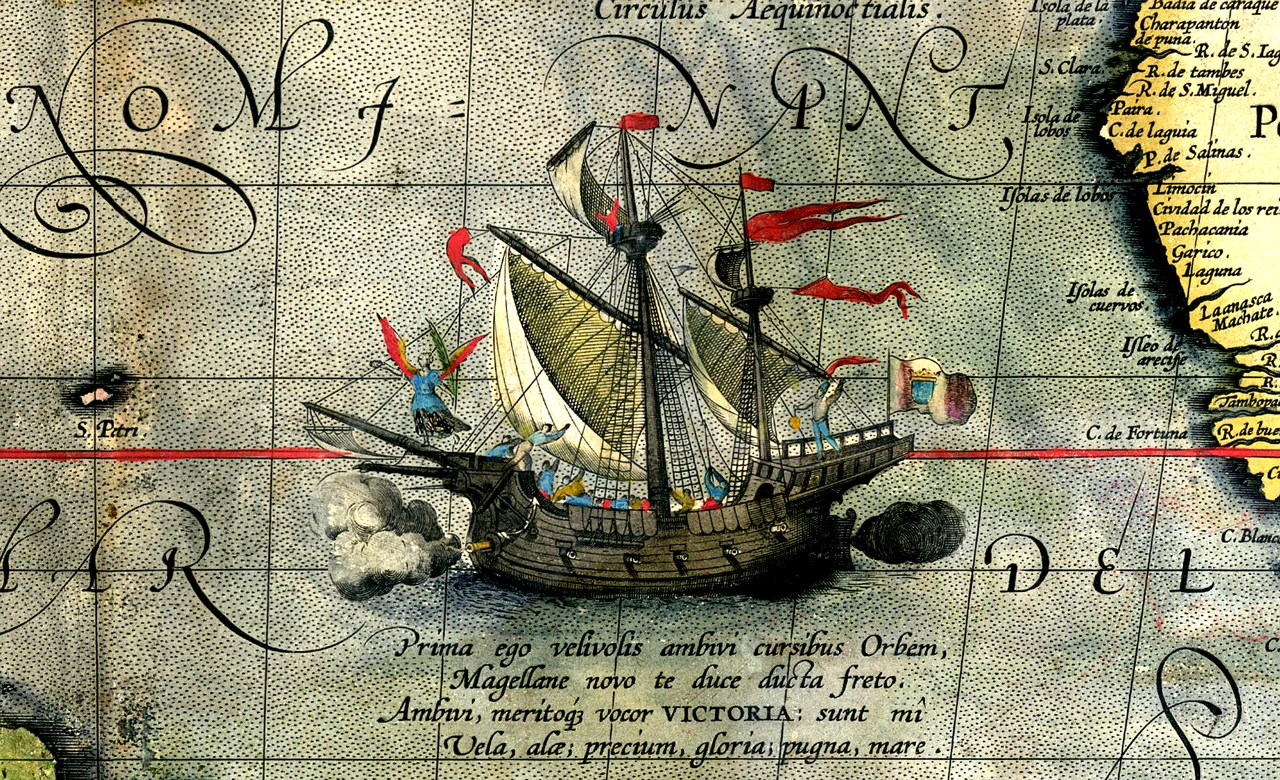
On 20 September 1519 from the port of Sanlúcar de Barrameda near Seville, 5 ships set sail: the Trinidad, the San Antonio, the Concepción, the Victoria and the Santiago. On board — about 270 men: Spaniards, Portuguese, Italians, Greeks and even an Englishman. Among them was the young Italian Antonio Pigafetta, who would keep a diary: it is thanks to him that we know the details. The first year was hard: a mutiny by the Spanish captains, who did not trust Magellan the Portuguese, at San Julián in Patagonia; the execution of one mutineer and the marooning of another; the loss of the Santiago in a storm; the desertion of the San Antonio, which turned back to Spain with most of the supplies.
The Strait of Magellan and the Pacific Ocean (1520—1521)
In October—November 1520 Magellan finally found what he was looking for: a narrow, tangled, island- and rock-filled strait at the southern end of South America. Thirty-eight days passed before the three remaining ships worked their way through this labyrinth. At the far end opened up an endless ocean. Magellan called it Mar Pacífico — the "Peaceful Sea," because at that moment it was calm. This was a terrible misnomer: ahead of them lay a hundred days of sailing without sight of land.
The Pacific turned out to be twice as large as the boldest estimates had supposed. The supplies ran out. The crew ate leather straps, sawdust off the masts and rats (a piaster was paid for a rat). Sailors lost their teeth to scurvy; about thirty men died. In March 1521 the ships finally reached the Philippine archipelago — for the first time Europeans had come into Asia from the Pacific side, from the west. Magellan was overjoyed: one of his Malay slave-translators turned out to be understood by the locals — the language was the same. This was the first time Europeans had closed the globe: the western route met the eastern one.
The death of Magellan; Elcano\'s Victoria — 18 out of 270 (1521—1522)
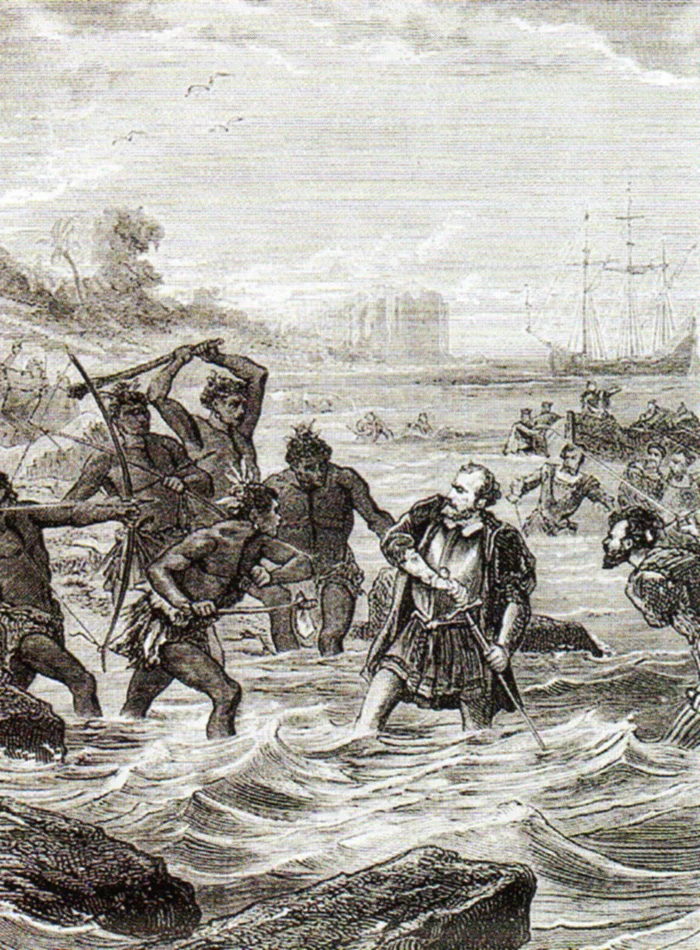
In the Philippines Magellan, in a missionary frenzy, intervened in a local quarrel between two chiefs and promised one of them to punish the other. On 27 April 1521 on the little island of Mactan some 50 Spaniards landed against the 1,500 warriors of the chief Lapu-Lapu. In the shallow water the caravels could not come close enough to cover the landing with their cannon; Spanish arquebuses misfired in the damp air. Magellan was wounded in the leg with a poisoned spear and finished off in the surf. The Philippines to this day count Lapu-Lapu as a national hero: he "stopped the European conqueror for forty years."
The expedition did not give up. Two ships remained: the Trinidad and the Victoria. The Trinidad tried to go back across the Pacific to America — and was lost somewhere in the seas off Ternate. The Victoria, under the command of the Basque Juan Sebastián Elcano, in December 1521, with her hold packed with the spices of the Moluccas, went west across the Indian Ocean, rounded the Cape of Good Hope — and on 6 September 1522 came back into the port of Sanlúcar. On board were 18 men alive out of the 270 who had set out three years before. The crew came ashore exhausted, in the same rags they had sailed in — to find out that, sailing the world from west to east, they had "lost" a whole day: by their diary it was Thursday, but on the shore it was Friday. This was final proof that the Earth is round — and one of the greatest voyages of all time.
Phase 5. The conquista of the Americas (1519—1543)
While Magellan was going around the planet, a completely different story was unfolding on another continent: a handful of conquistadors — Spanish adventurer-mercenaries, sloppily dressed in steel breastplates, armed with arquebuses, swords and horses — in twenty years brought down two of the largest empires of the Western Hemisphere: the Aztec and the Inca. How this was even possible is still a subject of argument among historians.
Cortés against the Aztecs (1519—1521)
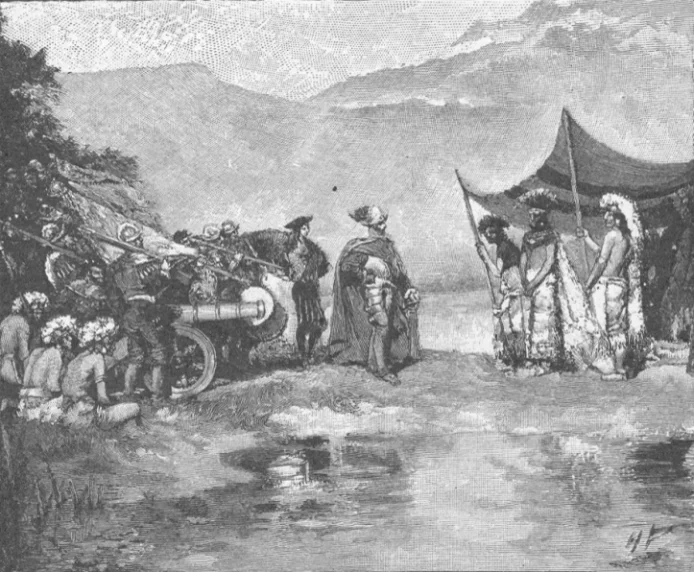
In 1519 a small expedition left a Cuban port under Hernán Cortés, a 32-year-old lawyer and adventurer: 11 ships, about 600 soldiers, 16 horses and 14 small cannon. He set off for the mainland — for the coast of what is now Mexico. Here lived the most highly developed Indian civilisation in the north — the Aztecs, with their splendid capital Tenochtitlan, of 200,000—300,000 inhabitants, in the middle of Lake Texcoco (where Mexico City stands today). The Aztec empire covered most of Mexico, had a complex hierarchy, rituals of human sacrifice and, most importantly, many enemies — subject peoples who paid tribute and endlessly hated Tenochtitlan.
Having landed on the coast at Veracruz, Cortés did something that has gone down in legend: he burned his ships, so that his soldiers would not be tempted to go back to Cuba. The only way was forward. On the way to the capital he made alliances with the enemies of the Aztecs — above all with the Tlaxcalans. This was decisive: there were only a few hundred Spanish invaders, but at the moment of the storming of Tenochtitlan they were accompanied by tens of thousands of Indian allies. The conquista is best described as a civil war among the Indians with Spanish participation.
Malinche and the fall of Tenochtitlan (1521)
It is worth mentioning Malinche (Doña Marina) separately — an Indian woman who was given to Cortés as a slave along with several dozen others. She knew both Nahuatl (the language of the Aztecs) and Mayan; she quickly learned Spanish — and became Cortés\'s chief interpreter, diplomat and political adviser. Without Malinche there would have been no alliance with the Tlaxcalans, none of those negotiations in which the Spaniards managed to split and turn against each other the peoples of the Aztec empire. In modern Mexican culture attitudes to her are split in two: to some she is the mother of the new Mexican nation (her son by Cortés is considered the first mestizo), to others she is a symbol of betrayal.
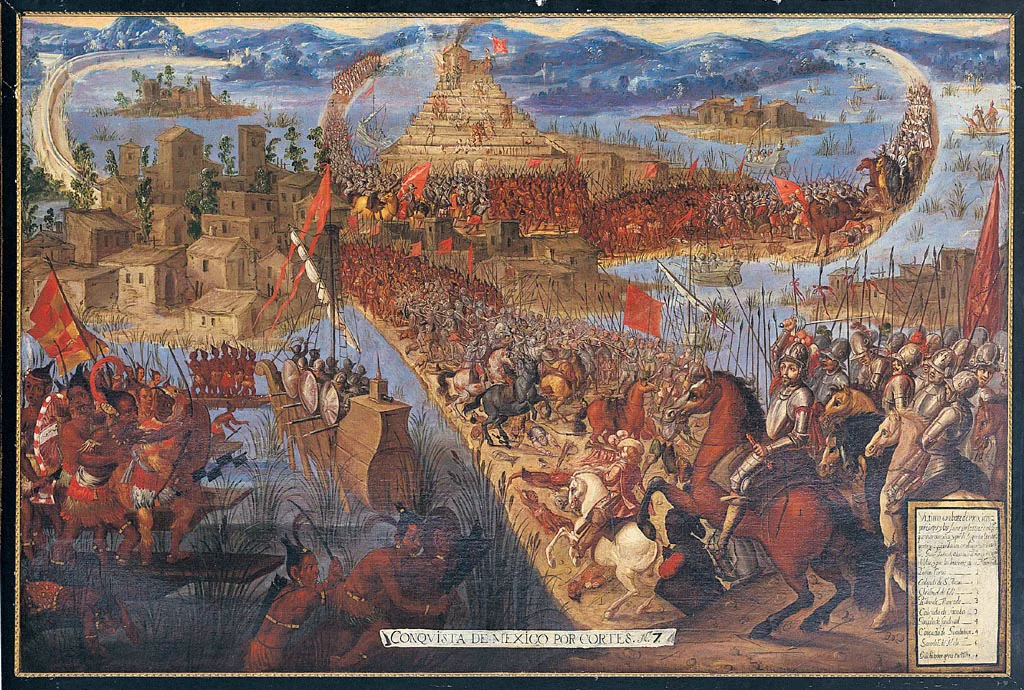
The Aztec emperor Moctezuma II himself received Cortés in Tenochtitlan peacefully enough (one tradition has it that he even mistook him for the returning god Quetzalcoatl). The Spaniards in effect took the emperor prisoner. When in 1520 the Aztecs rose up and threw the Spaniards out of the city — this was Cortés\'s terrible "Sad Night" (La Noche Triste), in which half of his army perished. But then something happened that nobody had expected: along with the Spaniards, smallpox arrived in Mexico, against which the Indians had no immunity. Within a few months in Tenochtitlan, by some estimates, 30—50% of the population died of the disease, including the new emperor Cuitláhuac. When Cortés came back with reinforcements, the city had already been half-ruined by the epidemic. The siege of Tenochtitlan lasted from May to August 1521; on 13 August 1521 the city fell. The last Aztec emperor — Cuauhtémoc — was captured and later hanged. So ended the Aztec empire.
Pizarro and Cajamarca (1532)
Ten years after Cortés, another conquistador — Francisco Pizarro, an illiterate bastard from a poor Extremaduran family who had been to Peru to scout — decided to repeat the trick, but this time on the Inca empire. In 1531 he landed on the Pacific coast of South America with 168 soldiers, 62 horses and a few cannon. The Inca empire (Tawantinsuyu), which covered territory from modern Ecuador to Chile, had 6—10 million people, splendid roads, bridges and a complex administration. The fact that with anyone but Pizarro this kind of project would have looked like outright suicide did not stop him — nor did the fact that Pizarro arrived at the very moment when the empire had just emerged from a bloody civil war between two heirs: Huáscar and Atahualpa. Atahualpa had just won.
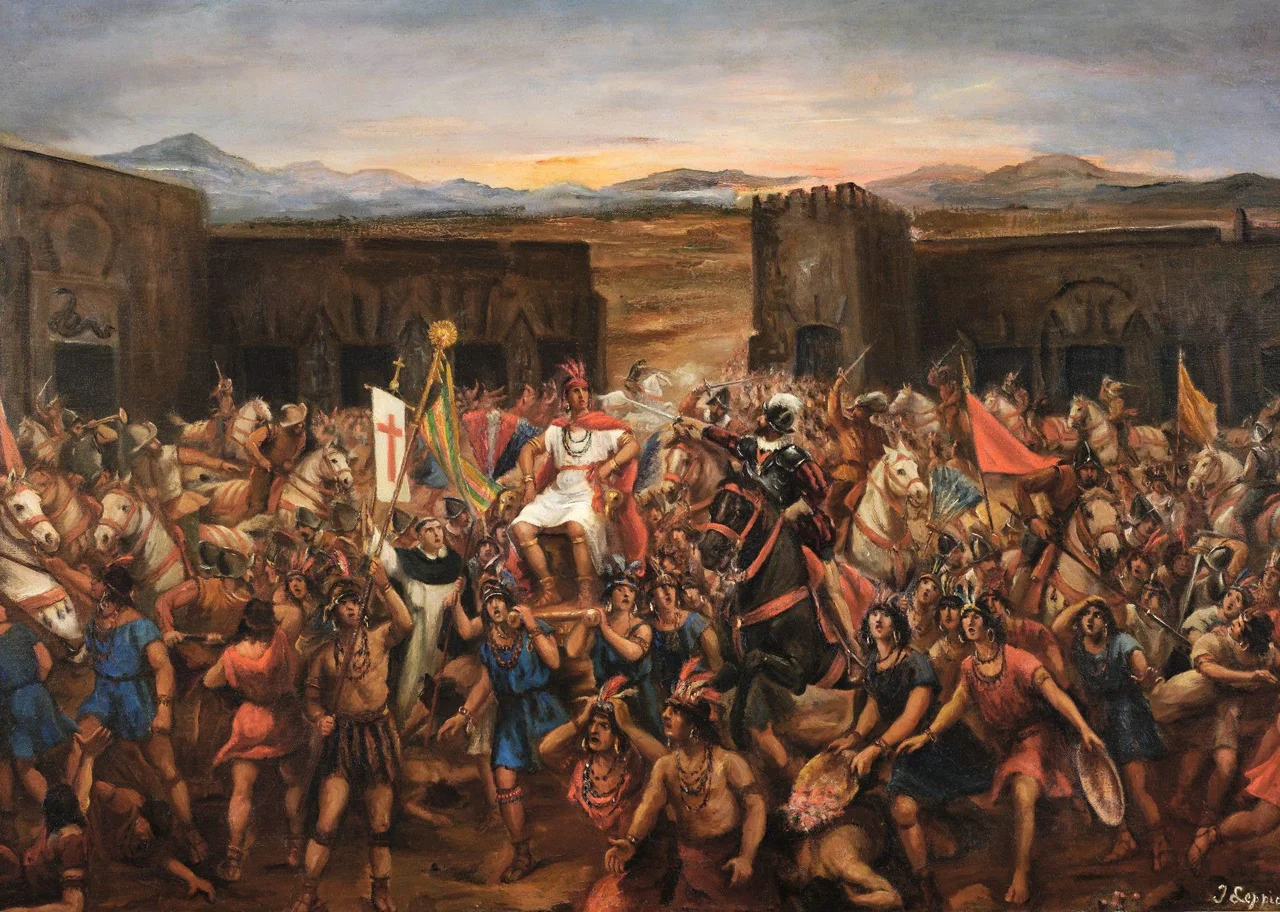
On 16 November 1532 in the town of Cajamarca on a northern Andean pass one of the strangest military scenes in history took place. Atahualpa, with 6,000—7,000 guards (unarmed — it was meant to be a parade), entered the main square, where he was supposed to receive a "message from the Spanish king." The message was handed over by a friar: he held out a Bible to the emperor and proposed he should voluntarily accept Christianity. Atahualpa threw the book on the ground — and then from behind the walls of the square the Spanish cavalry burst out with arquebuses and sabres, with their pre-rehearsed cry of "Santiago!" Thirty minutes later 2,000 dead Indians lay in the square; the Spaniards had lost none of their own (Pizarro had injured his hand getting through to Atahualpa); the emperor was a prisoner.
The execution of Atahualpa and the fall of Cuzco (1533)
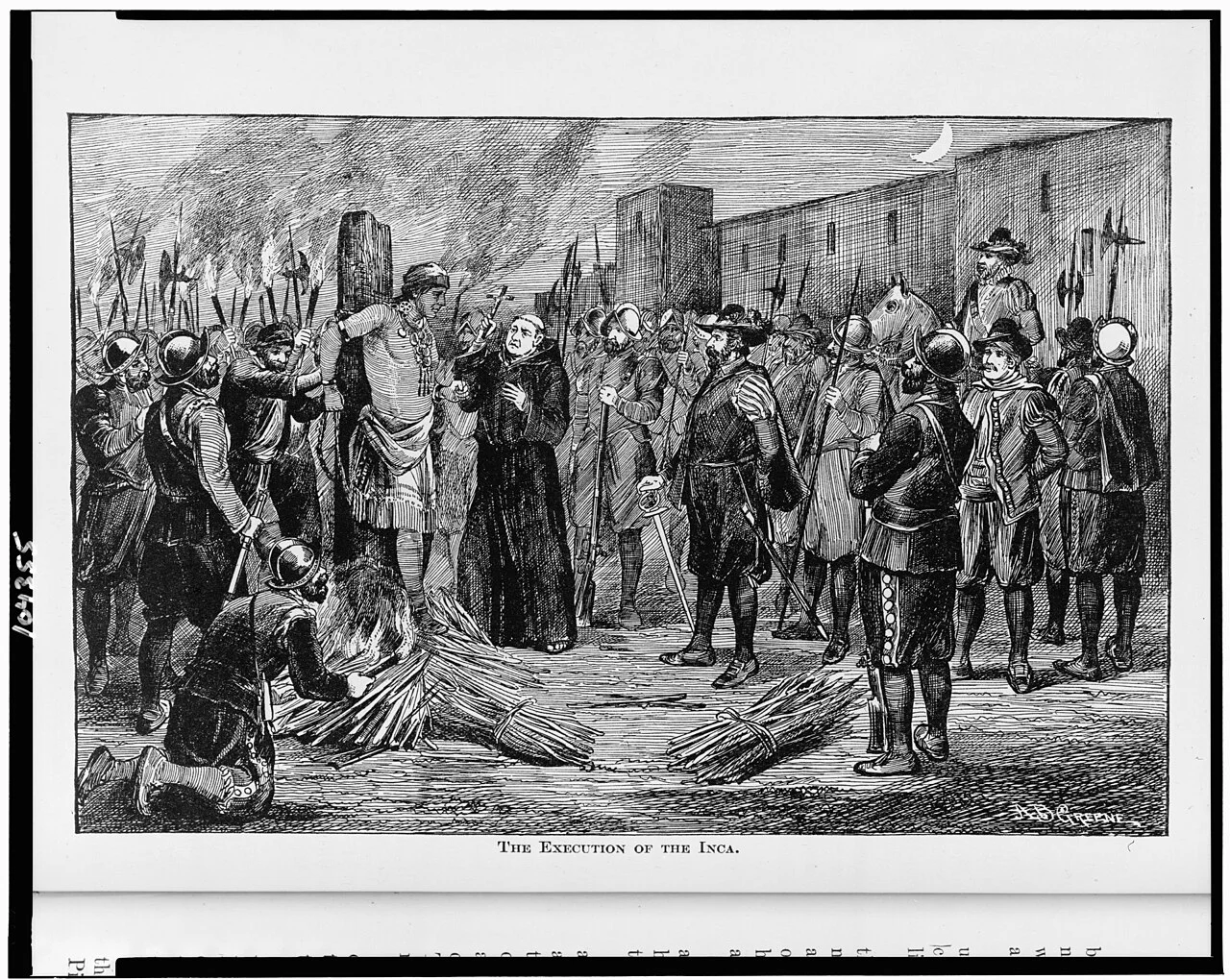
From his prison Atahualpa offered Pizarro a fairy-tale ransom: he would fill a large room with gold up to the height of his outstretched arm and would fill it twice over again with silver. The Spaniards agreed. For 7 months, from every corner of the Inca empire, caravans of ritual gold and silver came to Cajamarca — statues, masks and the vessels of the sun temples were melted down. By various estimates about 6 tons of gold and 12 tons of silver were collected — the largest ransom for a single human being in history. Pizarro took the ransom and all the same executed Atahualpa: on 26 July 1533 the emperor was condemned by a sham trial for "heresy and conspiracy" and strangled with a garrotte in the main square of Cajamarca.
Four months later, in November 1533, Pizarro entered the sacred Inca capital — Cuzco. The fall of Cuzco meant the end of the Inca empire as a political structure. The remnants of resistance under the "unconquered Inca" Manco Cápac and his sons would last another 40 years in the remote mountain fortress of Vilcabamba; it would not be taken until 1572. Pizarro himself, in 1541, was murdered in Lima by his own former conquistador comrades in a quarrel over the division of loot. No tombstone in Lima would ever again carry the word "conquistador" with such pride.
Legacy: the world after 1543
The Age of Discovery changed the planet fundamentally — and not in one direction. First, the Columbian Exchange took place: from the Old World to the New went horses, cows, pigs, chickens, wheat, rice, sugar cane, grapes — and the smallpox virus; from the New to the Old went the potato, maize, tomatoes, cocoa, tobacco, pumpkin, the bean, vanilla and the pineapple. Without the American potato there is no modern Ireland or Poland; without maize there is no modern Italy or Africa; without the tomato there is no modern Naples. Second, the Atlantic slave trade appeared: over 350 years about 12.5 million people were forcibly transported from Africa to America, of whom roughly 1.8 million died on the voyage. Third, fantastic silver mines opened up in Peru and Mexico — above all Potosí in present-day Bolivia, from which over the next 200 years more than 40,000 tons of silver flowed to Europe, causing the European price revolution (an inflation of 4—6 times over the 16th century). Fourth, the greatest demographic catastrophe in human history took place: in the hundred years after Columbus the native population of the Americas fell, by various estimates, from 50—60 million to 5—10 million — mostly because of epidemics of smallpox, measles, typhus and influenza. Fifth, the first real global empires appeared — the Spanish and the Portuguese — to be replaced after a century by the Dutch, the English and the French. The modern world — with its global economy, the inequality of continents, racial division and the colonial legacy — begins precisely here.
Epilogue: why it still matters
The Age of Discovery gave humanity one unprecedented thing: for the first time in history, the capacity to think of the Earth as a single planet. Before 1419, for the inhabitant of Europe China was as unreachable as the Moon; for the inhabitant of Peru, Spain simply did not exist. A hundred and twenty years later all of this had become part of a single network of trade, correspondence, migration and — unhappily — violence. Today we eat tomatoes, speak English in Africa, wash down our coffee from Brazil — and all of this is the consequence of those few decades. But at the same time this epoch has left us with the greatest open wound of modern history: racial inequality, the consequences of the transatlantic slave trade, the cultural annihilation of the native peoples of America, the unhealed psychological trauma of the colonial and decolonised peoples. The modern world is a world that, in five hundred years, has still not fully digested the consequences of 1492. To understand how we got here is to understand why the continents are so unequal today: why Europe and North America are rich, why Latin America and Africa are still poorer, and why even the notion of a "global economy" is not a neutral abstraction but the legacy of the years 1419—1543.