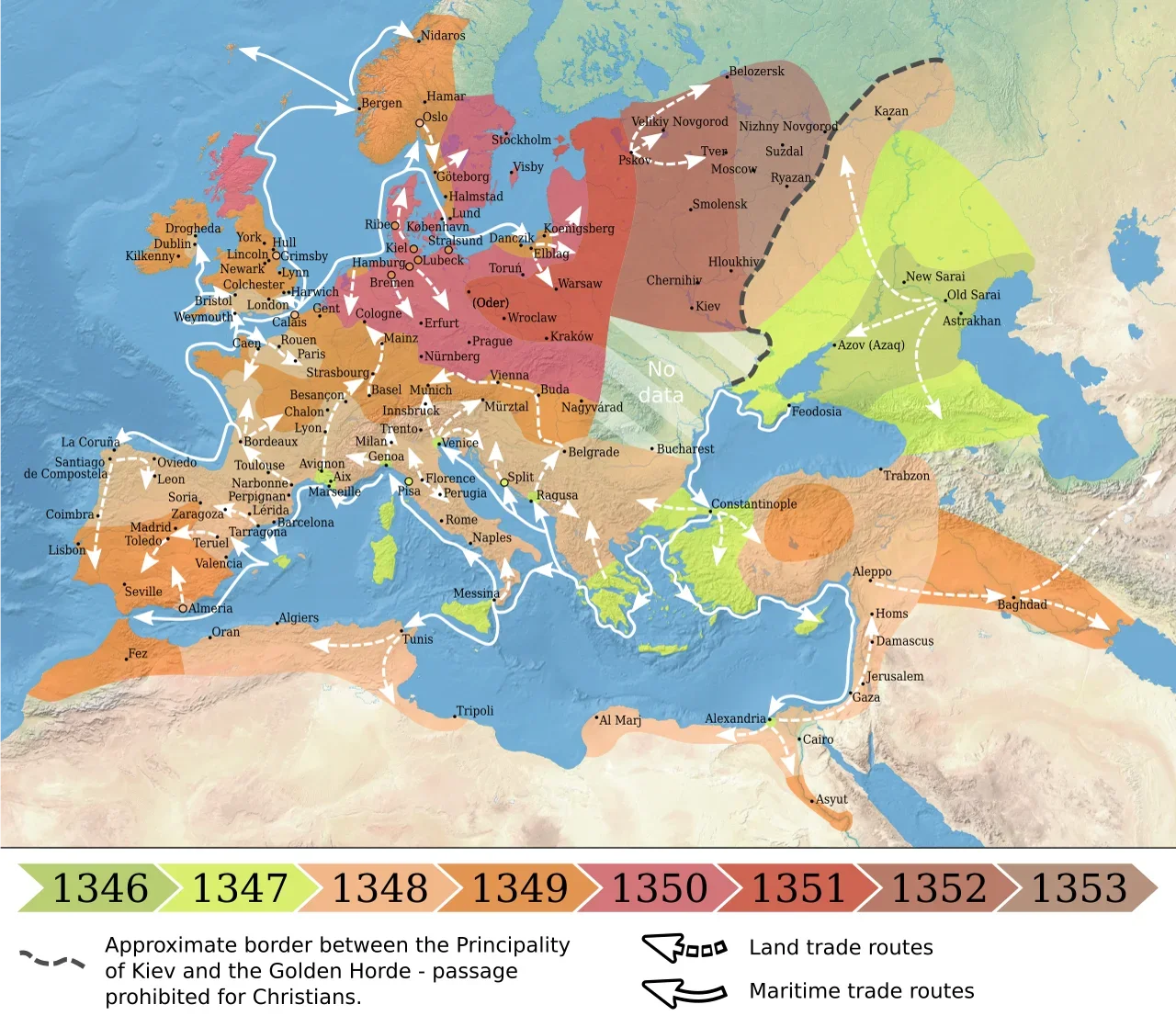
Six decades — from the first plague burials on the shores of Issyk-Kul in 1338—1339 to the last outbreaks in Scandinavia in 1353 — Europe lived through the greatest demographic catastrophe of its millennium. The Black Death took between a third and a half of the continent's population: about 50 million lives out of 80—100 million. The plague did not merely kill — it buried the Middle Ages: it destroyed the feudal economy, undermined the authority of the Church, set in motion the search for a new medicine, new forms of labour and a new picture of the world. All that we would later call the Renaissance grew from the bones of 1348.
Issyk-Kul and the Silk Road: where the plague came from
The first documented plague burials were found by archaeologists in 1885 on the shores of Lake Issyk-Kul in present-day Kyrgyzstan. Nestorian gravestones in Syriac were dated to 1338—1339; one of them bore the inscription: "This is the grave of Kutluk. He died of the pestilence." Modern genetic analysis of Yersinia pestis DNA from those burials has confirmed it: from these Tian Shan steppes the European strain begins.
The natural reservoir of plague was the marmots and ground squirrels of the Tian Shan and the Altai. The Mongol conquests of the 13th century had united Eurasia into a single trading network — Pax Mongolica — and for the first time in a thousand years made possible the swift movement of people, goods and bacteria from Beijing to the Crimea. Along the Silk Road, caravan by caravan, the plague crept westward: 1331 — an epidemic in China, 1338 — Semirechye, 1346 — the Volga, the Caucasus and at last the Crimea.
Caffa 1346: the biological warfare of Khan Jani Beg
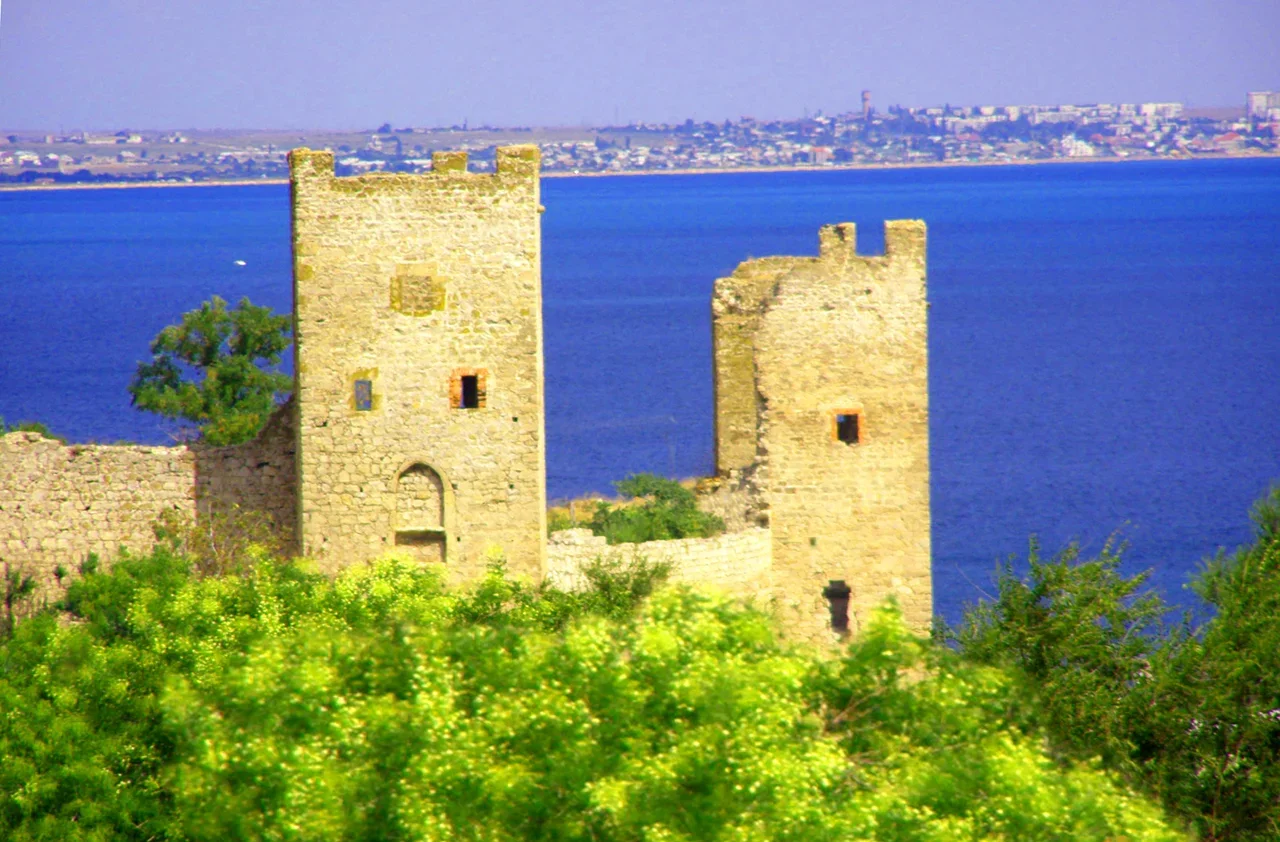
In 1346 Khan Jani Beg of the Golden Horde laid siege to the Genoese colony of Caffa in the Crimea — the largest slave port in Europe. The siege dragged on for months, and plague broke out in the Tatar army. According to the notary Gabriele de Mussi, who lived through the pestilence himself, the khan ordered the corpses of the dead to be flung by catapult into the city over the walls — so as to infect the besieged. This is the first documented act of biological warfare in history.
Modern epidemiologists doubt that the infection came from these "missiles" — more likely it was the rats and fleas that crossed the lines of defence freely. But the image of the wall of Caffa with corpses flying over the rampart entered European memory for ever. Within a few weeks the plague was raging inside the city; Genoese merchants rushed to their galleys and sailed away — carrying the Black Death westward, into the very heart of the Christian world.
The twelve galleys: the voyage into the abyss
From Caffa in the autumn of 1346 there sailed a squadron of twelve Genoese galleys. Course — home, to Genoa, through the Bosphorus and the Mediterranean. On the way the ships put in at every great Black Sea port: Trebizond, Pera — the Genoese quarter of Constantinople — and Varna. In each of them the pestilence had already broken out by the winter of 1346—1347; Constantinople lost, by various estimates, up to half its population.
The crews of the galleys melted away before their eyes: sailors died one after another on the decks. When in the autumn of 1347 a handful of these ships reached the Sicilian ports, only the dying remained on board. Most of the galleys never made it to Genoa — they sank or were burned. But a few got through — and through them death entered Europe by the front door.
Messina, October 1347: the first European port
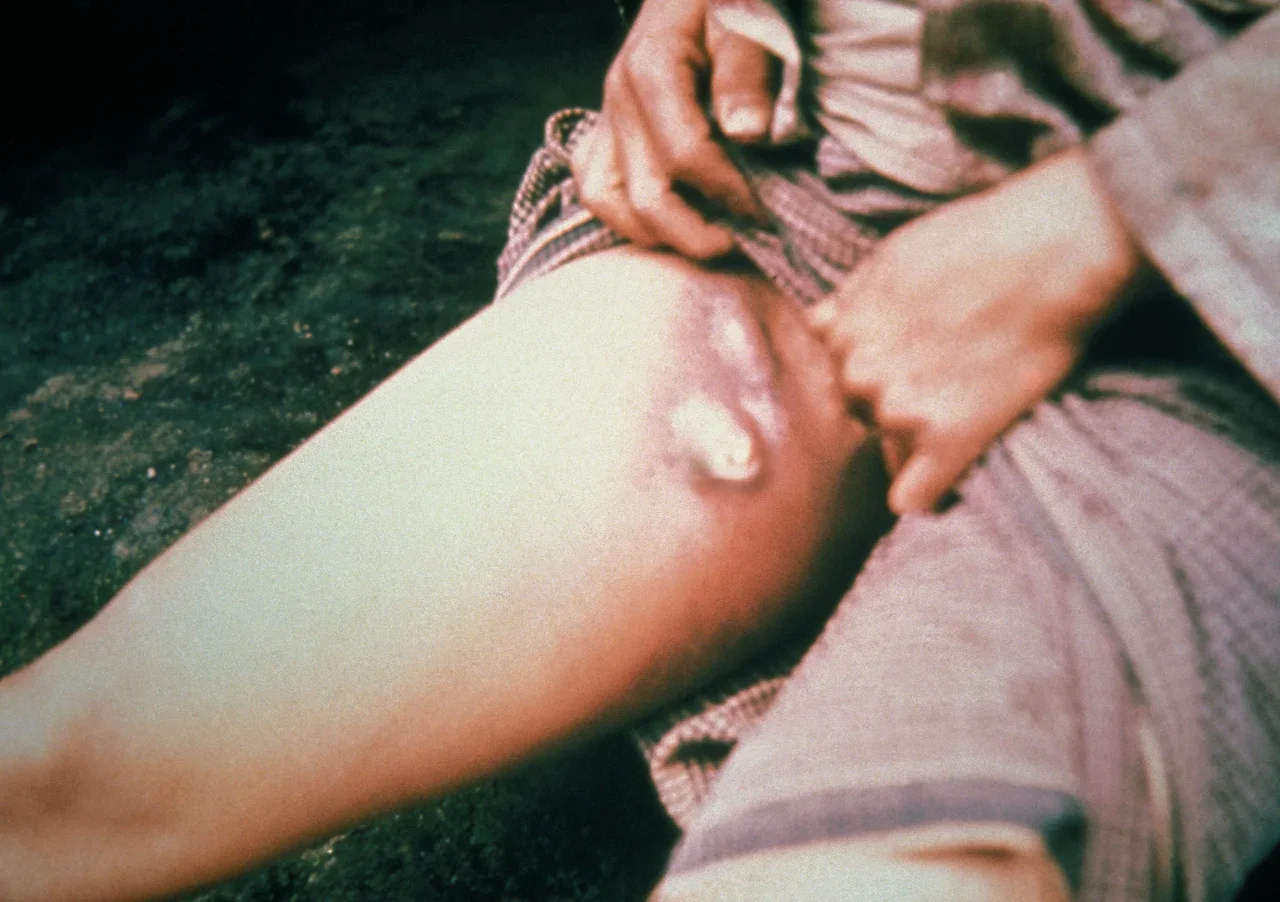
In October 1347 the twelve Genoese galleys put in at the port of Messina in Sicily. The Franciscan Michele da Piazza has left the most detailed account of it: the sailors brought ashore "such a sickness as though there was an evil spirit in their bones"; the skin was covered with black blotches and swellings the size of a hen's egg; within three days the sick died in fearful agony. The Messinians understood and drove out the galleys — but it was too late.
Within a week whole families were dying; within a month the city was burying a thousand a day; by the spring of 1348 Messina had lost about half of its inhabitants. The survivors fled to the mountains and carried death to Catania, Syracuse and Palermo. In Catania even Saint Agatha did not help — or rather, her relics were carried through the streets, but they saved no one. Sicily was the first — and its fate became the pattern for the rest of the continent.
1347: Marseille, Venice, Genoa, Ragusa
By the end of 1347 the plague had taken every great port of the western Mediterranean. In November the galleys reached Marseille — and in a winter every second Marseillais was dead. In December the plague entered Venice; the Venetian Republic, for the first time in history, introduced a system of trade restriction — ships from suspect ports stood at anchor on the island of Lazaretto for three days before being allowed in.
In the same winter Genoa fell: the trading giant that had sent death out from Caffa was now itself losing up to a thousand inhabitants a day. The small Dalmatian Ragusa (modern Dubrovnik) — an Adriatic city-republic cradled in its bay — was also struck; it was its town council that, thirty years later, would make the historic step that would change medicine for ever. By the spring of 1348 the plague front had passed from Cádiz to Bucharest.
Yersinia pestis: the enemy no one could see
The agent of the plague was discovered only five and a half centuries later. In 1894, during a plague outbreak in Hong Kong, the Swiss-French physician Alexandre Yersin in a cramped laboratory of reeds and bamboo isolated the bacillus for the first time and proved that this was what killed people. The bacterium was named in his honour Yersinia pestis. Almost simultaneously the same pathogen was described by the Japanese Kitasato Shibasaburō, but it was Yersin who worked out the mechanism of transmission.
The classic chain of transmission: rats — fleas — human. The black rat Rattus rattus lived alongside man wherever there was grain. On the rats lived the Oriental rat flea Xenopsylla cheopis; when the infected rat died, the hungry fleas leapt onto people. Inside the flea's gut the bacteria multiplied so as to block the passage of blood — and the flea was forced to bite again and again, with every bite pumping into a new victim tens of thousands of bacilli. All this 14th-century Europe explained as "poisoned air" and the wrath of God.
The three faces of death: bubonic, pneumonic, septicaemic
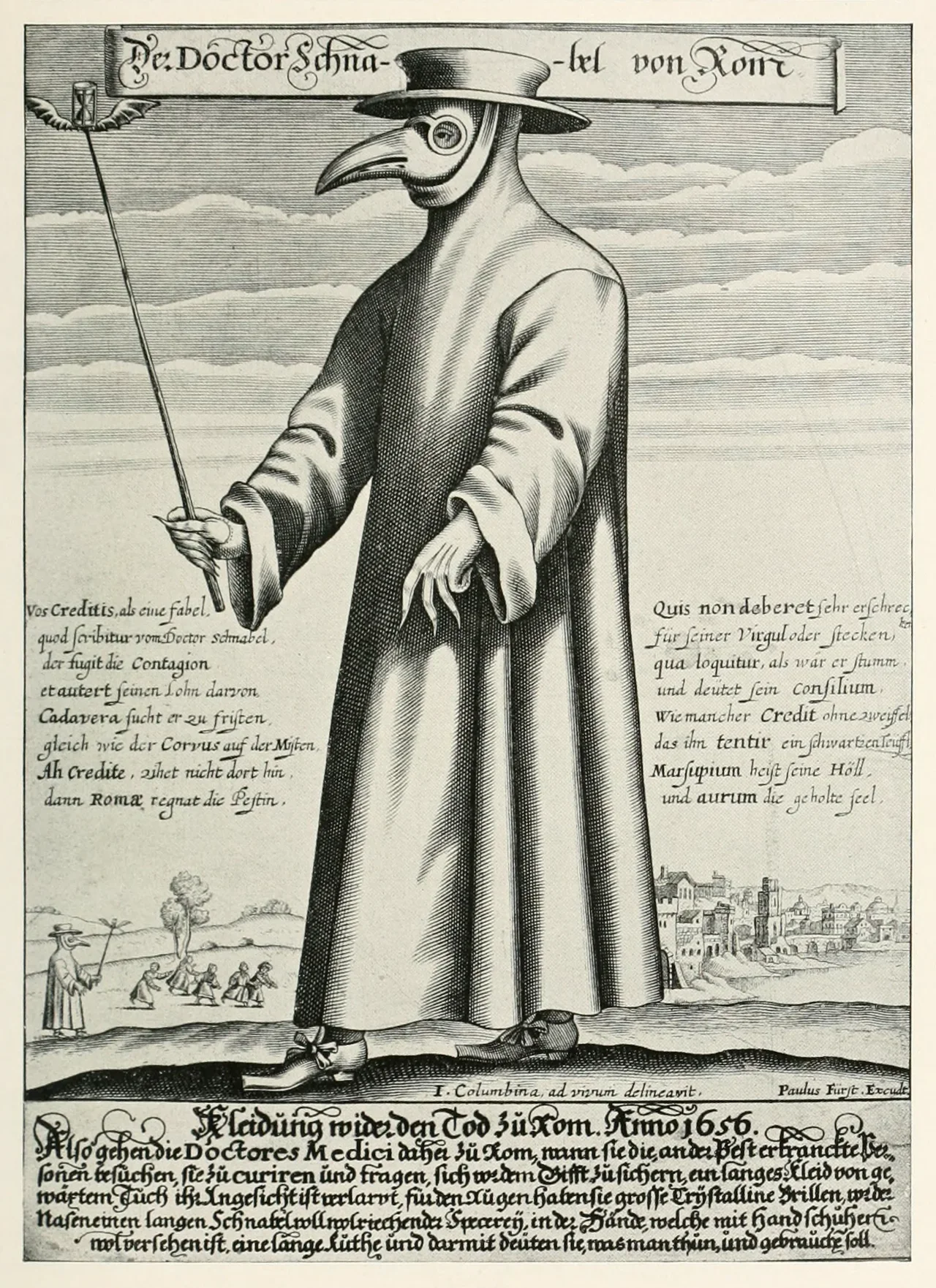
Plague has three clinical forms. The bubonic is the most familiar: the bite of a flea, the bacteria settle in the nearest lymph node (groin, armpit, neck), the node swells to the size of an egg and blackens — and this is the bubo. Without treatment mortality is 50—70 per cent; death comes in 4 to 7 days from sepsis. It was buboes that medieval doctors saw — and from them the disease took its name.
The pneumonic plague is the most terrible: the bacteria attack the lungs and the disease passes from person to person by airborne droplet, with no flea between. Mortality is about 100 per cent, the time from infection to death is two or three days. It is the pneumonic form that explains the speed of spread in the winter of 1347—1348, when fleas ought to have been dormant. The septicaemic plague is the fastest: the bacteria enter the blood directly, a man dies within 24 hours, the skin darkens from haemorrhages — and from this came the later popular name of the pestilence: "the Black Death."
Florence, March 1348: the Decameron begins
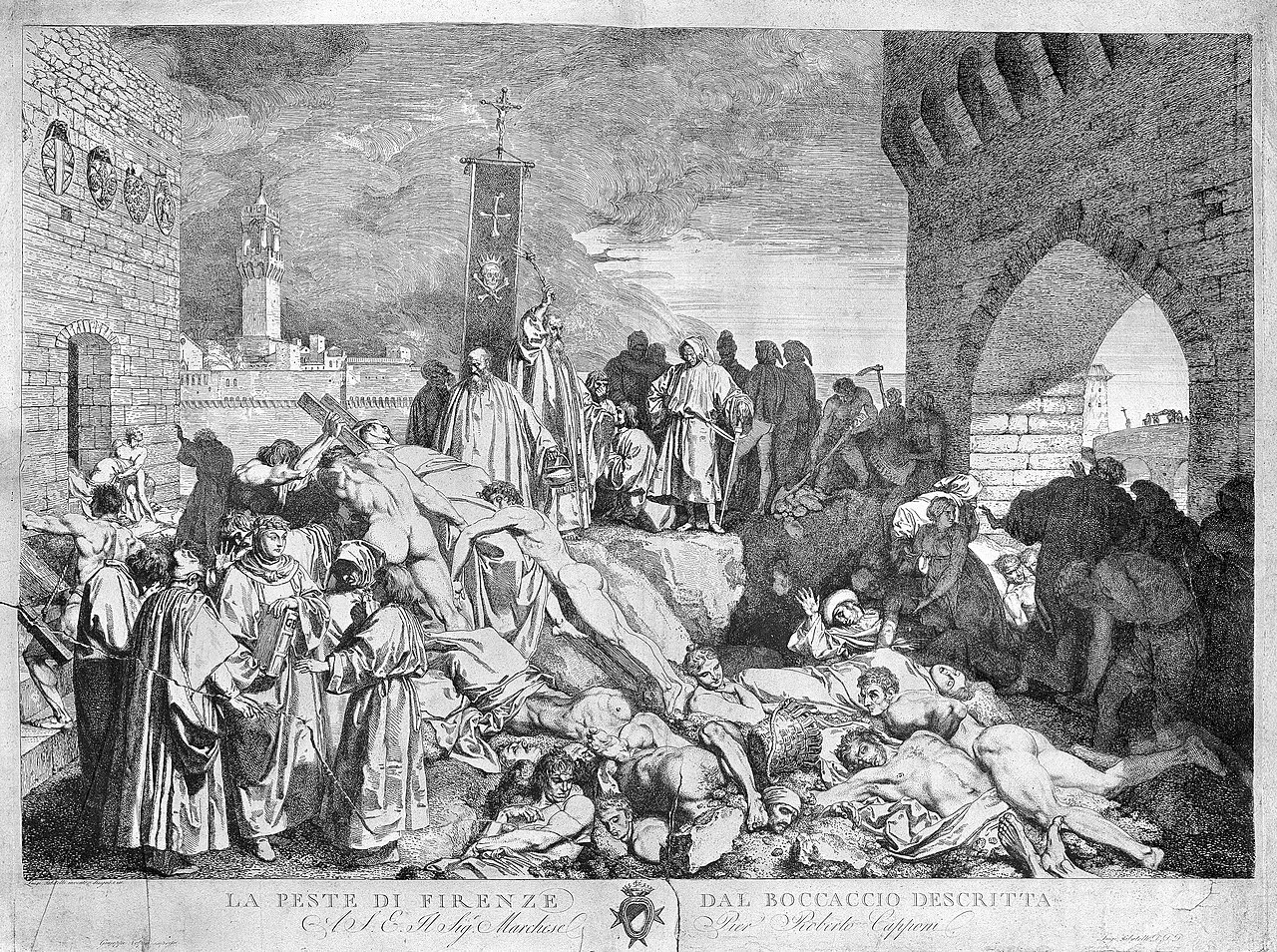
In March 1348 the plague entered Florence. By the summer a city of 100,000 had lost about 60,000 of its inhabitants — the highest mortality rate among the great European centres. The forty-year-old notary Giovanni Boccaccio buried his father and his stepmother and survived only because he had managed to flee to a villa beyond the walls.
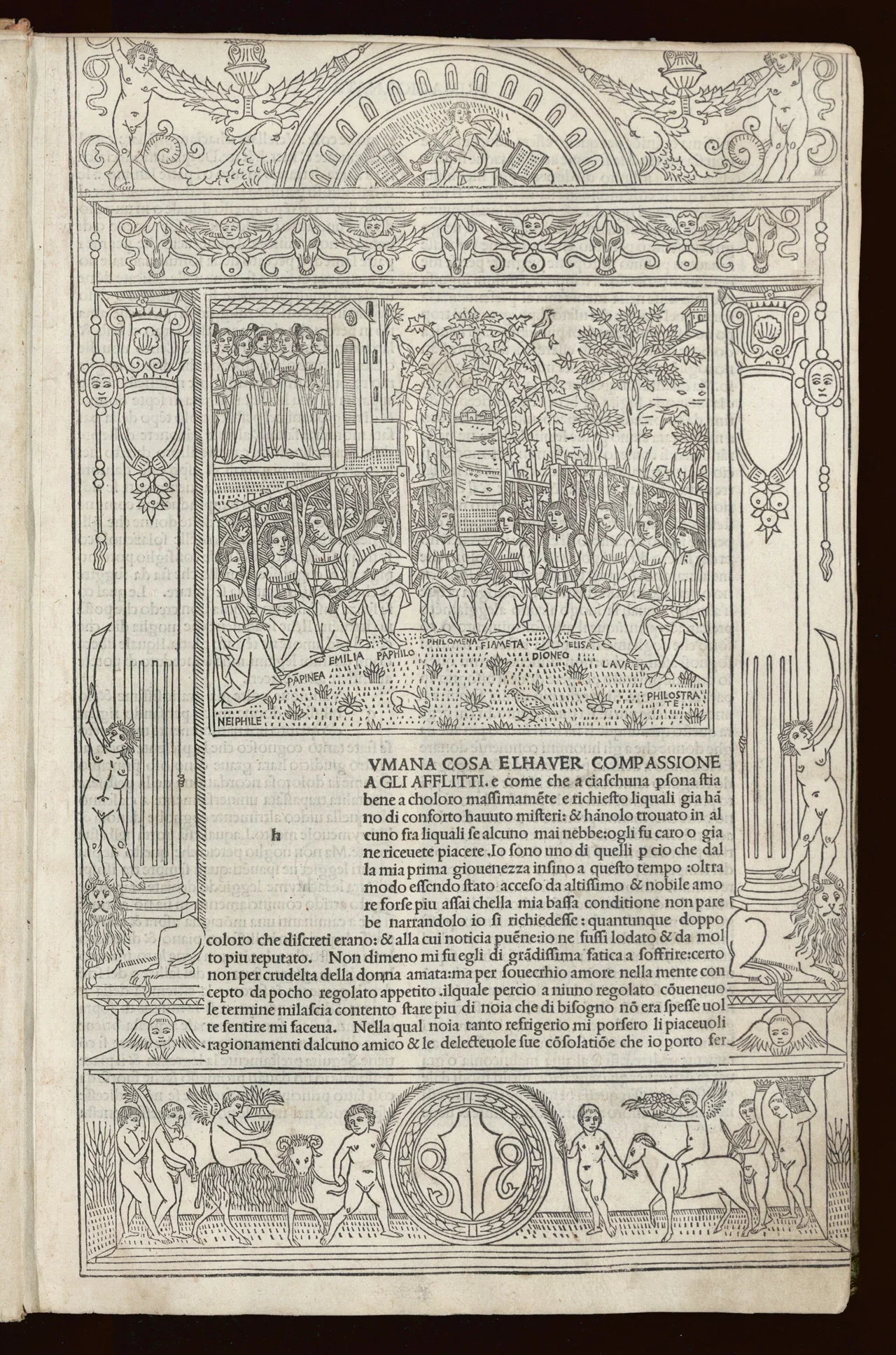
What Boccaccio saw in Florence he made the frame of his great work, the Decameron. Seven young women and three young men meet in the church of Santa Maria Novella, agree to leave the stricken city for a villa, and there, amidst gardens and fountains, tell one another a hundred stories in ten days. Boccaccio's preface is the most powerful description of a plague-stricken city in literature: parents abandoning children, wives abandoning husbands, the dead piled in heaps, and the living walking the streets as if drunk. European prose was born of this description.
Avignon 1348: the pope between two fires
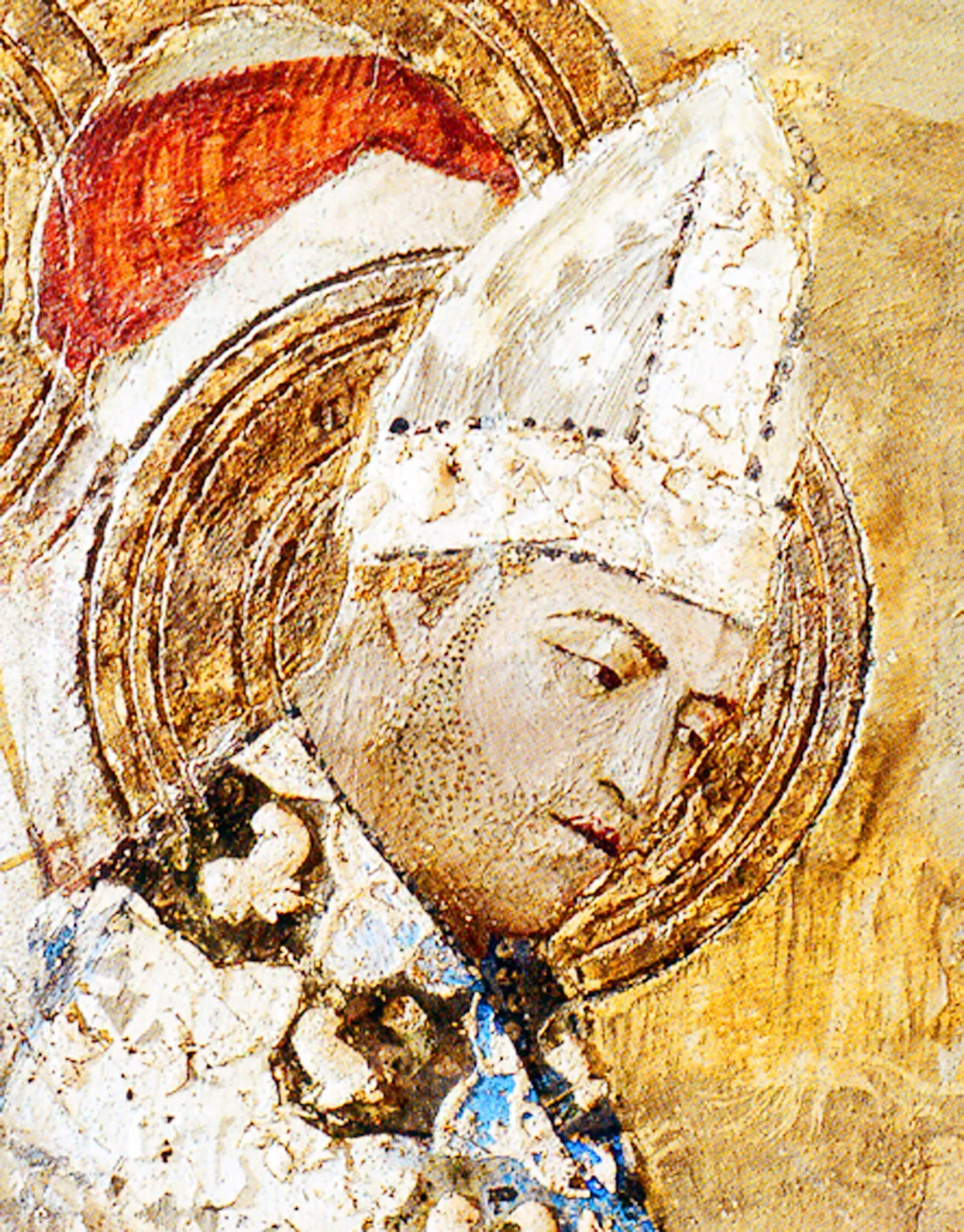
In January 1348 the plague reached Avignon — the seat of the papal throne in the time of the "Avignon captivity." Pope Clement VI found himself at the epicentre: in the small town that spring about half the population died, cardinals dying in their own palaces. The pope shut himself up in his castle and on the advice of his personal physician Guy de Chauliac — the most distinguished surgeon of the 14th century — ordered two fires to be lit on either side of him, between which he sat for days at a time.
Strangely enough, this primitive sanitary measure worked: the heat drove away the fleas. Clement VI survived the plague. The same Guy de Chauliac was the first to describe the clinical picture of the pestilence: "For the first two months it was a pneumonic plague, of which men died in three days; for the last four months it was bubonic, of which men died in five." This is the most accurate medical report of the entire age.
Paris 1348: the university looks for a cause
In the summer of 1348 the plague entered Paris. King Philippe VI ordered the medical faculty of the University of Paris — the most prestigious medical school in the Europe of the day — to carry out a scientific inquiry and explain the causes of the pestilence. In October 1348 the faculty issued an official report in which the cause was named as the conjunction of Saturn, Jupiter and Mars in the constellation of Aquarius on 20 March 1345.
According to Aristotelian medicine, this configuration had poisoned the air with "hot and humid vapours"; the air rose, settled on the fields and the wells, and penetrated the human body, upsetting the balance of the four humours. The treatment — bloodletting, purges, purification of the air with perfumes. None of it helped anyone. But the Paris report was accepted across Europe as official doctrine — and outlived the plague itself by nearly two hundred years.
London, autumn 1348: the death of Princess Joan
In the autumn of 1348 the plague crossed the English Channel. The first English port was Weymouth in Dorset; by November plague was in Bristol, by December in London. Edward III, the victor of Crécy only two years earlier, found himself powerless before a new enemy: in a winter every third Londoner was dead, and in the spring of 1349 the king ordered parliament to be closed.
To the king's personal grief was added the death of his beloved daughter — the fifteen-year-old Princess Joan of England. In August 1348 she had set out with a magnificent retinue through Bordeaux for Castile, where she was to marry Pedro the Cruel, the heir to the Castilian throne. The plague overtook her in the Gascon town of Loremo on 2 September 1348. Edward III wrote a letter of condolence to the bridegroom — a rare document of royal sorrow: "It seems that the Lord wished this princess for Himself."
Bergen 1349: the plague in the north
In May 1349 a storm drove an English ship into the Norwegian port of Bergen — the entire crew was dead. The local stevedores rushed to unload the cargo, not knowing that on the corpses lived hungry fleas. So the plague entered Scandinavia — and over the summer of 1349 rolled across the whole of Norway.
By the winter of 1349—1350 the Black Death was in Sweden, in Denmark, in Finland; by the summer of 1350 it reached Iceland and Greenland. Norway lost, by the estimates of modern historians, up to two thirds of its population — the highest mortality in Europe. The Greenland Vikings never recovered from the epidemic: their two colonies — the Western and the Eastern Settlements — slowly died out for another century, until in the 15th century their last inhabitants vanished for ever. So the plague set the final full stop to the age of the Vikings.
Flagellants 1349: whips and penitence
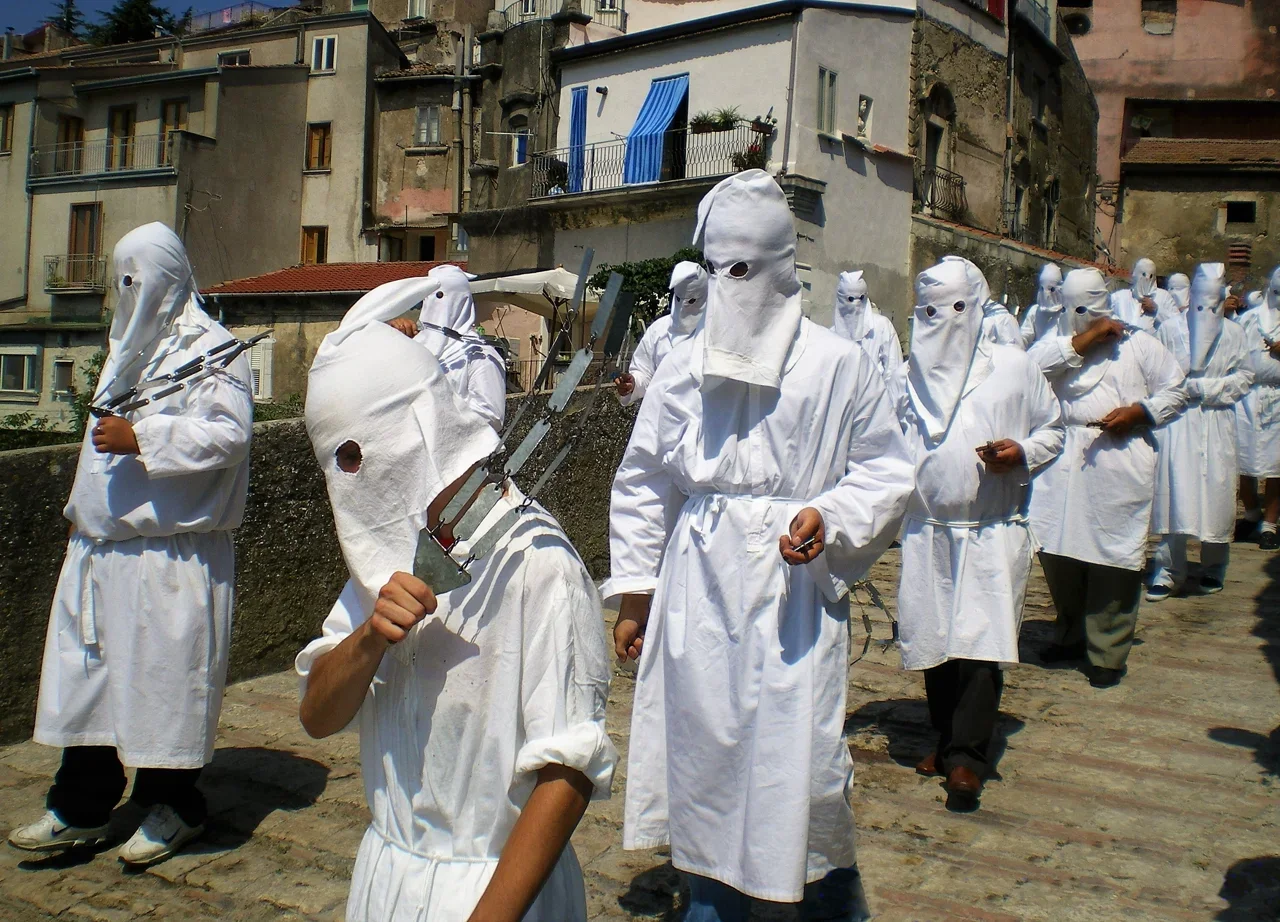
In the spring of 1349 in the Italian town of Perugia strange processions appeared: hundreds of men, stripped to the waist, walked through towns and villages, whipping each other with leather thongs into which iron spikes were sewn, and singing penitential hymns. These were the Flagellants (from Latin flagellum — a whip). The movement spread like wildfire: by the summer of 1349 it had crossed the Alps into the Rhine valley and into Flanders.
The logic of the Flagellants was simple: the plague was the wrath of God, and the only way to turn it aside was public penitence and self-mortification. The processions lasted 33 and a half days — a year for each year of Christ's life. Among the followers were people of every estate: peasants, craftsmen, monks, noblemen. Clement VI tolerated them at first, then was horrified: the movement was quickly turning into a heresy, the Flagellants proclaiming that priests were not needed and attacking churches. In October 1349 the pope, by his bull Inter sollicitudines, banned the movement — and it smouldered underground for another decade.
Strasbourg, 14 February 1349: a pogrom on Saint Valentine's Day
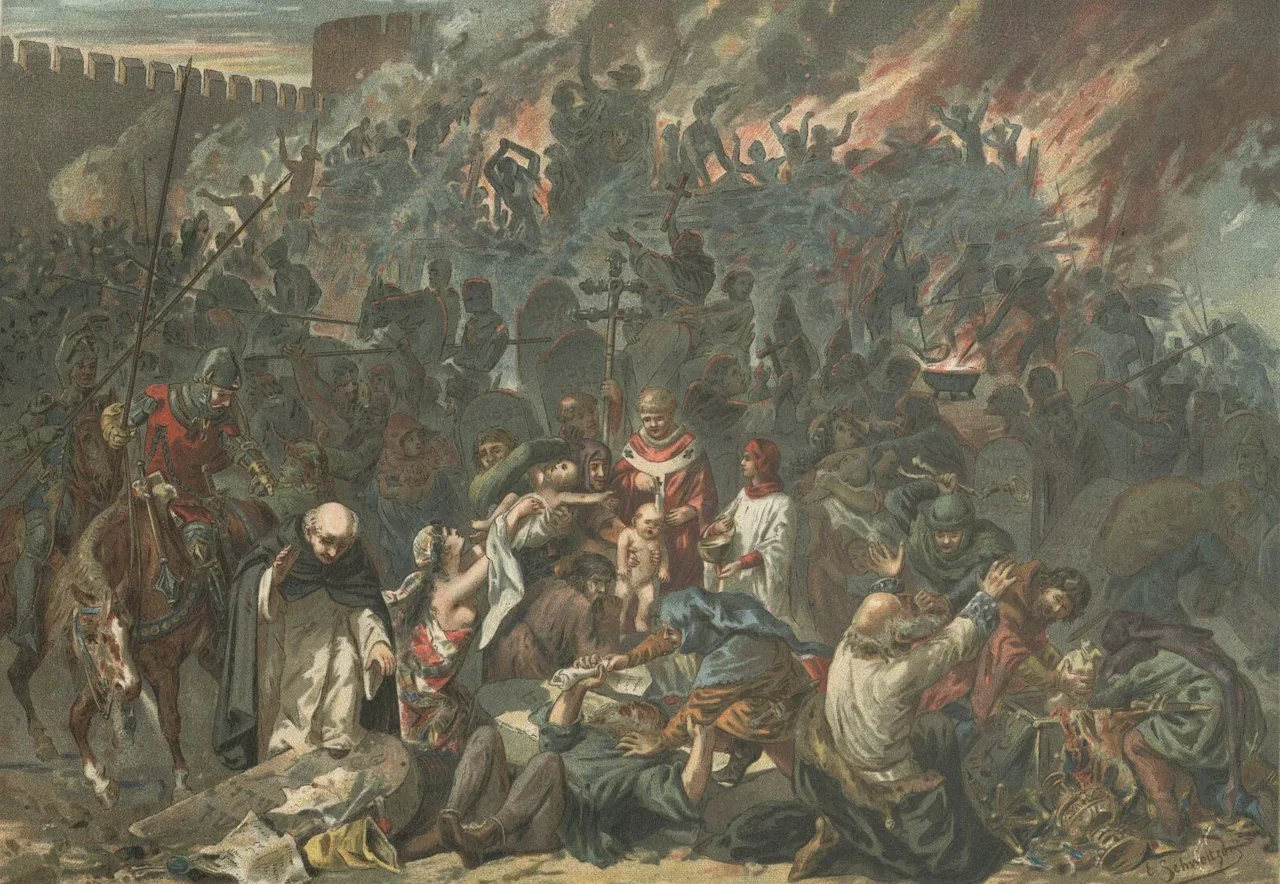
The plague was looking for someone to blame — and found one. Across Europe spread the libellous rumour: the Jews were poisoning the wells, and that was why the Christians were dying. At the castle of Chillon a Jew named Balavinus had a "confession" wrung out of him under torture in 1348; copies of the "confession" were sent out across the cities of the Rhine, Swabia and Alsace. In one place after another pogroms broke out: Basel, Freiburg, Colmar, Mainz, Cologne.
The bloodiest of all took place in the free imperial city of Strasbourg on 14 February 1349, on Saint Valentine's Day. The city council had at first defended the Jews, but a mob of artisans threw it down and elected a new one — and the new council gave its consent to the killing. Some two thousand Strasbourg Jews were led to the cemetery, set on a wooden platform and burned alive. Those who agreed to be baptised were spared. The property of the murdered was divided between the townsmen and Christian debtors.
Sicut Iudaeis non: the pope in defence of the Jews
Among all the rulers of Europe only one dared publicly to take the side of the Jews — that same Clement VI who sat between two fires at Avignon. In July 1348, even before the Strasbourg pogrom, he issued the bull "Sicut Iudaeis non" (from the opening: "As one must not do to the Jews..."), in which he straightforwardly named the accusations of well-poisoning a lie.
The arguments of Clement VI are a marvel of rationality in the 14th century: "The Jews die of the plague just as the Christians do. In the places where there are no Jews, men die just the same. It cannot be that this sickness comes from people, for it is the chastisement of God." The pope ordered Christians who killed Jews to be excommunicated; the burgomaster of Avignon under his protection received about a thousand refugees from the Rhine into the town. This is one of the most noble gestures of the Middle Ages — and the one story in which Clement VI stands in the full light of his faith.
Casimir III invites the Jews to Poland (1351)
While the Rhine cities were burning, in the east of Europe a contrary wave was gathering. The Polish king Casimir III the Great saw in the Jewish refugees a resource which Poland sorely lacked: merchants, craftsmen, financiers, physicians. In 1351 he issued a general privilege guaranteeing to Jews who came to Poland personal inviolability, freedom of worship, the right to their own courts and the self-government of their communities.
Over the next century and a half more than a hundred thousand Jews moved from the Rhine, Swabia, Bohemia and Austria into Poland and Lithuania. By the 16th century there lived in the Polish-Lithuanian lands the greatest Jewish community in the world — more than a million people. Here was born the culture which today we call Ashkenazi: the Yiddish language, Hasidism in the 18th century, the Lithuanian yeshivas, the Krakow gematria, the Lviv printing presses. All of this, in a sense, is the direct consequence of the Strasbourg bonfire — and of the Polish wisdom of Casimir.
1353: half of Europe in the ground
By 1353 the first wave of the Black Death had passed. Its last touches were Moscow, Novgorod and Pskov — which the plague reached through the Baltic and Belarus in 1351—1353. In Moscow, according to the Nikonian Chronicle, Metropolitan Theognostus and two sons of the Grand Prince Simeon the Proud died; and so did the prince himself.
The general balance: Europe lost from a third to a half of its population. The figures are dreadful even in relative terms: England, of 5 million — 2.5; Italy, of 11 — 5; France, of 16—17 — about 8. The worst hit were the towns (there were rats, crowding, trading routes) and the monasteries (closed communities died out wholesale and fast). Best off were the mountainous and isolated districts: the Swiss Alps, Poland, parts of Catalonia came through with relatively small losses. The economy of Europe lay in ruins.
Ibn al-Khatib: the first contagionist
On the other shore of the Mediterranean, in Muslim Granada, the court physician, poet and statesman Ibn al-Khatib (1313—1374) in his treatise "A convincing and decisive argument concerning the recurring and frequent plague," written about 1349, did what the University of Paris had proved incapable of doing: he denied the religious explanation of the epidemic.
"It can be observed," wrote Ibn al-Khatib, "that he who touches a man sick with plague dies; he who lives in the same house with him also dies. He who flees into the mountains and the deserts remains alive. In walled cities more die than in open ones. This means that the disease passes from man to man." This is the first developed theory of contagion in the history of medicine — five centuries before Pasteur. For this "heresy" Ibn al-Khatib was executed at Fez in Morocco in 1374. Europe did not learn of his work until the 19th century.
The Statute of Labourers 1351: an attempt to freeze time
The greatest unexpected consequence of the plague was economic: the death of half the workforce meant that there were half as many working hands — and the demand for them remained the same. Peasants and craftsmen for the first time gained leverage: they began demanding double and triple the old wages, moving from farm to farm, from town to town. The feudal system was caving in before men's eyes.
England was the first to react. In 1351 the parliament of Edward III passed the Statute of Labourers. The law forbade workers to demand wages higher than those before the war (the level of 1346); offenders — three days in the stocks. Sheriffs were given powers to catch peasants who had fled from their lords. The law did not work: labour was so scarce that the lords themselves secretly paid twice and three times as much. By the 1380s the tension exploded in the revolt of Wat Tyler. The economic law turned out to be stronger than the royal one.
Pestis secunda 1361—1363: the children's plague
The Black Death did not depart for ever. In 1361—1363 Europe was overtaken by a second wave — they called it pestis secunda, "the second plague." This time "only" 10—20 per cent of the population died, but with a disturbing peculiarity: among the dead children and the young preponderated sharply. Contemporaries called it the "children's plague" — la mortalité des enfants.
The explanation is simple: those who had lived through 1348 had acquired a partial immune memory; the generation born after 1348 had no protection at all. So began the pattern: plague outbreaks every 10—15 years, a cycle that lasted into the 18th century. In London the Great Plague of 1665 would kill another 100,000; the last great European outbreak would be at Marseille in 1720. The plague became a constant companion of European life for four and a half centuries.
The end of Western serfdom
And yet in the long run the Black Death did the peasant a great service. The economic law of supply and demand turned out to be stronger than the statutes: in fifty years after 1348 real wages in England doubled, and in Italy rose three- or fourfold. Peasants in great numbers bought themselves out of bondage or simply fled to the new towns, where after "a year and a day" of residence they became free.
By 1450 classical personal serfdom had practically disappeared in Western Europe — first in England, then in France, the Netherlands, northern Italy. The peasant became a free tenant; a labour market, a land market, the first signs of capitalism appeared. Many historians — from Henri Pirenne to David Herlihy — hold that it was the Black Death that cleared away the medieval economic building and laid the first bricks of what, five centuries later, would be the Industrial Revolution.
The Second Serfdom: the splitting of Europe
In the east of Europe history went in the opposite direction. While the western lands were freeing themselves, Poland, Hungary, Bohemia, Lithuania, Muscovy were taking the contrary road. The local magnates, seeing the gain from the export of grain to the hungry western market, began to tighten serfdom: in the 15th to 17th centuries the peasant in the east turned from a relatively free tenant into something close to a slave.
In Poland this was secured by the Statutes of Piotrków (1496) and Brest (1501); in Muscovy by the Sobornoye Ulozhenie of 1649. Western Europe got a labour market, the east got chattel serfdom; historians have called this the "Second Serfdom" (Zweite Leibeigenschaft). The line of demarcation ran roughly along the Elbe — and outlived every historical cataclysm, up to and including what the 20th century would call the "Iron Curtain." The socio-economic splitting of Europe into a West and an East is also, in the long view, the legacy of 1348.
Ragusa, 27 July 1377: the birth of quarantine
The first official quarantine in history was introduced by the small Dalmatian republic of Ragusa (modern Dubrovnik). In 1377, on 27 July, the city's great council passed a decree: "All those who come from plague-infected places shall not enter Ragusa or its district until they have spent a month on the island of Mrkan or in the town of Cavtat for purification."
A month — in Italian trentino, "thirty days." A few decades later the Venetians extended the term to forty — quaranta giorni — and from this came into all the languages of the world the word "quarantine." This is the first example of the state taking public health upon itself: before Ragusa in 1377 the plague was a matter for doctors and priests; after, it was a matter for administration, frontiers, documents. Modern public health begins here.
The revolt of Wat Tyler 1381: the peasants' reckoning
Thirty years of attempts to freeze wages bore their fruit. In May 1381 in the English counties of Essex and Kent the greatest peasant rising of medieval England broke out. The pretext was a new poll tax, but the real cause was the pent-up pressure of the post-plague generation under the statutes, which saw that the lords needed the grain but would not pay normally for it.
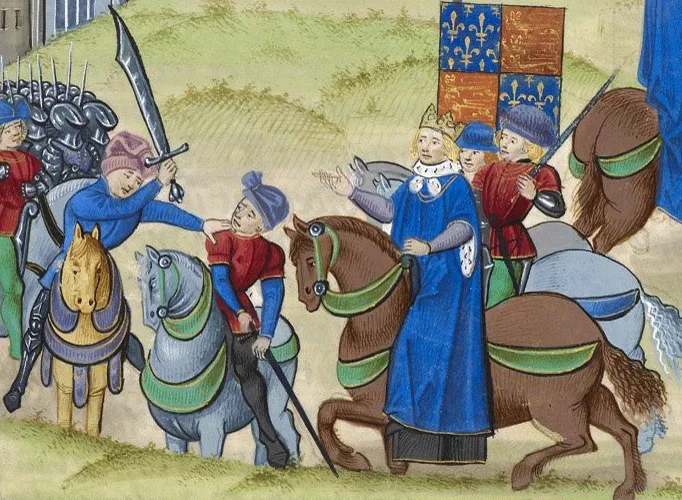
At the head of the revolt stood Wat Tyler, a soldier from Kent. In June 1381 some 60,000 peasants entered London, burned John of Gaunt's palace, opened the prisons, beheaded the Lord Chancellor and the Archbishop of Canterbury. The young Richard II, fourteen years old, rode out to parley at Smithfield; during the conversation the Mayor of London with his own hand stabbed Tyler. But the king had already had time to promise the peasants the abolition of serfdom — a promise which afterwards, of course, he revoked. The mere fact that the king spoke with peasants as with equals was unprecedented. The old world was dead.
The Decameron: a hundred stories in ten days
Meanwhile in Florence between 1349 and 1351 Boccaccio finished the Decameron — the greatest literary monument of the age. Seven women and three men, fleeing the plague to a villa beyond the walls, agreed: each would tell one tale a day for ten days. A hundred novellas. Each day is led under a "king" or "queen" of the day, the themes set in advance.
The subjects: merchants who cheat, monks who betray, wives who find lovers, peasants who turn out to be cleverer than their lords. Unlike Dante's "Divine Comedy," written ten years earlier, in Boccaccio there is no God — only living people, with their passions and their cunning. This is the birth of European secular literature; thirty years later Chaucer would write the "Canterbury Tales," directly borrowing the form. All the novelistic tradition from Cervantes to Maupassant traces its descent from here.
The Dance of Death: Cimetière des Innocents 1424
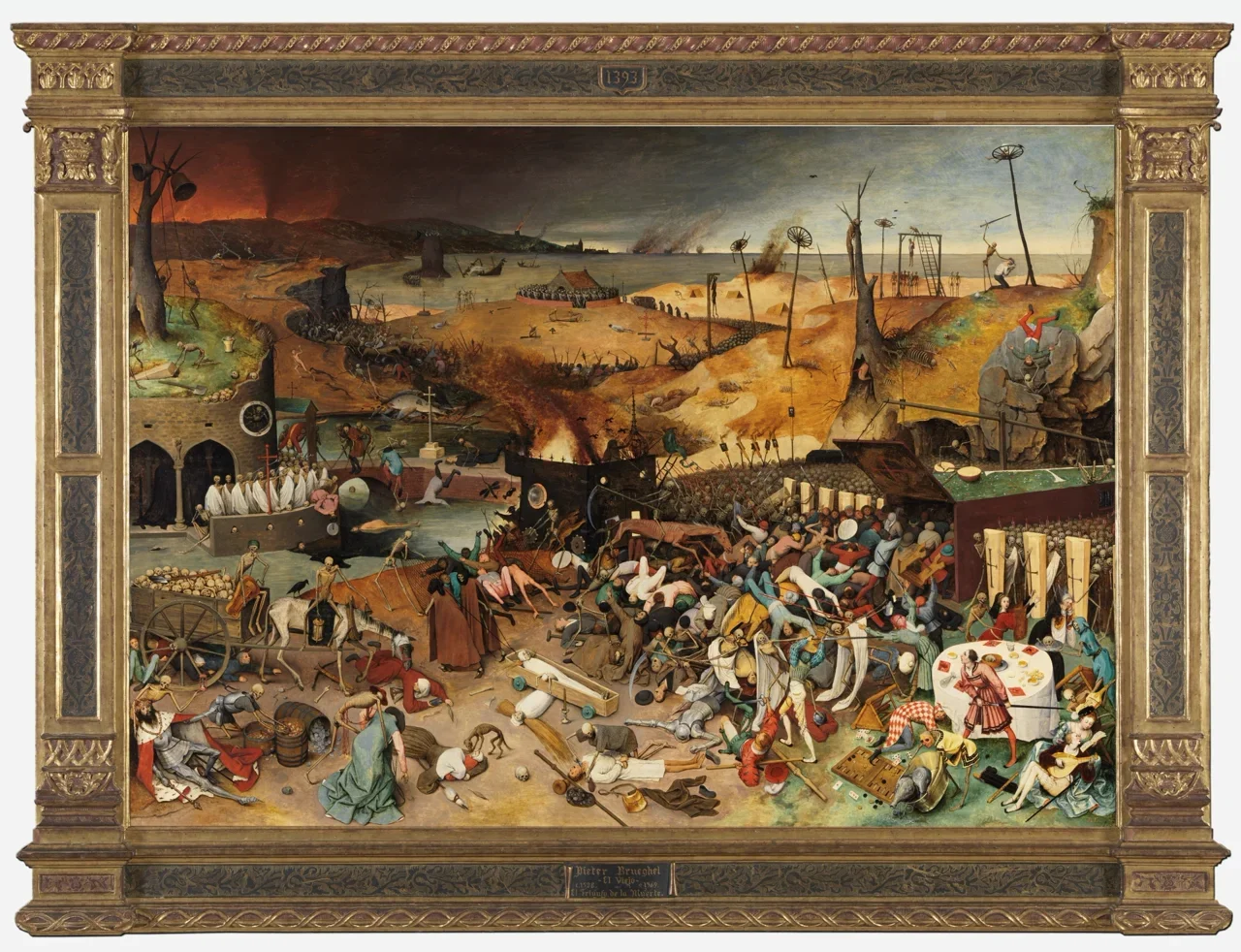
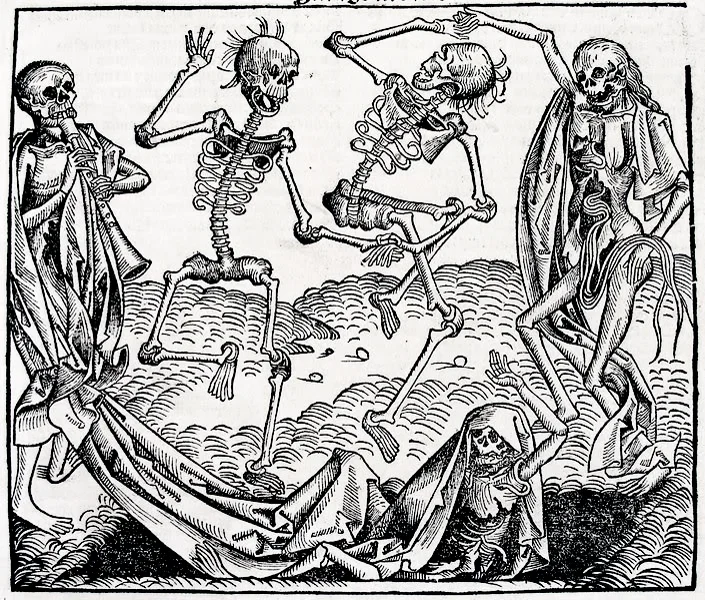
The plague gave birth also to a new iconography. In 1424—1425 on the walls of the Parisian cemetery of the Cimetière des Innocents there appeared frescoes depicting the "Dance of Death" — Danse Macabre. Skeletons lead by the hand the pope, the emperor, the cardinal, the knight, the peasant, the child; all are equal before death, all dance to its rhythm in the same measure.
The theme spread like lightning through Europe: frescoes at Lübeck, Basel, Ljubljana, Berne; the entire series of woodcuts by Hans Holbein the Younger of 1538 remains the summit of the genre. Memento mori — "remember death" — became the chief device of the 15th and 16th centuries; the recurring plague wrote death into the most everyday experience as no culture had known it before. The Baroque aesthetic with its skulls in still lifes, Jesuit pedagogy with its meditation on death, and at last the whole European philosophy of mortality, from Montaigne to Heidegger — all this grows out of the frescoes of the Holy Innocents.
"The Black Death": a name that came later
The name "Black Death" itself did not exist at the time. Contemporaries in the 14th century called the pestilence simply magna mortalitas — "the great mortality," or pestis, or pestilencia magna. The French said la grande peste, the Italians la pestilenza, the English simply the great mortality or the pestilence.
The term "atra mors" — "black death" in Latin — was introduced by the Danish chronicler Johannes Pontanus in his book "Rerum Danicarum Historia" in 1631, 280 years after the events. In English "the Black Death" was first used in 1755 by a British lexicographer; it entered general use only in the 19th century. The colour here is not from the dark blotches on the skin of septicaemic patients, as is often thought, but from the Latin figurative sense of atra — "dreadful, terrible, ill-omened." So the pestilence got a name worthy of its scale — but with a delay of nearly three centuries.
The crisis of the Church: the seeds of the Reformation
One of the groups that suffered most was the clergy. Priests went to the dying to confess them; monks lived in cramped monasteries where the plague mowed them all down within a week. In some English dioceses the clergy died at 40—50 per cent — twice the average rate. By 1349 there were already not enough priests; bishops ordained illiterate candidates — anyone, just to fill the parishes.
The quality of the Church fell catastrophically. Contemporaries began to see: priests fleeing the plague-stricken towns, not confessing the dying, selling indulgences for indifferent money. The authority of Rome, already shaken in the Avignon captivity, now truly cracked. Within decades there were born John Wycliffe in England and Jan Hus in Bohemia — the first great reformers to put the very system in question. Luther in 1517 would come onto an already cleared field. The Black Death did not destroy the Church — but it tore from it its moral monopoly.
The legacy of the Black Death
Six decades of catastrophe left civilisation a legacy which we are still living through. Modern epidemiology begins with the Ragusan quarantine of 1377; modern medicine with the discovery of Yersin in 1894; modern public health with the Venetian lazarettos. The words by which we describe pandemics — "quarantine," "isolation," "cordon sanitaire" — were born in answer to the Black Death.
But the deeper legacy is in the structure of European society. The end of serfdom in the west, the labour market, the early forms of capitalism, the secular literature of Boccaccio, the picture of death in Holbein, the pre-Reformation movements of Wycliffe and Hus, the Jewish migration into Poland — all these are branches of a single trunk cut in 1348. If medieval Europe died of any one death, it was the Black Death. What rose from its ashes is the world in which we live. Six decades that buried half of Europe laid the foundation of the entire modern age.