Six years that consumed roughly 70 to 85 million lives and redrew the world. The war was fought on three continents and across every ocean — from Narvik in Norway to Leyte in the Philippines, from the Egyptian desert to the war plants of the Urals. It began with the German invasion of Poland on September 1, 1939, and ended with Japan's surrender aboard the battleship USS Missouri on September 2, 1945. In between came the Holocaust, the atomic bomb, the end of Europe's empires, and the rise of the bipolar US—Soviet world that would shape the next half-century.
Who fought whom
The Allies. Britain and its Dominions (Canada, Australia, New Zealand, South Africa, India) — at war from day one. France until June 1940, after which the Resistance and Charles de Gaulle's Free French carried on the fight. The Soviet Union joined after Germany invaded in June 1941, and the United States after Pearl Harbor in December 1941. Add Poland, Norway, Greece, Yugoslavia, China (already at war with Japan since 1937), and later Brazil and dozens of others. The "Big Three" leaders: Franklin D. Roosevelt, Winston Churchill, and Joseph Stalin.
The Axis powers. Nazi Germany under Adolf Hitler, Fascist Italy under Benito Mussolini, and Imperial Japan (nominally under Emperor Hirohito, in practice under a military government). Satellites and co-belligerents: Hungary, Romania, Bulgaria, Finland (which fought a separate "Continuation War" against the USSR), Slovakia, Croatia, Vichy France, and Thailand. The Axis was never a unified bloc — its three main partners coordinated poorly and never fought as a single army.
Phases of World War II
World War II was really several wars that fused into one. We will divide it into five phases. Blitzkrieg (1939—1940): Germany overruns Poland, Scandinavia, and France in a matter of weeks. Globalization (1941—1942): the invasion of the USSR, Pearl Harbor, and Japan's Pacific blitz turn the war global. The Turning Point (1942—1943): Midway, El Alamein, Stalingrad, and Kursk shift the strategic initiative to the Allies. The Allied Offensive (1944): D-Day in Normandy, Operation Bagration in Belarus, and the American return to the Philippines. Surrender of the Axis (1945): Berlin, Hiroshima, Nagasaki, and the USS Missouri. A short epilogue on the consequences follows.
September 1, 1939: the invasion of Poland
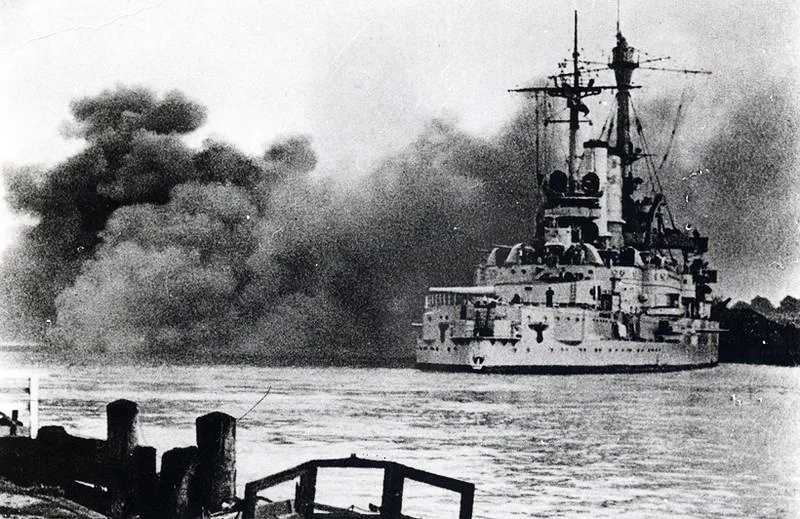
At 4:45 a.m. on September 1, 1939, the German battleship Schleswig-Holstein opened fire on the Polish garrison at Westerplatte, in Danzig. At the same moment some 1.5 million German troops, 2,700 tanks, and 2,000 aircraft poured across the border. It was the first demonstration of Blitzkrieg — coordinated armored thrusts, air power, and motorized infantry. The Polish army, still largely infantry and cavalry, had no answer.
On September 2, Britain and France issued an ultimatum; on September 3, they declared war. On September 17, 1939, the Red Army crossed Poland's eastern border under the secret protocol of the Molotov—Ribbentrop Pact (August 23, 1939), by which Hitler and Stalin had carved up Eastern Europe. Poland fell by early October. Its government fled to London and led the resistance from exile. In the occupied territories, ghettos went up, and the educated class was systematically murdered (Operation Tannenberg, and at Katyn in 1940).
The Phoney War — Sitzkrieg
Britain and France had declared war, but they were not actually fighting. From September 1939 until May 1940 the Western Front went quiet — the Allies sat behind the Maginot Line, the Germans behind the West Wall. French soldiers played cards; British planes dropped leaflets. The Germans called it Sitzkrieg ("sitting war"), the British Phoney War, the French drôle de guerre ("strange war").
Paris and London were thinking defensively: repeat the strategy of the First World War and grind Germany down with a blockade. Berlin's logic was the opposite — buy time, redeploy from Poland, and strike in the spring. It was a strategic blunder: the same Blitzkrieg that had destroyed Poland in three weeks would, eight months later, destroy France too.
Denmark, Norway, Dunkirk
On April 9, 1940, Germany invaded neutral Denmark and Norway without warning. Denmark surrendered within a day. In Norway the fighting lasted two months; British and French expeditionary forces landed at Narvik but were evacuated in June. Hitler's aim was to keep Swedish iron ore flowing through Norwegian ports and to deny Britain the North Atlantic.
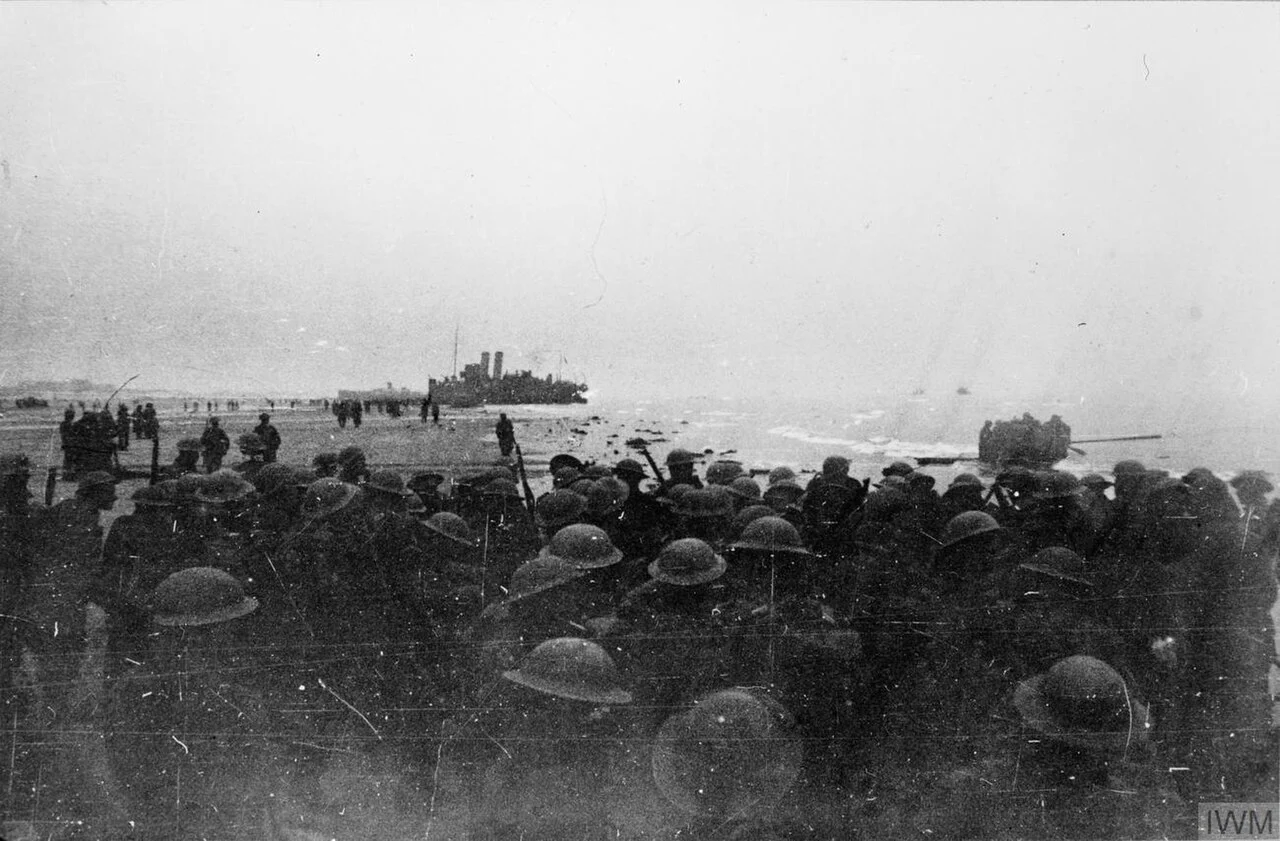
On May 10, 1940, the Wehrmacht struck west — through Belgium, the Netherlands, and, decisively, through the Ardennes, where the French had not expected armor. In ten days the German spearheads reached the Channel and cut the Allied armies in the north in two. Between May 26 and June 4, 1940, Operation Dynamo evacuated some 338,000 soldiers from the beaches of Dunkirk aboard hundreds of warships and civilian boats. Most of the equipment was left behind. It was a catastrophe — one Churchill turned into a national legend.
The fall of France
After Dunkirk the German armies wheeled south. On June 14, 1940, the Wehrmacht entered Paris without a fight — the government had declared it an "open city" to spare it. On June 22, 1940, in the Forest of Compiègne — in the very railway carriage where Germany had signed its 1918 surrender — Marshal Philippe Pétain signed an armistice with Hitler. France had fallen in six weeks.
The country was split: the north and Atlantic coast were under direct German occupation; the south became the collaborationist Vichy regime under Pétain. In London on June 18, 1940, Brigadier General Charles de Gaulle went on the BBC: France had lost a battle, but not the war. That broadcast launched the Free French, who would keep fighting — in Africa, in Syria, and eventually back inside France alongside the domestic Resistance (Résistance).
The Battle of Britain
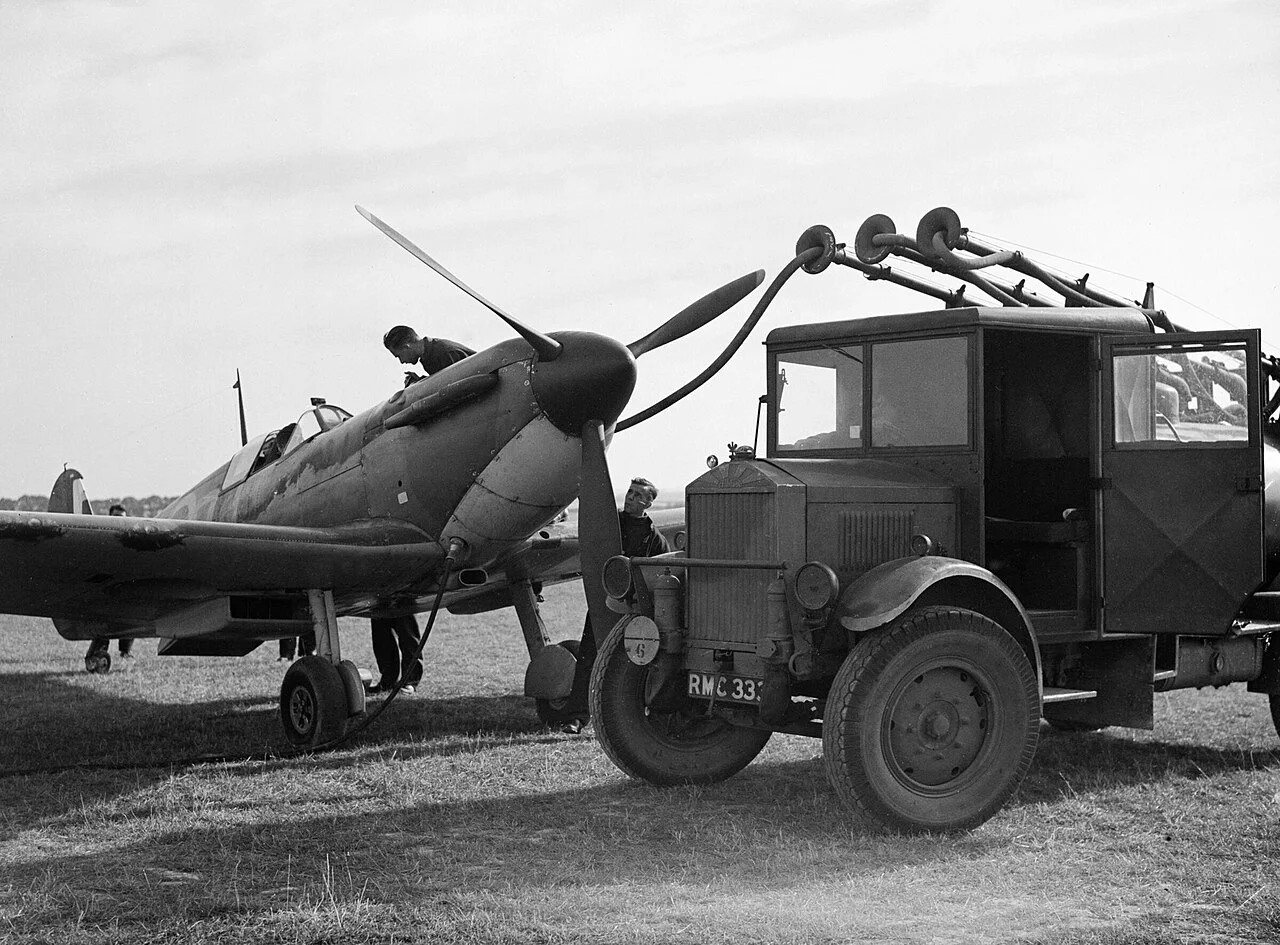
From June 1940, Britain stood alone. Hitler planned an invasion — Operation Sea Lion — but first the Luftwaffe had to destroy the Royal Air Force so that German barges could cross the Channel. From July to October 1940, the Battle of Britain raged over southern England: roughly 2,500 RAF pilots — including Poles, Czechs, and Canadians — flying Spitfires and Hurricanes against a far larger Luftwaffe.
The RAF had two advantages: the Chain Home radar network and a centralized fighter-control system. In the fall, Hitler shifted his bombers to London and other cities, beginning the Blitz, which lasted until May 1941 and killed about 40,000 civilians. Britain held. Sea Lion was indefinitely postponed. Churchill on the pilots: "Never in the field of human conflict was so much owed by so many to so few."
The Balkans, Greece, and Yugoslavia
In the autumn of 1940, Mussolini attacked Greece from Albania — and was humiliated. The Italians retreated; the Greeks even pushed into southern Albania. Hitler had to bail his ally out. In April 1941 the Wehrmacht struck through the Balkans: Yugoslavia capitulated in 11 days, Greece in three weeks. British expeditionary forces were evacuated to Crete, but Crete fell in May 1941 after an unprecedented airborne assault. The Germans lost so many paratroopers that Hitler never again attempted a large airborne operation.
The Balkan campaign was lightning-fast, but it pushed Operation Barbarossa back by five weeks — from mid-May to June 22. Those five weeks would prove decisive outside Moscow at the end of the year. In Yugoslavia, the communist Josip Broz Tito would launch a partisan war — the most effective resistance in occupied Europe.
Barbarossa: June 22, 1941
At 3:15 a.m. on June 22, 1941, more than 3 million German and Axis soldiers, 3,600 tanks, and 2,700 aircraft crossed the Soviet border. Operation Barbarossa was the largest invasion in history. Hitler expected to destroy the USSR in 8 to 10 weeks, before winter, using Blitzkrieg. Stalin had been warned by British intelligence and by Soviet spies in Japan and Switzerland, and he ignored them all.
The first month was a catastrophe for the Red Army: encirclements at Minsk, Białystok, Kyiv (September — about 600,000 prisoners, the largest pocket in history), and Vyazma. By November the Wehrmacht stood thirty kilometers from Moscow and could see the Kremlin spires through binoculars. In the occupied territories the Nazis put Generalplan Ost into effect: the extermination of the Jews (mass shootings by Einsatzgruppen — Babi Yar in Kyiv, September 29—30, 1941, more than 33,000 killed in two days), the deliberate starvation of Soviet POWs (about 3 million died in German camps), and plans to colonize the Slavic east with German settlers.
The Battle of Moscow
By November 1941 the Wehrmacht was spent. The roads had turned to mud in the autumn rains (the rasputitsa), and then the temperature crashed to —30°C: German soldiers in summer greatcoats, tank engines that would not start, weapon oil that froze solid. Stalin shifted fresh Siberian divisions west from the Far East after Soviet spy Richard Sorge, in Tokyo, confirmed that Japan would not attack the USSR.
On December 5, 1941, the Red Army, commanded by Marshal Georgy Zhukov, launched its counteroffensive outside Moscow. For the first time in the war the Wehrmacht fell back. By early 1942 the Germans had been pushed back 100 to 250 kilometers. The Blitzkrieg had failed. What lay ahead was a long war of attrition that Germany was not built to win. Hitler promptly fired several generals and took personal command of the army.
Pearl Harbor and the entry of the United States
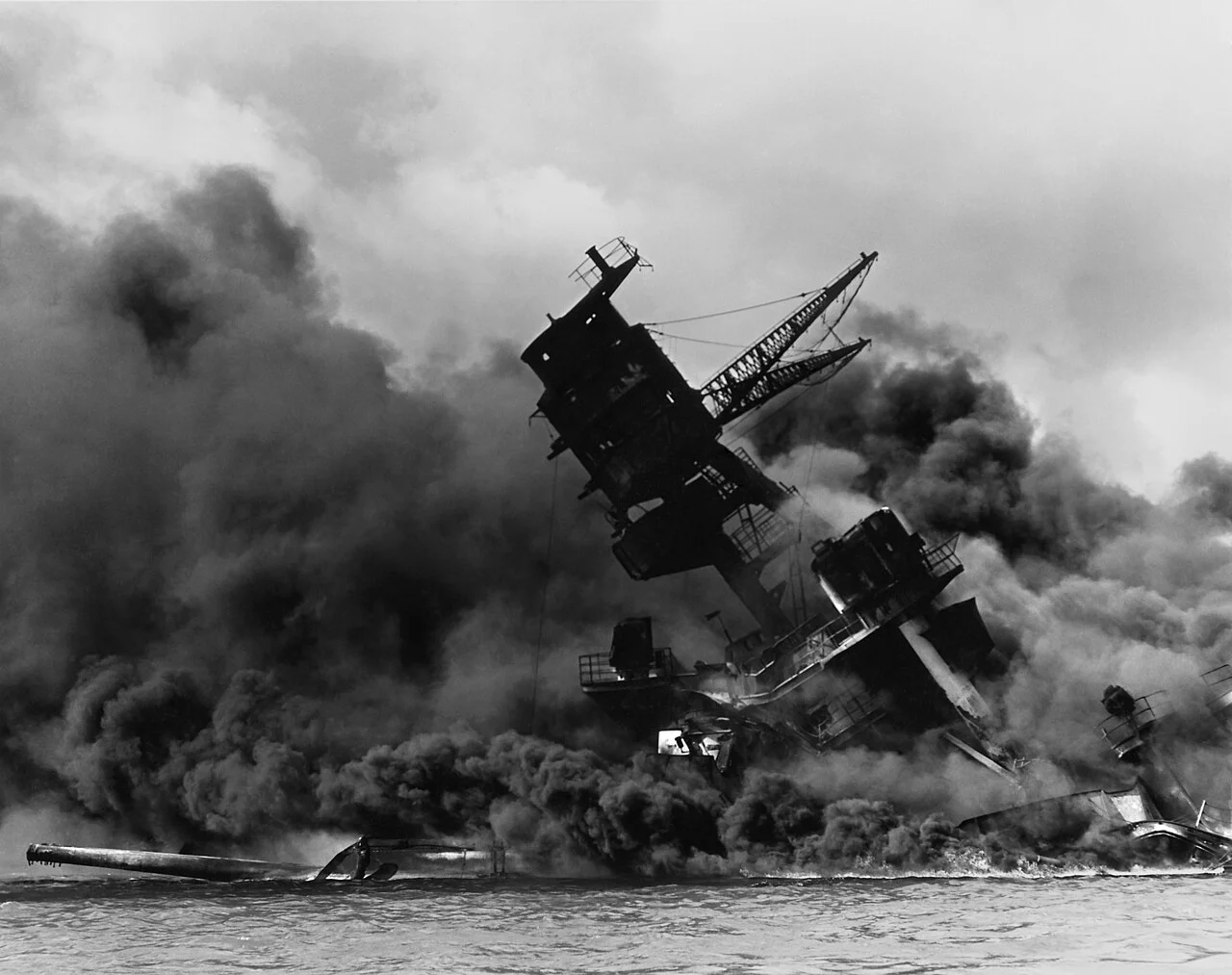
At 7:48 a.m. on December 7, 1941, 353 Japanese aircraft launched from six carriers struck the U.S. Pacific Fleet at Pearl Harbor, Hawaii. Three hours later, eight American battleships were damaged or sunk and more than 2,400 men were dead. Japan was betting on a quick win: cripple the U.S. fleet in one stroke, seize the oil fields of the Dutch East Indies, and lock in the resources to fight a long war.
It was a strategic miscalculation. The next day, President Franklin D. Roosevelt went before Congress and called December 7 "a date which will live in infamy". The United States declared war on Japan. On December 11, 1941, Hitler — out of treaty obligation and his own arrogance — declared war on the United States. It was the worst strategic decision of his career. The war was no longer European. American industrial capacity — roughly equal to Germany's and Japan's combined — was now switched on against the Axis.
Japan's Pacific blitz
In the six months after Pearl Harbor, Japan built the largest empire in its history. December 1941—January 1942: Hong Kong, Guam, and Wake captured. February 15, 1942: the fall of Singapore — Britain's "impregnable fortress" surrendered to an 80,000-strong Japanese force in a week. It was the worst defeat in British military history. May 1942: General Douglas MacArthur was evacuated from the Philippines with the line "I shall return"; 76,000 American and Filipino soldiers surrendered and were forced through the Bataan Death March — a 100-kilometer trek under blazing sun, with no water or food, that killed thousands.
The Japanese took Burma, Malaya, and the Dutch East Indies (today's Indonesia), and they pressed toward Australia and India. They seemed unstoppable. But the technology of war had changed: in the Pacific, the decisive weapon was not the battleship but the aircraft carrier — and Japan no longer had a carrier advantage.
Midway: June 1942
From June 4 to 7, 1942, near Midway Atoll in the central Pacific, the U.S. Navy met Admiral Nagumo's Japanese carrier strike force. Admiral Chester Nimitz held a decisive advantage: American codebreakers had cracked the Japanese naval code JN-25, so the U.S. knew when and where the blow would fall.
The battle lasted four days. Japan lost four carriers out of its six best, more than 250 aircraft, and the core of its veteran airmen. The Americans lost one carrier (USS Yorktown). It was a strategic catastrophe Japan never recovered from — it would never again hold the initiative in the Pacific. Midway was the turning point of the Pacific war, a Stalingrad equivalent six months earlier than the one on the Eastern Front.
El Alamein
In North Africa, the German-Italian Afrika Korps under General Erwin Rommel (the "Desert Fox") had been pushing the British back toward Egypt and the Suez Canal since 1941. By the summer of 1942, Rommel was within 100 kilometers of Alexandria — one more victory, and the British Empire's main artery would be cut.
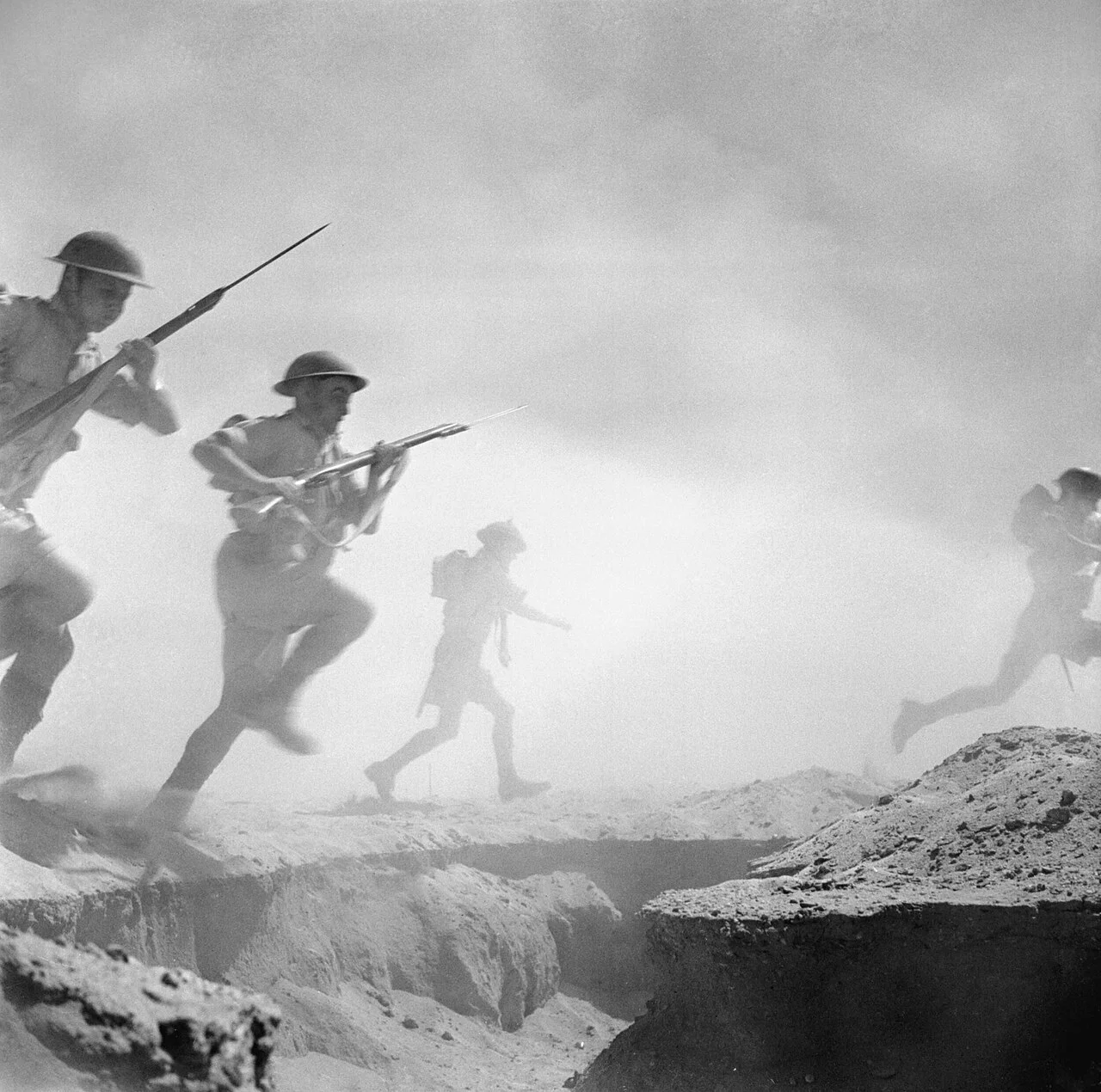
In August 1942, General Bernard Montgomery took command of the British Eighth Army. He prepared methodically: men, tanks, and artillery, until he had a 2-to-1 edge. The Second Battle of El Alamein (October 23 — November 11, 1942) lasted 20 days. The British broke the German-Italian line and drove Rommel west. On November 8, Americans landed in Morocco and Algeria (Operation Torch). The Afrika Korps was caught in a vise and surrendered in Tunisia in May 1943. Churchill on El Alamein: "This is not the end. It is not even the beginning of the end. But it is, perhaps, the end of the beginning."
Stalingrad
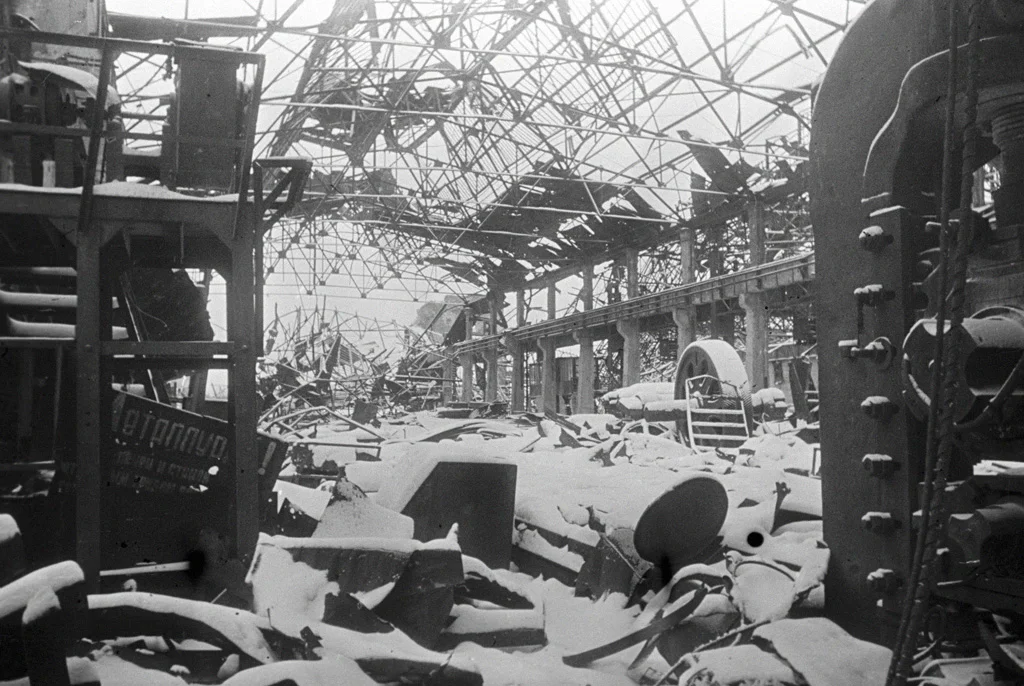
In the summer of 1942, Hitler struck south — for the oil of the Caucasus and the Volga. The city of Stalingrad (today Volgograd) sat at the tip of the German advance and took on symbolic weight. The Battle of Stalingrad lasted from July 17, 1942 to February 2, 1943. In August 1942, General Friedrich Paulus's Sixth Army entered the city. What followed was six months of hell — fighting for every building and every floor, in the ruins of the tractor plant and the grain elevator. Soviet snipers (Vasily Zaitsev), assault groups, and nighttime attacks ground the Germans down.
On November 19, 1942, the Red Army launched Operation Uranus: two armored thrusts encircled the Sixth Army inside the city. Hitler forbade any retreat. General Manstein's relief attempt failed. On February 2, 1943, the remnants of the Sixth Army — around 91,000 men under Field Marshal Paulus (Hitler had promoted him the day before, hinting that field marshals do not surrender) — gave up. Combined losses at Stalingrad topped one million on both sides. It was the strategic turn of the Eastern Front: the Wehrmacht would never again attack along its entire length.
Kursk: the largest tank battle
Summer 1943. Near the city of Kursk a large salient — a bulge — had formed in the Soviet-German front. Hitler planned Operation Citadel: pinch off the salient with attacks from the north and south, encircle the Soviet armies inside, and recover the strategic initiative. Soviet command knew the plan through intelligence — including the Cambridge Five in London — and built a defense in depth: minefields, antitank ditches, and layered positions.
The battle ran from July 5 to August 23, 1943. The most famous moment was the tank engagement at Prokhorovka on July 12, 1943, with hundreds of tanks on each side. It is the largest meeting tank battle in history; the exact numbers, somewhere between 600 and 1,200 vehicles total, are still debated. Citadel failed. After Kursk the Wehrmacht launched no further strategic offensives in the East — only defensive battles and a steady retreat westward.
Sicily and the fall of Mussolini
On July 10, 1943, the Allies landed in Sicily (Operation Husky). In 38 days, American and British forces under Eisenhower, Patton, and Montgomery took the island. In Rome it triggered a political collapse: on July 25, 1943, the Grand Council of Fascism deposed Mussolini, and King Victor Emmanuel III asked Marshal Badoglio to form a new government. Mussolini was arrested and held in a hotel high in the Apennines.
On September 3, 1943, the new Italian government secretly signed an armistice with the Allies. The Germans immediately occupied the upper half of Italy. In September 1943, an SS commando under Otto Skorzeny freed Mussolini from a mountain road — and he was installed at the head of the puppet Italian Social Republic in the north. Fighting in Italy would drag on for another year and a half — a slow Allied grind up the spine of the country through Monte Cassino, Anzio, and finally to Rome, which fell on June 4, 1944.
The Tehran Conference
From November 28 to December 1, 1943, the leaders of the Big Three — Roosevelt, Churchill, and Stalin — met in the Iranian capital. It was the first time the three had ever met in person. Tehran was a compromise location: Stalin refused to fly farther, citing his health and the security of his cipher communications.
The key decision: open a second front in Western Europe in the spring of 1944 — something Stalin had been demanding since 1941. The Allies agreed, and the plan was christened Operation Overlord. In return, Stalin pledged to enter the war against Japan after Germany surrendered. The leaders also discussed Poland's future borders (to be shifted westward at Germany's expense) and a future international security organization (the future UN). Tehran did more than reshape the war — it began to set the postwar order, in which the USSR would inherit Eastern Europe.
D-Day: Normandy, June 6, 1944
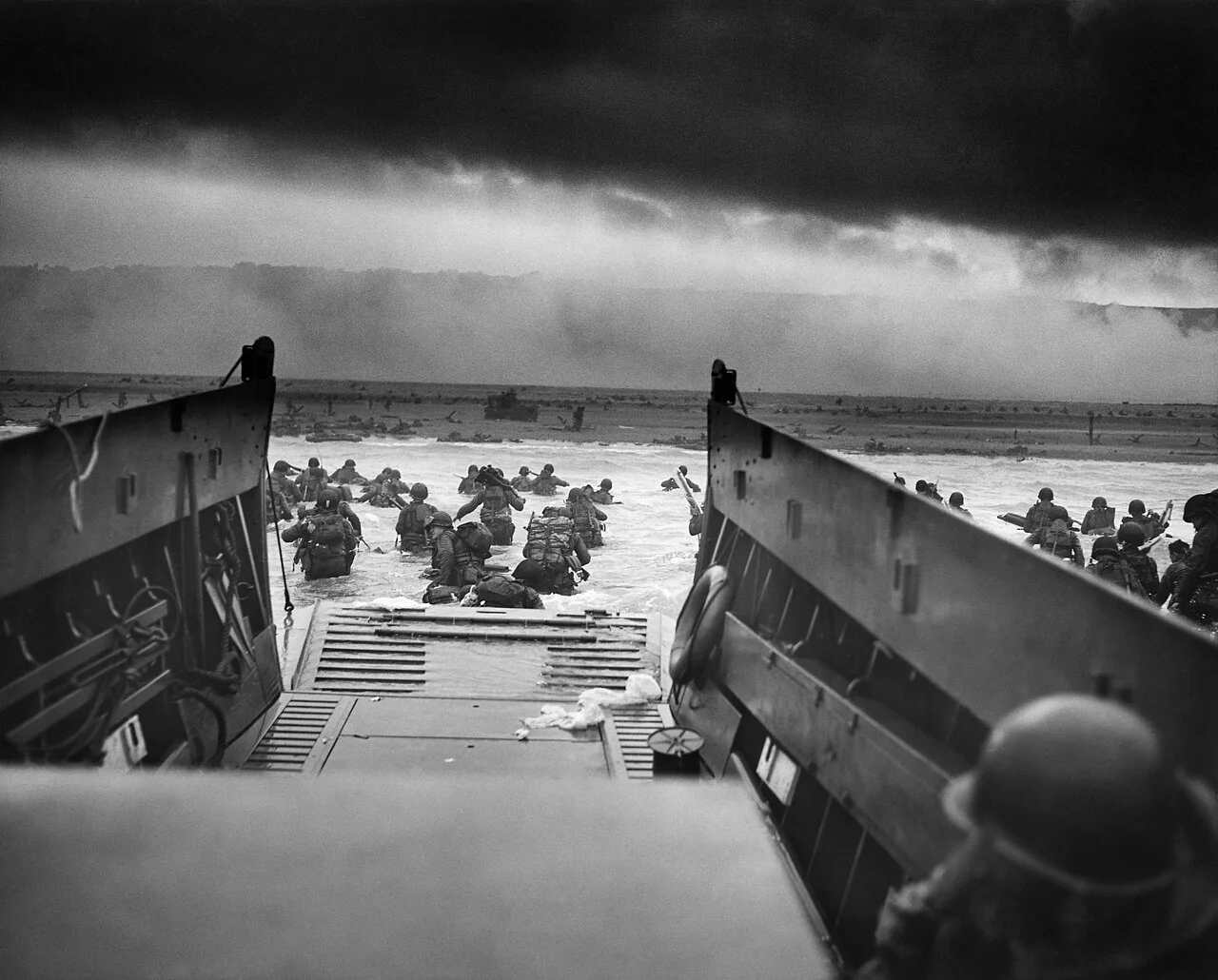
Under the supreme command of American General Dwight D. Eisenhower, the Allies spent more than a year preparing Overlord: 156,000 soldiers in the first wave, 5,000 ships, 11,000 aircraft. The landing beaches got code names: Utah, Omaha, Gold, Juno, and Sword. The Germans were deceived — Operation Fortitude convinced Berlin that the main blow would fall at the Pas de Calais, not in Normandy.
At 6:30 a.m. on June 6, 1944, the largest amphibious operation in history began. The bloodiest beach was Omaha, where the Americans lost about 2,000 men in a single day to well-fortified German bunkers. By nightfall the beachhead held. By August, more than a million Allied troops had landed in Normandy. On August 25, 1944, General Leclerc's troops entered Paris — the city was free. De Gaulle walked down the Champs-Élysées. "Paris outraged! Paris broken! Paris martyred! But Paris liberated!"
Bagration: the destruction in Belarus
While the Allies were landing in Normandy, the Eastern Front was preparing a blow five times larger. On June 22, 1944 — exactly three years after Barbarossa — the Red Army launched Operation Bagration in Belarus. 1.7 million troops, 4,000 tanks, and 24,000 guns along an 1,100-kilometer front. The operation was named for the Georgian prince and general killed at Borodino in 1812.
In six weeks the German Army Group Center was destroyed outright — some 350,000 to 400,000 killed, wounded, or captured. It was the worst defeat the Wehrmacht suffered in the entire war, bigger than Stalingrad. Over the summer the Red Army advanced 600 kilometers, from Minsk to the suburbs of Warsaw. In July 1944, Stalin staged the Parade of the Defeated: 57,000 German soldiers and officers were marched through the streets of Moscow, followed by water trucks — a symbolic "washing away" of the Nazi trail.
The Warsaw Uprising
On August 1, 1944, the Warsaw Uprising broke out — a rising of the Armia Krajowa, the Polish underground loyal to the government-in-exile in London. The plan: rise while the Red Army stood across the Vistula, liberate the capital with Polish forces, and greet the Soviets as the city's masters. The insurgents held central Warsaw for 63 days.
The Red Army, only a few kilometers away in Praga, the right-bank suburb, did not move. Stalin refused aid and refused to let Allied planes from Italy refuel on Soviet airfields. With no outside help, the rising drowned in blood: about 200,000 Poles died, and Warsaw was systematically razed by the Germans. It was a political move on Stalin's part — let Hitler's forces destroy the anti-Soviet wing of the Polish resistance, leaving the field clear for a pro-Soviet government once the Red Army moved in.
Market Garden and the Battle of the Bulge
In September 1944, Montgomery proposed a daring plan — Operation Market Garden: airborne troops would seize the bridges over the canals and rivers of the Netherlands, and an armored column would race up to Arnhem and open the road into the Ruhr. It failed. The British 1st Airborne Division was encircled and destroyed at Arnhem. "A bridge too far" became the phrase — the one chance to end the war by Christmas 1944 was gone.
On December 16, 1944, Hitler threw his last reserves into the Battle of the Bulge in the Ardennes: the Wehrmacht's last major offensive, intended to split the Allied front and reach Antwerp. In the opening days the Germans pushed 80 kilometers forward — the "bulge" on the map gave the battle its name. The U.S. 101st Airborne held Bastogne; the skies cleared, Allied air power came back online. By late January 1945, the bulge had been erased. The cost to the Wehrmacht was its last battle-ready divisions in the West.
Return to the Philippines: Leyte
On October 20, 1944, General Douglas MacArthur, as he had promised in 1942, returned to the Philippines. The landing on Leyte coincided with the largest naval battle in history — the Battle of Leyte Gulf (October 23—26, 1944). Japan committed nearly everything left of its Combined Fleet. It lost four carriers, three battleships (including the giant Musashi), and dozens of cruisers and destroyers. As a strategic force the Japanese navy ceased to exist.
It was at Leyte that Japan first used kamikaze pilots in numbers — suicide flyers who deliberately rammed Allied ships. It was a tactic of desperation: nothing else still stopped the American carrier groups. By the end of the war about 3,800 kamikaze had flown their final mission; they sank about 50 Allied ships and damaged hundreds more. Liberating the Philippines took until August 1945; the capital, Manila, fell in March after a month of brutal street fighting.
Yalta: February 1945
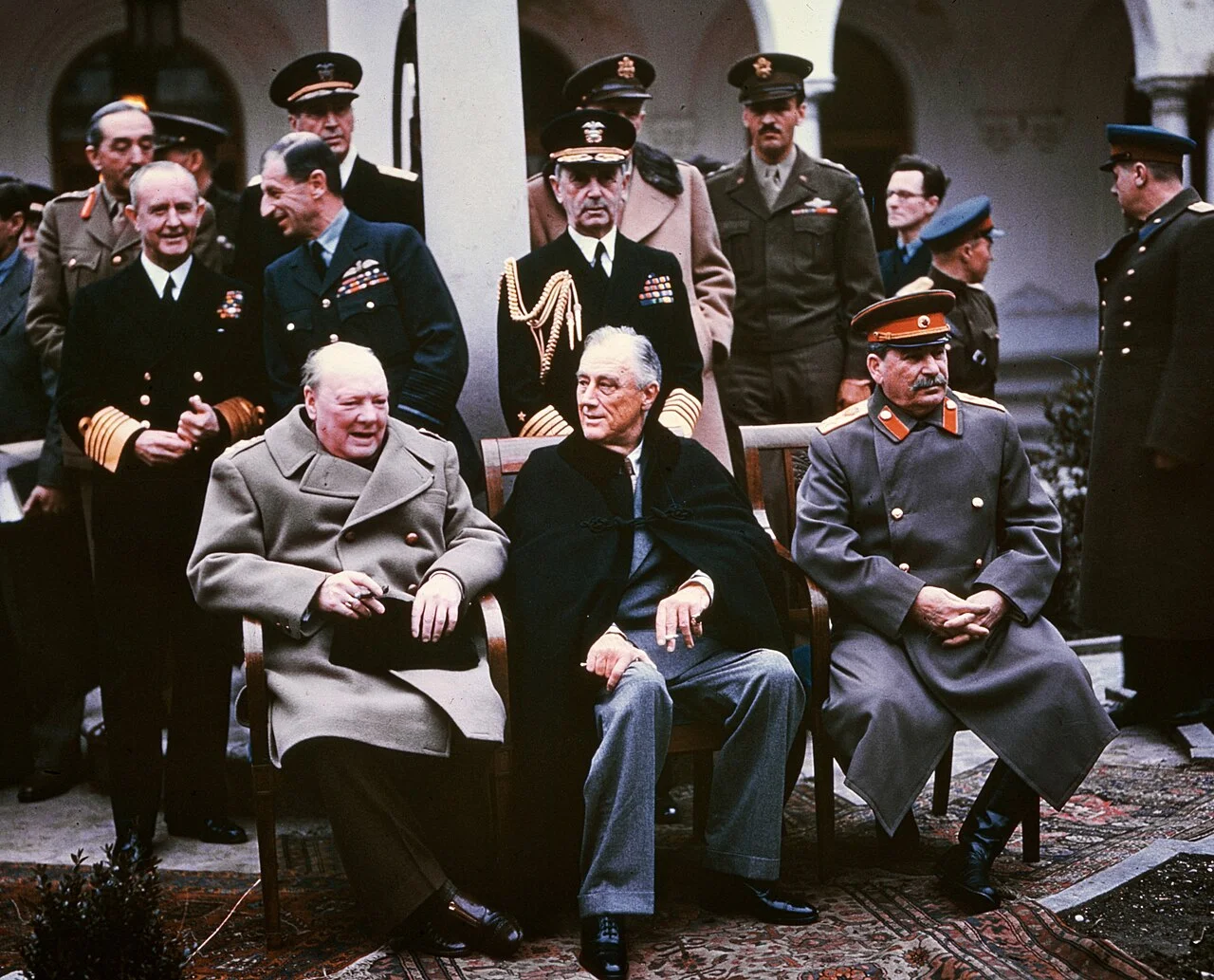
From February 4 to 11, 1945, the Big Three — Roosevelt, Churchill, and Stalin — met for the third time, at the Livadia Palace in Yalta, Crimea. The war was nearly over: the Red Army stood 60 kilometers from Berlin and the Allies were crossing the Rhine. The question was no longer how to win, but what came next.
The decisions shaped the postwar world. Germany would be divided into four occupation zones (American, British, French, and Soviet); Berlin would be split into four sectors as well. Poland's western border would shift west to the Oder—Neisse line. Stalin confirmed that the USSR would enter the war against Japan two to three months after Germany's surrender. The leaders agreed to create the United Nations. The verbal promise of "free elections" in Eastern Europe was decorative — Stalin had no intention of keeping it, and the two Western leaders knew it. Yalta laid the foundation of the Cold War.
Iwo Jima and Okinawa
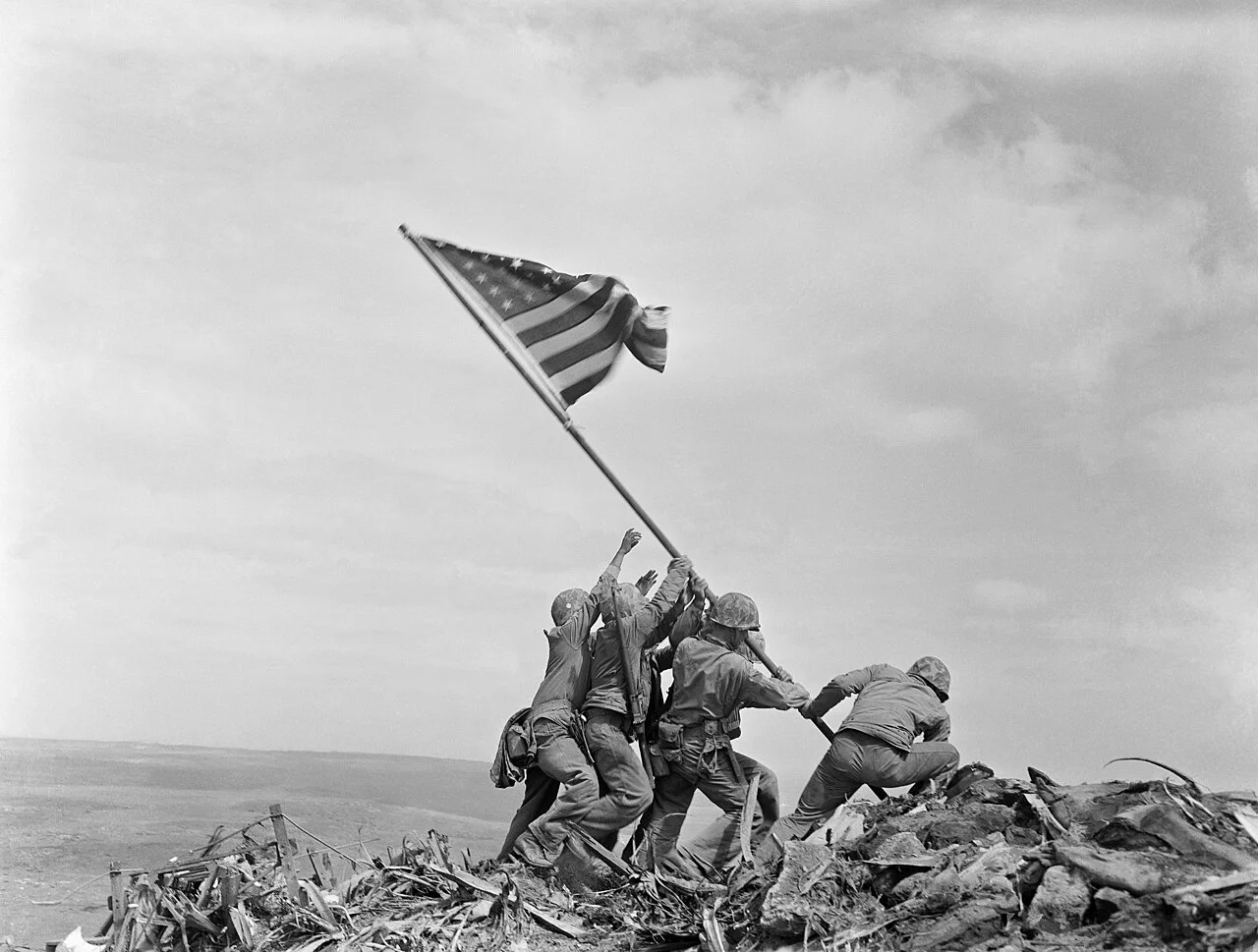
While the Allies were closing on Berlin in Europe, in the Pacific the U.S. Marines were island-hopping their way toward Japan itself. Iwo Jima (February 19 — March 26, 1945) — a tiny volcanic island 1,200 kilometers from Tokyo, needed as an emergency airfield for B-29 bombers. 36 days of fighting, about 6,800 American dead, and nearly all 21,000 Japanese defenders killed. Joe Rosenthal's photograph of the American flag being raised on Mount Suribachi became one of the most famous images of the century.
Okinawa (April 1 — June 22, 1945) — 82 days on the largest island of the Ryukyus. More than 12,000 American and roughly 100,000 Japanese military dead, plus enormous civilian losses: thousands of Okinawans killed themselves, having believed Japanese propaganda about American atrocities. Okinawa gave the U.S. airfields 600 kilometers from Kyushu — and a preview of what an invasion of the Japanese home islands would cost in lives. That calculation would weigh on the decision to use the atomic bomb.
The Battle of Berlin
On April 16, 1945, the Red Army — more than 2.5 million troops under Marshals Zhukov and Konev — launched the Berlin Offensive. By April 25 the city was fully encircled. That same day, American and Soviet soldiers met on the Elbe at Torgau — Germany was cut in two.
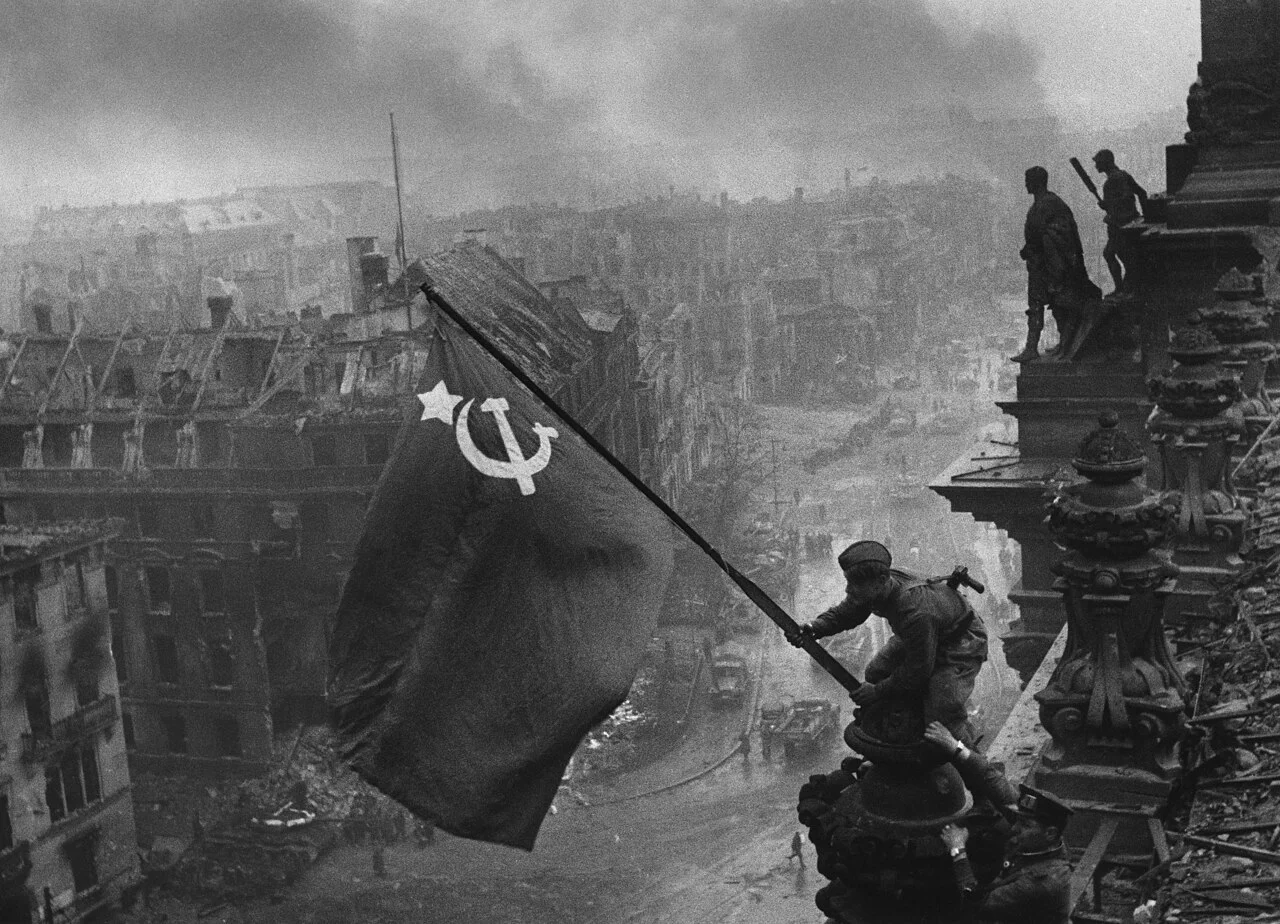
The battle for Berlin lasted two weeks. Old men of the Volkssturm and 14-year-olds of the Hitler Youth defended the rubble against the veterans of Stalingrad. On April 30, 1945, in his bunker beneath the Reich Chancellery, Adolf Hitler killed himself alongside Eva Braun, whom he had married the day before — he shot himself, she took cyanide. He had named Admiral Karl Dönitz his successor. On May 2, 1945, the Berlin garrison surrendered. The Soviet flag was raised over the Reichstag — Yevgeny Khaldei's photograph became an icon of victory.
Germany surrenders
The Dönitz government sent envoys. On May 7, 1945, in Reims, at Eisenhower's headquarters, General Jodl signed the instrument of unconditional surrender, effective at 23:01 Central European Time on May 8. Stalin insisted on a second ceremony in Berlin, where the document was countersigned that night by Field Marshal Keitel. By Moscow time it was already May 9 — which is why Victory Day is May 8 in the West (V-E Day) and May 9 in the post-Soviet states.
The war in Europe had lasted five years, eight months, and six days. Allied troops were liberating the death camps: Auschwitz (Red Army, January 27, 1945), Bergen-Belsen (British, April), Dachau (Americans, April), Buchenwald. The world saw with its own eyes the scale of the Holocaust — the systematic extermination of Europe's Jews, roughly six million victims. To them must be added Roma, gay people, the disabled, and political opponents. The word "genocide," coined in 1944 by the jurist Raphael Lemkin, became a legal term at Nuremberg.
Hiroshima and Nagasaki
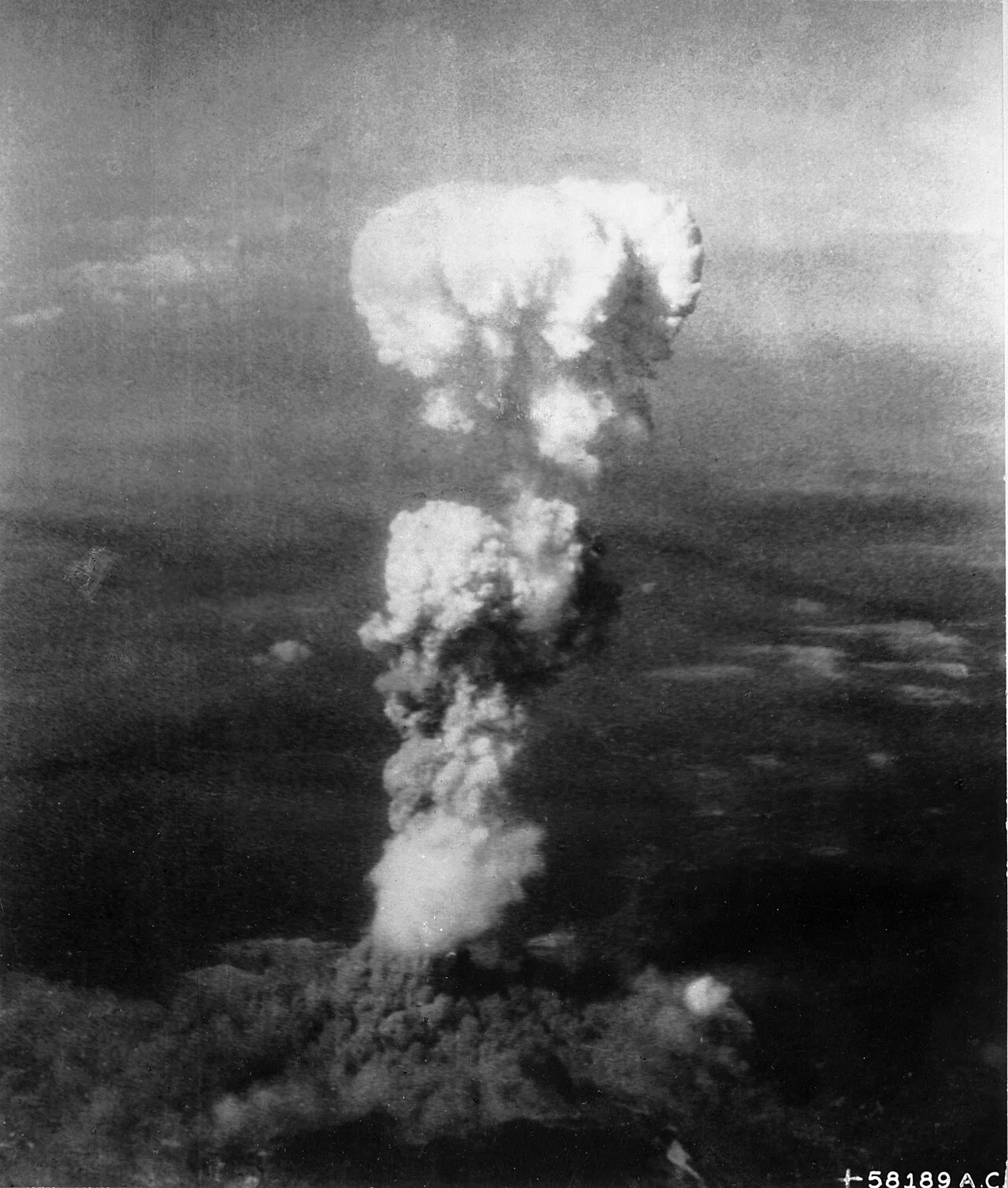
Japan kept fighting. The government refused the unconditional-surrender terms of the Potsdam Declaration (July 26, 1945). President Harry S. Truman (Roosevelt had died on April 12, 1945) authorized the use of a new weapon developed under the secret Manhattan Project. At 8:15 a.m. on August 6, 1945, the B-29 Enola Gay dropped the uranium bomb "Little Boy" on Hiroshima. About 80,000 people were killed instantly; a year later the death toll stood near 140,000.
On August 9, 1945, the plutonium bomb "Fat Man" was detonated over Nagasaki — about 70,000 dead. The same day, the USSR honored its Yalta pledge, declared war on Japan, and invaded Manchuria. On August 15, 1945, Emperor Hirohito spoke to the Japanese people by radio for the first time in history: Japan would surrender. Whether the bombs were militarily necessary remains a historical argument. Their psychological effect is not in doubt: they opened the nuclear age and have shaped international politics ever since.
USS Missouri, Potsdam, Nuremberg
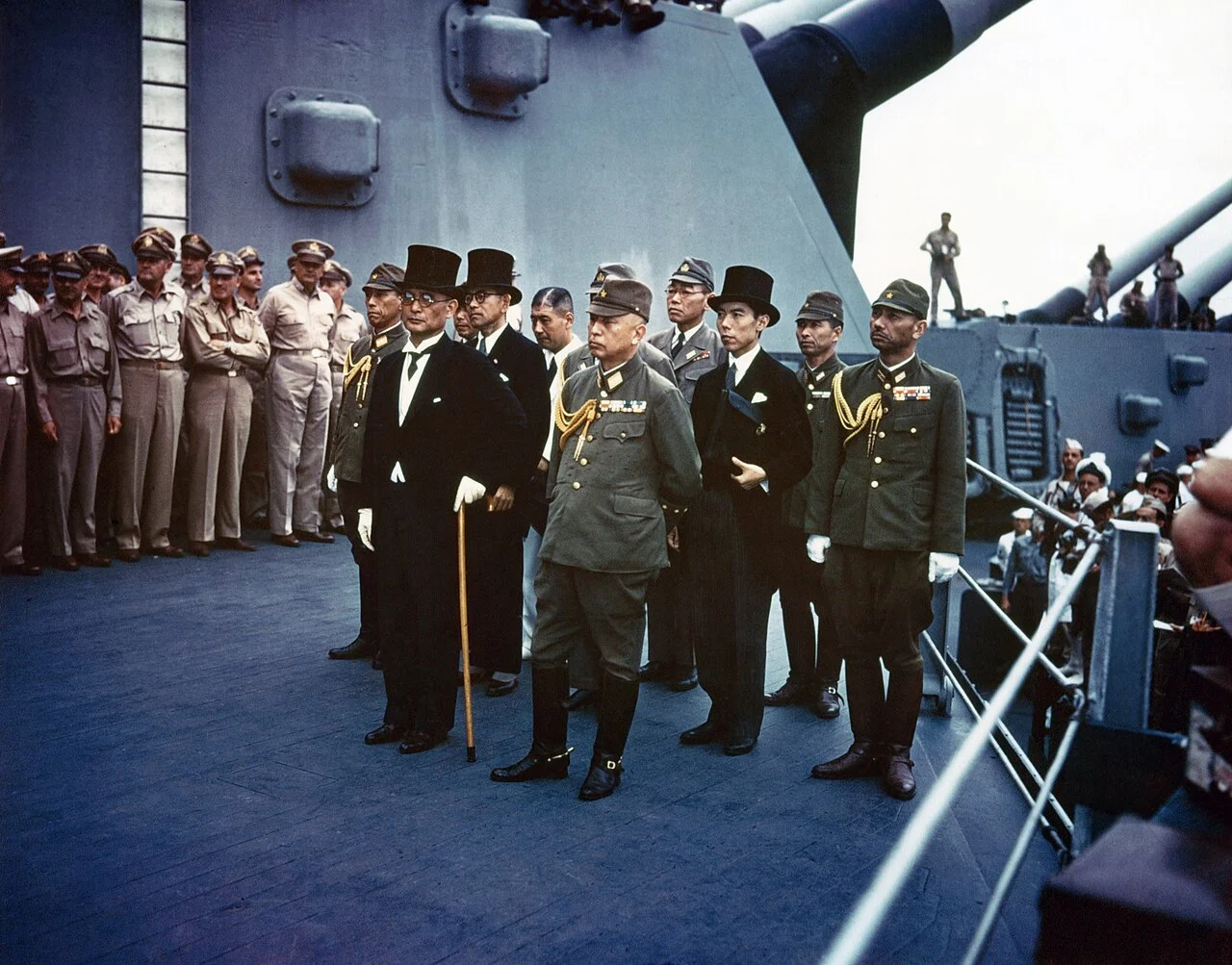
On September 2, 1945, on the deck of the American battleship USS Missouri in Tokyo Bay, Foreign Minister Shigemitsu and General Umezu signed Japan's surrender to General MacArthur. World War II was officially over — six years and one day after the attack on Poland.
From July 17 to August 2, 1945, the last of the three-power conferences was held at Potsdam — Truman, Stalin, and at first Churchill (replaced mid-conference by his Labour victor, Clement Attlee). The leaders confirmed the occupation structure of Germany, the exchange of POWs, and reparations. Truman casually mentioned a "new weapon of unusual destructive force"; Stalin showed no surprise — he already knew through his spies. From 1945 to 1949 the International Military Tribunal at Nuremberg tried 24 Nazi leaders; 12 were sentenced to death, including Göring (who poisoned himself the night before his execution), Ribbentrop, Keitel, and Jodl. In October 1945 the United Nations was founded — successor to the League of Nations, but with a Security Council that actually had teeth.
What the war left behind
The human cost. Around 70 to 85 million dead, roughly two thirds of them civilians. The Soviet Union lost about 27 million; China, 15 to 20 million; Poland, 6 million (of whom 3 million were Polish Jews); Germany, 7 million; Japan, 3 million. The Holocaust: about 6 million European Jews were systematically exterminated.
The geopolitical cost. Europe stopped being the center of the world. Britain and France were exhausted; over the next 20 years their colonial empires in India, Southeast Asia, and Africa would unravel. The six great powers of the prewar world had been reduced to two superpowers — the United States and the USSR — armed with nuclear weapons, locked in ideological rivalry, and ready to slide straight into a new confrontation. The Cold War began within two years. The Yalta—Potsdam order would last until 1991. The UN, the Bretton Woods institutions (the IMF and the World Bank), the Universal Declaration of Human Rights (1948), and the Geneva Conventions (1949) are the institutional legacy of the war — and they still set the rules of international life. World War II turned geopolitics from a European business into a global one, and the globalization of it has never gone away.