Almost 200 years during which a million Europeans, at different times, left their homes, sewed a red cross onto their clothes and marched to fight for the Holy Land — two and a half thousand kilometres from their native villages. It was the first international religious military movement the West had ever known: eight major Crusades, dozens of smaller expeditions, four Latin states along the coast of modern Lebanon, Syria, Israel and Turkey, two great military orders, and one catastrophe — the sack of Constantinople by Christians in 1204. The Crusades began on 27 November 1095, when Pope Urban II at Clermont cried "Deus vult!" ("God wills it!"), and ended symbolically on 28 May 1291, when the Mamluks of Sultan al-Ashraf Khalil took the last Christian fortress in the Holy Land — Acre. In those 196 years everything changed: the economy of Europe, the geography of its knowledge, the religious vocabulary of East and West, and even the recipes of European cuisine.
Who was fighting whom
On one side — Latin Christendom: the pope in Rome; the kings of France, England, Germany and Sicily; knights who went on "an armed pilgrimage"; the Italian sea-republics — Venice, Genoa, Pisa — who carried the armies, supplied them and in return received trading quarters in the conquered cities. Peasants and townsmen joined in, sometimes as mercenaries, more often out of plain faith. The military backbone in the East was provided by the Templars (founded in 1119) and the Hospitallers (from 1099): warrior monks who took vows of poverty, chastity and obedience — and held the most expensive castles of the age, such as Krak des Chevaliers in Syria.
On the other side — the Muslim world, which at the end of the 11th century was fractured: the Seljuks in Anatolia, Syria and Iraq had just crushed Byzantium at Manzikert in 1071; the Fatimid Caliphate in Cairo was at war with the Seljuks; dozens of emirs fought one another. It was this fragmentation that made the success of the First Crusade possible. By the middle of the 12th century things had changed: the Kurd Saladin had united Egypt and Syria into a single Ayyubid state and in 1187 took Jerusalem back. In the 13th century the Ayyubids were succeeded by the Mamluks — a caste of slave-soldiers of Turkic and Circassian origin who seized power in Egypt in 1250. It was the Mamluk Baibars and his successors who methodically destroyed the Crusader states. Another side of the conflict was the Byzantine Empire, which first invited the crusaders to help it against the Turks and then became their victim in 1204.
Phases of the Crusades
The Crusades can be conveniently divided into five phases. The birth of the idea and the First Crusade (1095—1099): the Council of Clermont, the People's Crusade of Peter the Hermit, the gruelling siege of Antioch and the taking of Jerusalem with its massacre. The Latin East and the Second Crusade (1100—1186): the four Latin states, the Templars and the Hospitallers, the preaching of Bernard of Clairvaux and the failure of the Second Crusade at Damascus. Saladin and the Third Crusade (1187—1192): Hattin, the loss of Jerusalem, Barbarossa drowning in a river, the rivalry of Philip and Richard the Lionheart at Acre, the Treaty of Jaffa. The Fourth Crusade — catastrophe (1198—1204): Innocent III's plan, the Venetian trap, the storming of Zara, the sack of Constantinople by Christians, and the Latin Empire. The late Crusades and decline (1217—1291): the Fifth Crusade in Egypt, the diplomatic Sixth Crusade of Frederick II, two failed Crusades of Louis IX, Baibars' Mamluks and the final fall of Acre. The page ends with a section on the legacy and an epilogue on why all of it still matters.
Phase 1. The birth of the idea and the First Crusade (1095—1099)
In 1071 the Seljuk sultan Alp Arslan crushed the Byzantine army at Manzikert, and within a decade had occupied almost all of Asia Minor. In 1095 the emperor Alexius I Comnenus sent an embassy to the pope asking for a modest force to help against the Turks. In reply Urban II set in motion a million people — and as a result, Europe and the Near East would never look the same again.
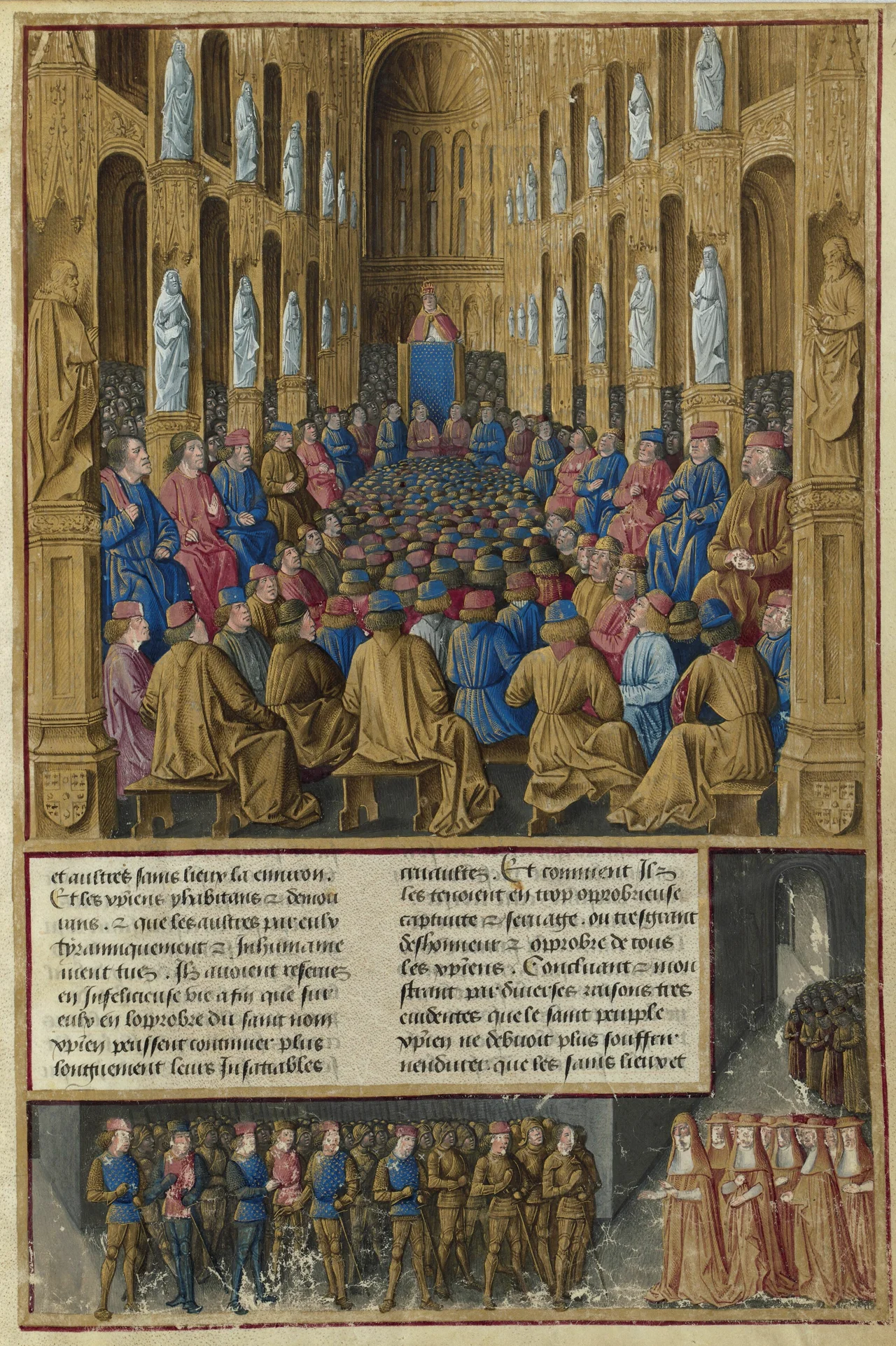
Clermont, 27 November 1095
At a council in the French city of Clermont, Pope Urban II preached a sermon to thousands of knights and clergy in the open air, because the cathedral could not hold them. The pope described how "the Turks have defiled the holy places," how pilgrims from Europe could no longer safely reach Jerusalem, how the eastern Christian brethren were begging for help. To those who took part in the expedition he promised full remission of sins — an indulgence that was at the time an unheard-of innovation — and the protection of their property and families while they were away. The crowd answered with the phrase that became the slogan of the whole movement: "Deus vult!" ("God wills it!"). Whoever wanted to go sewed a red cross onto his clothing — hence the word "crusader."
Why did Europe respond so passionately? Because everything came together at once. It was a period of demographic boom: population had risen by 50% in a century, and land passed to the eldest son — younger knights were left without inheritance and looked for land elsewhere. It was an age of pilgrimage: walking to Santiago, Rome or Jerusalem had become a norm of pious life. It was the age of the Peace of God: the Church was trying to tame the endless private wars by forbidding them on Sundays and feast days — and was now offering to channel the same warlike energy outwards. Add to that fears of the end of the world, apocalyptic expectations and the social tension from the famine of 1093—94. Nine months after Clermont, in the summer of 1096, more than 60,000 people were already on the road — knights and commoners together.
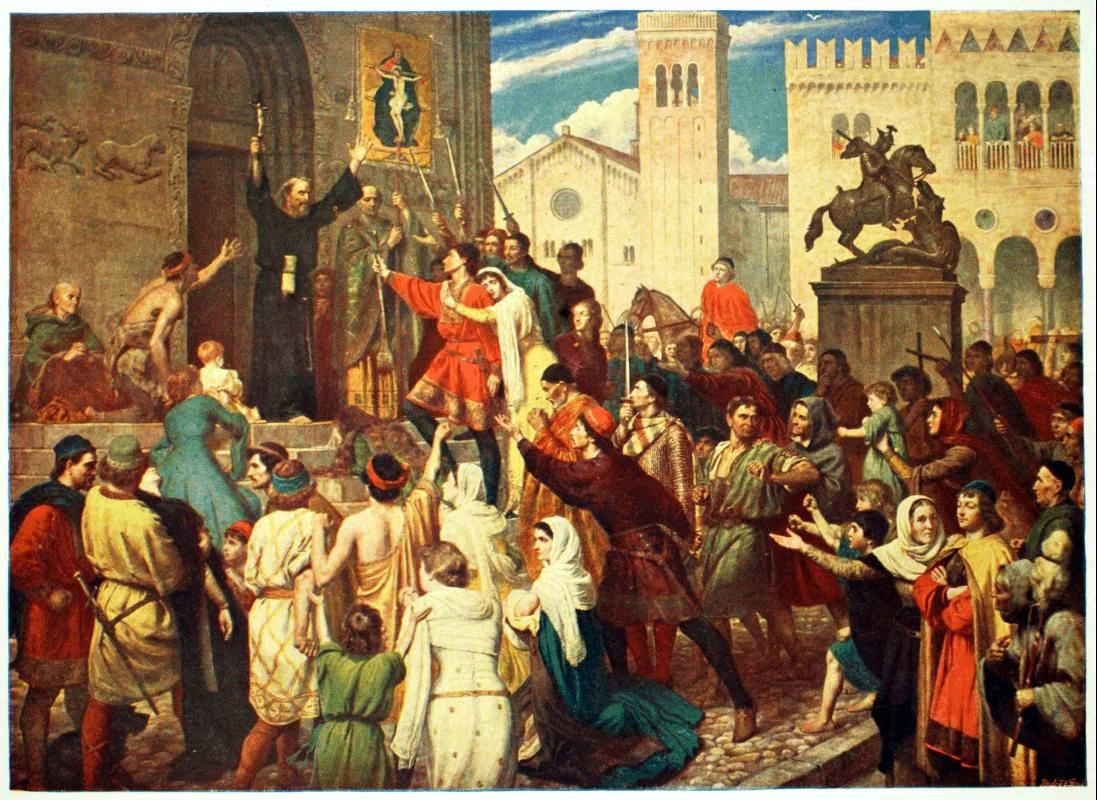
Peter the Hermit and the People's Crusade
Ahead of the knightly contingents the peasants set out — without weapons, without supplies, without commanders. At their head was Peter the Hermit, a small, gaunt monk in a coarse cloak from Amiens, a charismatic preacher who toured France and Germany; his audiences kissed the hooves of his donkey. In April 1096 a crowd of about 40,000 people — men, women, children, landless peasants, petty knights — set off for the East. As they passed through the Rhine valley they carried out the first crusader pogroms against the Jews: in Mainz, Speyer, Worms and Cologne whole communities that had lived there for centuries were wiped out; the bishops tried in vain to protect them. These were the first mass killings of Jews in medieval Europe — and a terrible foreshadowing of much that was to come.
Only half of them reached Constantinople: some were cut down by the Hungarians and Bulgarians for plundering, others starved. Emperor Alexius, seeing a horde without bread or discipline, at once shipped them across to Asia Minor. In October 1096, at Civetot, the Turks annihilated the People's Crusade. Peter the Hermit survived only because he happened that day to be in Constantinople fetching supplies. The bones of the fallen lay there for many years; when the main knightly army reached Anatolia a year later, it saw mountains of skulls. So the First Crusade began with a catastrophe.
The siege of Antioch, 1097—1098
In the autumn of 1097 the main crusader army — about 40,000 men led by the princes Godfrey of Bouillon, Raymond of Toulouse, Bohemond of Taranto, Tancred and Baldwin — drew up before the walls of Antioch, the greatest city in Syria, ringed by 400 towers and a triple line of walls. The siege lasted seven months in terrible conditions: in winter the crusaders ate their horses and their dogs, hunger, typhus and cholera ruled the camp, and even bishops deserted. By June 1098, by some estimates, more than a quarter of the army was dead.
On 3 June 1098 a Turkish officer named Firouz, for a bribe, opened by night the gates of his tower — Bohemond was first into the city, and by morning Antioch was taken. The next day a huge army of Kerbogha, the atabeg of Mosul, appeared under the walls, and now it was the crusaders who were besieged — in a city without supplies. In this hopeless situation came the episode that became legend: a poor Provençal pilgrim named Peter Bartholomew declared that the apostle Andrew had appeared to him and shown him where the Holy Lance (the one that had pierced Christ's side on the cross) was buried in St Peter's cathedral. The Lance was "found," and the inspired host — desperate, starving, with no other way out — flung itself into battle. On 28 June 1098 the crusaders defeated Kerbogha's army in unequal combat at the city gates. It was a decisive victory; from then on Antioch was Latin — and there Bohemond founded the first of the four Latin principalities.
The taking of Jerusalem, 15 July 1099
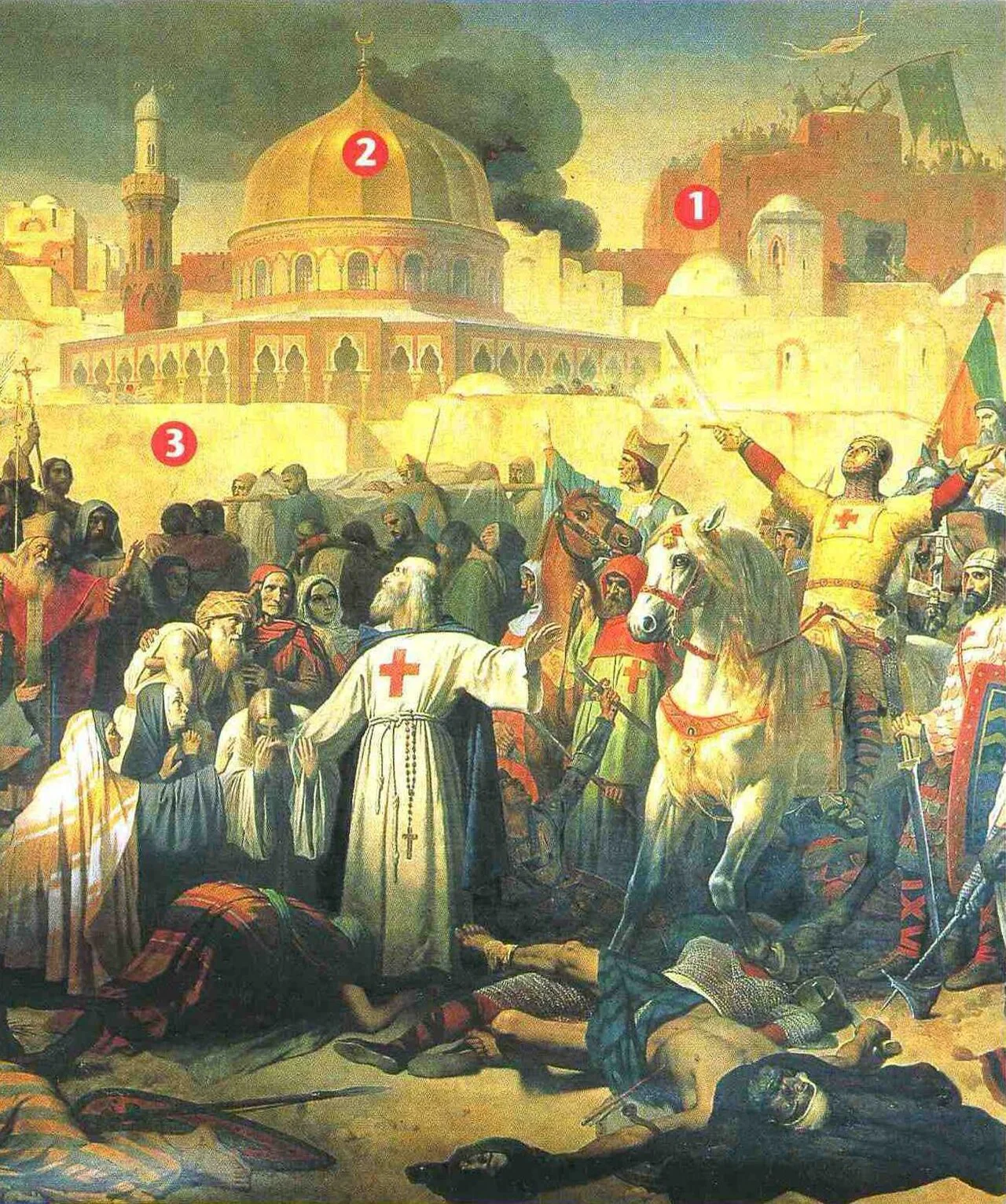
On 7 June 1099 a worn-out army — no more than 15,000 remained of the 60,000 who had started — stood before the walls of Jerusalem. The city was held by the Fatimid caliph of Cairo, with a garrison of about 1,000 Egyptian soldiers. The crusaders had neither wood for siege engines (the country around Jerusalem is desert) nor water. They were saved by Genoese and Pisan ships that arrived at Jaffa and broke up their own vessels to provide planks for siege towers. The assault began on 13 July; on 15 July, at three in the afternoon, the knight Letold of Tournai was the first to leap onto the wall from Godfrey of Bouillon's tower.
What followed went down in history as the Jerusalem massacre. For three days the crusaders methodically killed every living thing — Muslims in the al-Aqsa mosque, Jews in the main synagogue (which they set on fire with everyone inside), Eastern Christians taken for "infidels." The chronicler Raymond of Aguilers later wrote that on the Temple Mount "the horses waded in blood up to the riders' knees." Modern estimates put the dead at about 30,000 in a week. A week later the surviving knights walked barefoot to pray at the Holy Sepulchre. Godfrey of Bouillon refused to be crowned in the place where Christ had worn a crown of thorns, and took the title of "Defender of the Holy Sepulchre." Godfrey died a year later, and his brother Baldwin was crowned as king of Jerusalem. The First Crusade had given Europe more than it had hoped for — and for 88 years Jerusalem would be Latin.
Phase 2. The Latin East and the Second Crusade (1100—1186)
Between the first and second Crusades, a whole new world arose in the East — Outremer ("the land beyond the sea" in French): four Latin states stretching in a strip about 1,000 km long from Cilicia to the Red Sea. There French knights built mountain castles, wore caftans of Damascus silk, read the treatises of Arab physicians, and married Armenian princesses. It lasted one short, happy century — until Saladin appeared.
The four Latin states
Out of the conquered territory four states arose: the Kingdom of Jerusalem (with its capital first at Jerusalem, then at Acre), the Principality of Antioch (around the city of Antioch in northern Syria), the County of Edessa (in northeastern Syria — the most distant and most exposed), and the County of Tripoli (on the coast of modern Lebanon). All recognised the king of Jerusalem as their suzerain and joined in common campaigns against the Muslims. The structure was purely feudal: the king granted barons great fiefs, and the barons in turn granted them on to knights and vassals, the whole system held together by oaths. The land was farmed by local Arab and Syrian peasants, who changed neither their language nor their faith — the Latins were only a thin upper layer: about 200,000 Europeans among 1,500,000 Muslims and Eastern Christians.
The constant shortage of manpower made Outremer oddly tolerant: Latins married Armenian and Greek women, Muslim merchants lived quietly in Tyre, the synagogues and the Eastern-rite churches went on functioning. The cities had their own currency, the bezant, and the handwritten Arabic numerals which little by little came to Europe through the crusaders. The mountain castles were built on an unassailable model: Krak des Chevaliers in Syria, which could hold 2,000 fighters and a five-year stock of provisions, or Margat, or Belvoir above the Jordan valley. The stone walls of these places can still be seen today, and they remain among the most impressive fortifications of the entire Middle Ages.
The Templars and the Hospitallers
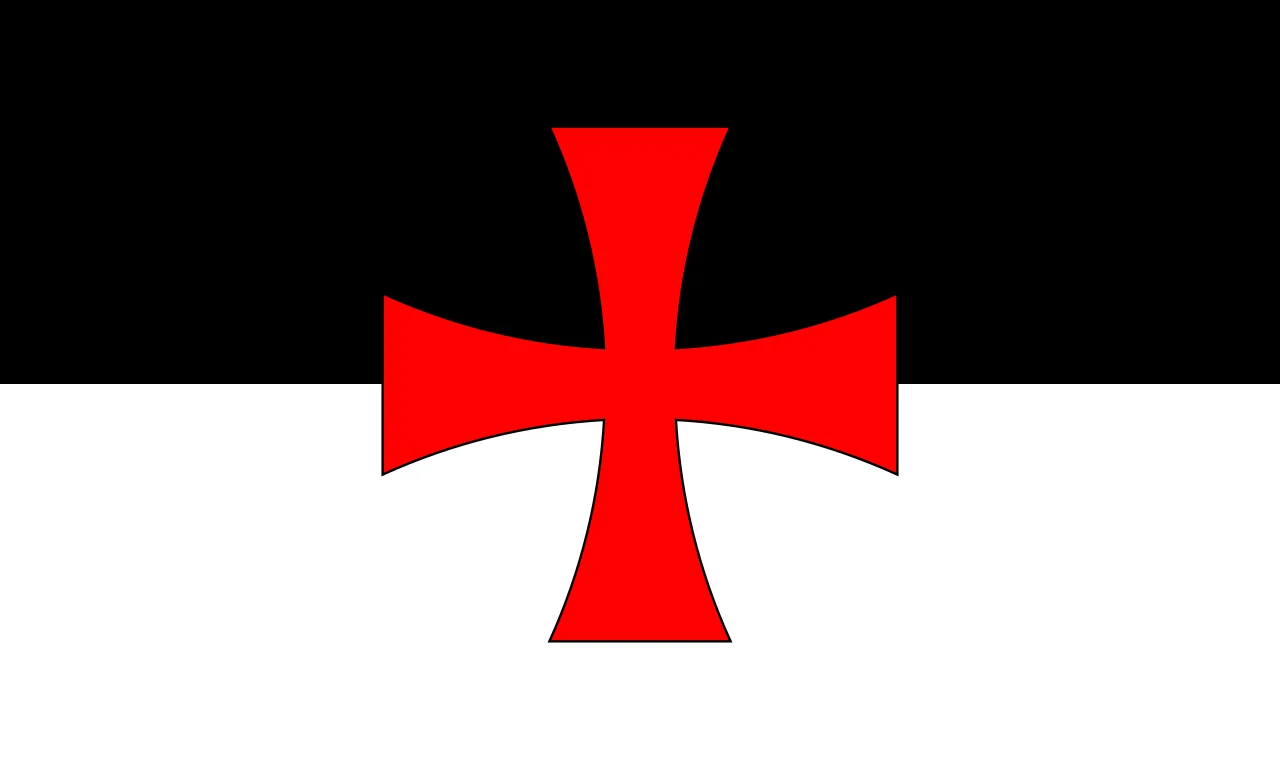
Manpower was a perpetual problem in the Holy Land: knights came, fulfilled their vow, and went home. In 1119 nine French knights led by Hugues de Payns swore to protect pilgrims travelling from the sea to Jerusalem, and King Baldwin II gave them part of the old royal palace — on the site of what had been Solomon's Temple. From this came the name — "Poor Knights of Christ and the Temple of Solomon," the Templars. In 1129, at the Council of Troyes, Bernard of Clairvaux wrote a Rule for them: monastic vows of poverty, chastity and obedience — plus daily drill in arms. The white mantle with the red cross of the Templar became the symbol of a new and unheard-of type — the warrior-monk.
In parallel, around the Hospital of Saint John in Jerusalem, the order of Hospitallers took shape — at first for the care of wounded and sick pilgrims, then also for armed defence. Their mantle was black with a white cross. By the middle of the 12th century the two orders had thousands of knights, estates all over Europe (whose revenues paid for everything), and complete independence from local kings — they answered directly to the pope. These were the first transnational military corporations in history, with their own financial apparatus (the Templars invented something close to banking by transfer — a deposit in one of their houses, paid out in another), their own ships and their own castles. The whole military strength of Outremer for the next 150 years rested on them.
The Second Crusade and the failure at Damascus, 1147—1149
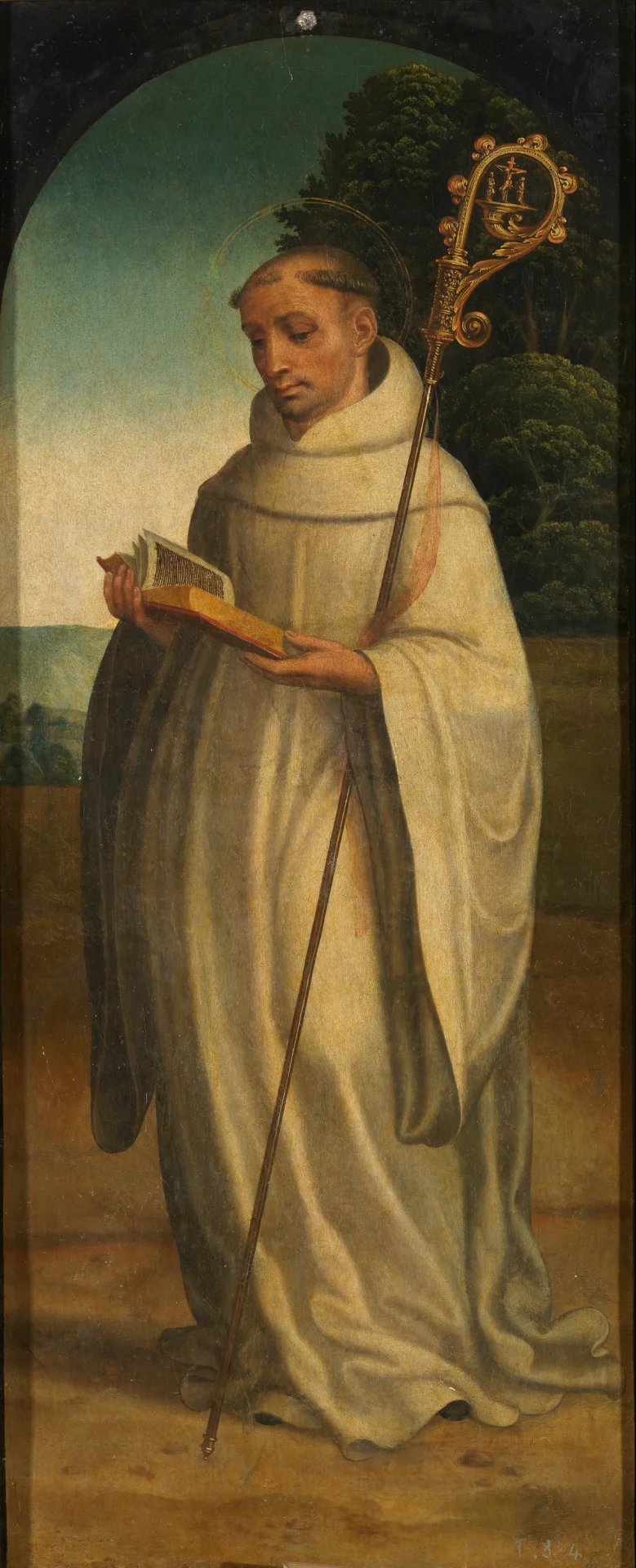
In 1144 the Turkish atabeg Zengi seized Edessa — the weakest and most distant of the Latin states. The fall of the first of the four eastern Christian states sent a shock through Europe. Pope Eugene III proclaimed the Second Crusade, and entrusted the writing of the sermon for it to the moral star of contemporary Christendom — Abbot Bernard of Clairvaux, the same who had composed the Templar Rule. From the spring of 1146 Bernard preached at Vézelay before King Louis VII, then at Speyer before Emperor Conrad III — and both monarchs took the cross.
The Crusade turned out a catastrophe. Conrad III's German army was almost wholly destroyed by the Turks in Anatolia, near Dorylaeum, in October 1147. Louis VII's French army also lost most of its men in the mountains of Cadmus. Only the two kings with small retinues reached Jerusalem. Instead of recapturing Edessa — which was the whole point — at a council at Acre in June 1148 it was decided to attack Damascus, which was at the time allied with the crusaders against Zengi. After five days of siege, betrayed by local barons and torn by political quarrels, the army withdrew. It was a total failure: no conquest, heavy losses, and a diplomatic blunder that drove Damascus into the arms of Zengi's son — Nur ad-Din. Bernard of Clairvaux, back in his monastery, explained the defeat by the sins of the crusaders, and died disillusioned in 1153. For the next 30 years weak or sick kings sat on the throne of Jerusalem — while in Syria a far more dangerous force was taking shape.
Phase 3. Saladin and the Third Crusade (1187—1192)
In 1187 the whole military infrastructure of Outremer, built up over 88 years, collapsed in a single week. A Kurdish general from Tikrit, who had united Egypt and Syria under his rule, first crushed the combined crusader army at a battle near the Sea of Galilee, and then occupied Jerusalem. In reply Europe gathered the greatest army of any of the Crusades — three kings set out for the East.
The phenomenon of Saladin
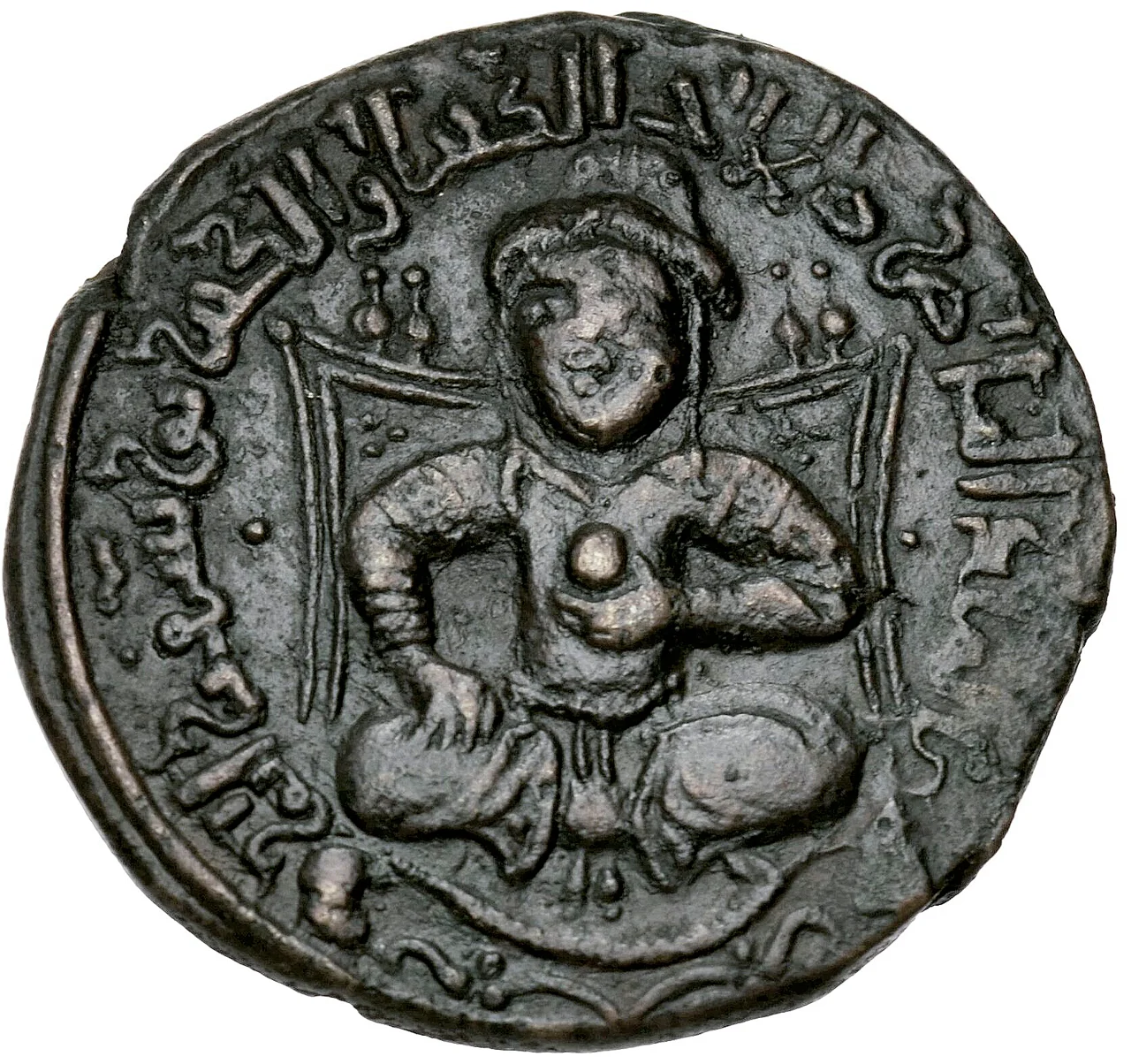
Salah ad-Din Yusuf ibn Ayyub (1138—1193) was born at Tikrit into a Kurdish family that served the Seljuk sultans. His uncle Shirkuh brought him as a young officer into Egypt, where in 1169, at the age of 31, the young man became vizier to the Fatimid caliph in Cairo, and two years later abolished the Fatimid caliphate and returned Egypt to Sunni orthodoxy under the nominal authority of the caliph of Baghdad. Then, over the next 15 years, Saladin methodically united Syria, Mesopotamia and the Hijaz — building what historians would call the Ayyubid state. For the first time in two centuries, on the southern borders of Outremer there stood a single power.
Saladin had a reputation unusual even among his enemies — that of a knight in the best sense of the word. He lived simply (he died, it is said, without any money of his own — he gave it all to charity), read poetry, never broke his word, freed enemies for a ransom or even without one, and had wounded knights treated by his own physician. European chroniclers wrote whole poems in his honour; in Dante's Divine Comedy (14th century) Saladin sits in Limbo alongside the ancient sages — that is, Dante could not bring himself to put him in Hell. In modern Arab culture Saladin is a national hero and a symbol of the unity of the Arab world; his name was claimed both by Gamal Abdel Nasser and by Saddam Hussein, who styled himself "the new Saladin." The paradox: a Kurd by birth became the symbol of Arab nationalism, and an enemy of the West became a model of Western chivalry.
Hattin, 4 July 1187
In June 1187 Saladin invaded the Kingdom of Jerusalem with an army of about 30,000 men. King Guy of Lusignan gathered in reply almost everything he had — about 20,000, including practically all the Templar and Hospitaller knights. It was the largest army Outremer ever put into the field. Count Raymond of Tripoli, the most experienced commander, urged that they not leave their mountain positions — let Saladin himself go after water and provisions. Guy decided otherwise, and on 3 July led the army across a plain scorched by heat towards the heights of Hattin, near the Sea of Galilee. Saladin cut them off from water, set the dry grass alight — and all night the crusaders, in their heavy armour, struggled without water in the smoky, sweltering valley.
At dawn on 4 July 1187 the battle began. The knightly charges could not break the Muslim line; the infantry, dying of thirst, threw down their weapons and fled; King Guy himself and the Grand Master of the Temple, Gerard of Ridefort, were captured along with the relic of the True Cross, which the army had carried with it. Between 17,000 and 18,000 knights and footmen lay on the field. Saladin ordered the immediate execution of every captured Templar and Hospitaller — as "murderers": unlike ordinary knights, by their Rule they had no right to surrender or be ransomed. The rest were taken prisoner. Hattin was a death sentence for Outremer: in two months Saladin took 52 towns. On 2 October 1187, after a short siege, Jerusalem fell. Unlike the crusaders of 1099, Saladin shed no blood — the inhabitants were allowed to ransom themselves or leave the city with their property. Where the crusaders had walked through blood, Saladin walked through mercy.
The Third Crusade: the death of Barbarossa and the siege of Acre
The news of the fall of Jerusalem shook Europe. Pope Gregory VIII proclaimed the Third Crusade — and the three most powerful monarchs of the West took the cross. Frederick I Barbarossa, Holy Roman Emperor, at 67 raised an army of about 100,000 and went by land through Hungary and Anatolia. Philip II Augustus, King of France, and Richard I the Lionheart, King of England, went by sea — each with his own fleet, settling their own quarrels along the way.
On 10 June 1190, in Cilicia in southern Anatolia, Frederick Barbarossa drowned in the river Saleph (today's Göksu) — he rode his horse into the water to cross, the current swept the horse away, the old emperor in armour was carried off; when they pulled him out he was no longer breathing. The great German army, having lost its leader, mostly turned back or melted away on the road — only a small force reached the Holy Land. So the first of the three monarchs never saw the East. In German popular tradition Barbarossa did not die — he is sleeping inside Mount Kyffhäuser in Thuringia, his red beard wound round a stone table, and he will awake when the empire needs him.
The siege of Acre and the Treaty of Jaffa, 1191—1192
Philip II and Richard I met under the walls of Acre — the main port of Outremer, which Saladin had taken in 1187 and which the last remnants of the Latin army had been trying unsuccessfully to recover for two years. The arrival of the western kings decided the matter: on 12 July 1191 Acre surrendered. Quarrels began at once: Philip, having fallen out with Richard and fallen ill, sailed home to France in August, where he at once began to plot against Richard's lands. Richard was left in the Holy Land almost alone.
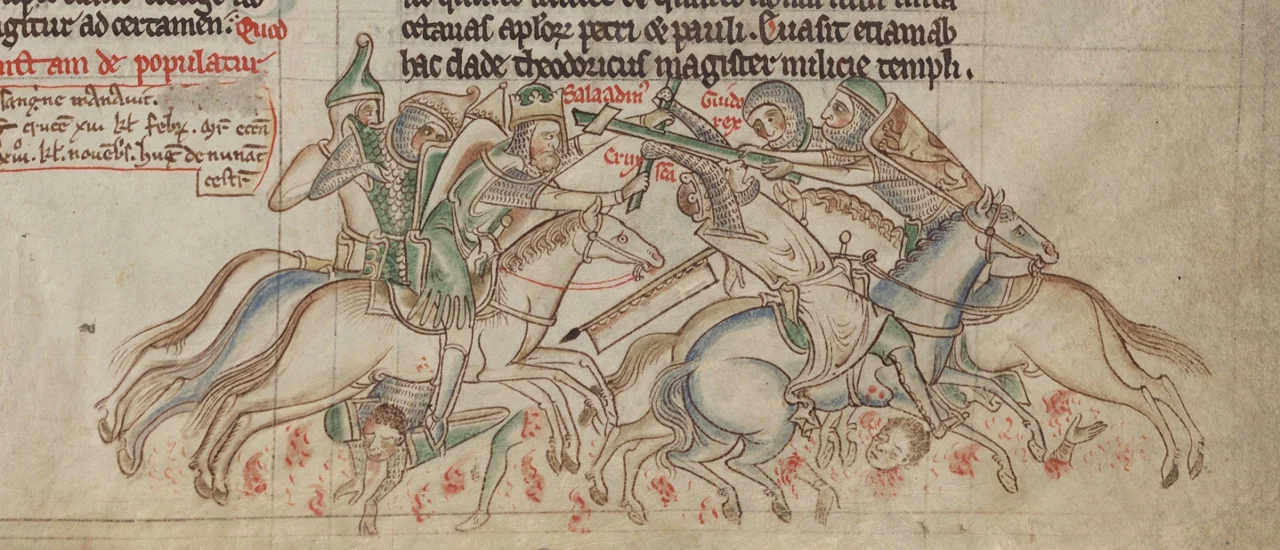
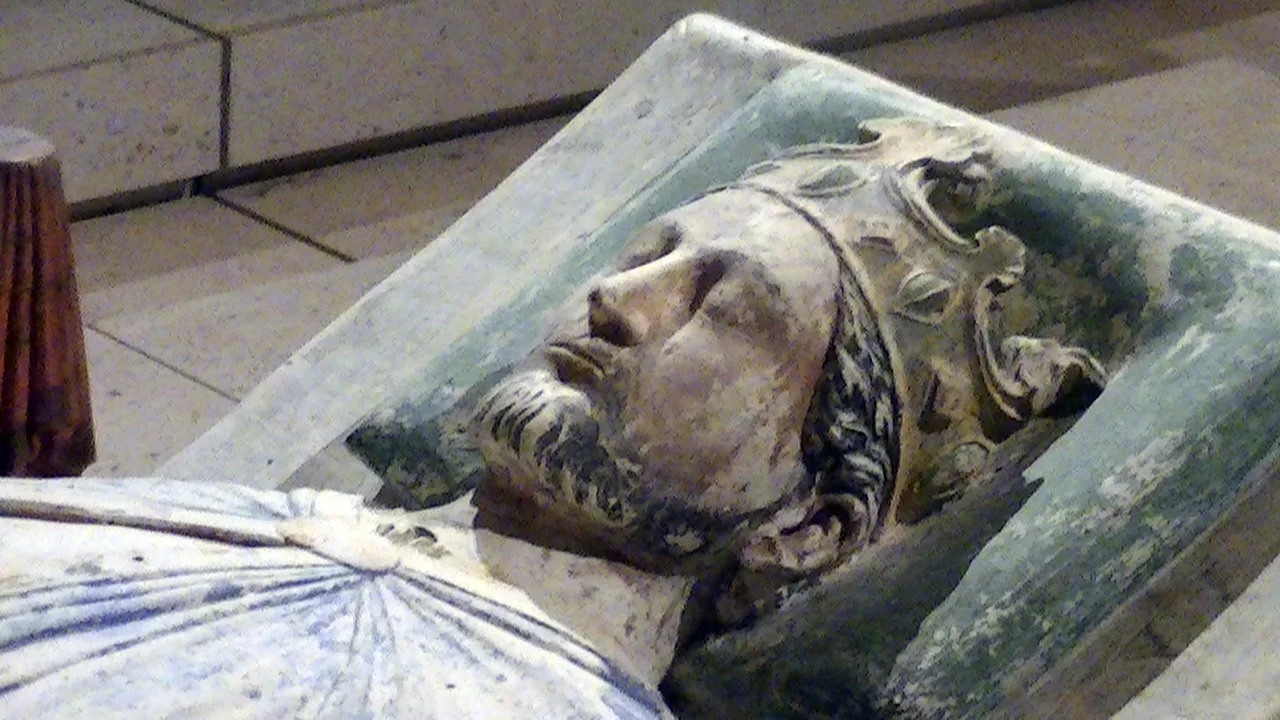
The campaign that followed was the duel between Richard and Saladin that has gone down in legend. The victory at Arsuf (September 1191), the methodical march to Jaffa, two attempts to retake Jerusalem (both times — within 20 km of the city — Richard turned back, because he did not have the strength to hold the city once taken), endless negotiations through intermediaries, exchanges of gifts: Saladin sent Richard fruit and snow when he was ill; Richard sent Saladin a falcon. In September 1192 they made the Treaty of Jaffa: Jerusalem stays under Saladin's rule, but Christian pilgrims have safe access to the Holy Sepulchre; the coast from Tyre to Jaffa stays Christian; truce for three years and eight months. Richard, who never saw Jerusalem (he is said to have refused to come within sight of its walls — "I will not look on the city I could not win back"), sailed home in October 1192. On the way he was captured by Duke Leopold of Austria and spent two years in a German castle — but that is another story. Six months later, in March 1193, Saladin died at Damascus — aged 55, with no money, having given it all in charity. His sword still hangs today in the Topkapi in Istanbul.
Phase 4. The Fourth Crusade — catastrophe (1198—1204)
If the First Crusade was a great religious adventure, and the Third a resonant military duel, the Fourth became the most disgraceful episode of the entire movement: an army that set out to liberate the Holy Land ended by sacking Christian Constantinople — and that wound between East and West has not healed to this day.
Innocent III and the idea
In 1198 the new pope Innocent III, an ambitious young lawyer of 37, proclaimed a new Crusade — to recover Jerusalem at last. Innocent chose as his strategy a blow from the south at Egypt — the heart of the Ayyubid state — through which the campaign would then move on the Holy Land. The plan was militarily sound: Egypt was the source of the enemy's strength, and with its fall Syria would drop into Christian hands. The pope raised money by a special tax on the clergy, and entrusted the preaching in France to the popular cleric Fulk of Neuilly. By 1202, mostly French and Flemish knights had gathered under the banner of the Crusade — about 33,000, under Count Theobald of Champagne (who died suddenly) and Boniface of Montferrat.
The kings of France (Philip Augustus) and England (John Lackland) did not take part — they were at that moment fighting each other for the Norman castles. This meant that the Fourth Crusade was the first to go without kings — knights only, and knights have to pay for their own war. And here begins the long chain of inexperienced financial decisions that led to disaster.
The Venetian trap
The knights turned to Venice with a contract for a fleet: 50 galleys and transports for 33,500 passengers and 4,500 horses — for 85,000 silver marks, a fantastic sum. Doge Enrico Dandolo — about 90 years old, completely blind, but one of the cleverest politicians of the Middle Ages — agreed, ordered all other Venetian trade to be halted for eighteen months and the fleet built specifically for the order. When the crusaders arrived on the Lido in July 1202, it turned out that there were only half as many as planned — many had changed their minds or sailed off on their own ships. The money — only a third of what was needed.
Dandolo issued an ultimatum: either the crusaders go home without their Crusade and lose everything they had already paid, or they work off the debt by performing a single service for Venice. The service: recover for Venice the Dalmatian port of Zara (today's Zadar in Croatia), which had been seized a few years earlier by the kingdom of Hungary. Zara was a Catholic town; its king had himself sewn a cross on his clothes and was in theory under the pope's protection. But the crusaders had no choice. In November 1202 the army of God stormed and sacked a Catholic city — at the bidding of a blind ninety-year-old Venetian banker. Pope Innocent III, when he heard, raged and excommunicated the whole army — but then quietly lifted the excommunication, because how else were they to get to Egypt.
The taking of Constantinople, 12 April 1204
Out of Zara into the crusader camp came a young Byzantine prince, Alexius Angelus, son of the deposed emperor Isaac II. He promised: if the crusaders helped him recover the throne in Constantinople, he would pay 200,000 silver marks (more than the Venetian bill), bring the Orthodox Church into union with Rome, and provide 10,000 Byzantine soldiers for the campaign in Egypt. It was an absolute fairy-tale — Byzantium had no such money; young Alexius simply wanted his throne. But to the hungry crusaders, and to the cunning Dandolo, who had long-standing grievances against Constantinople over trading privileges, the offer proved irresistible.
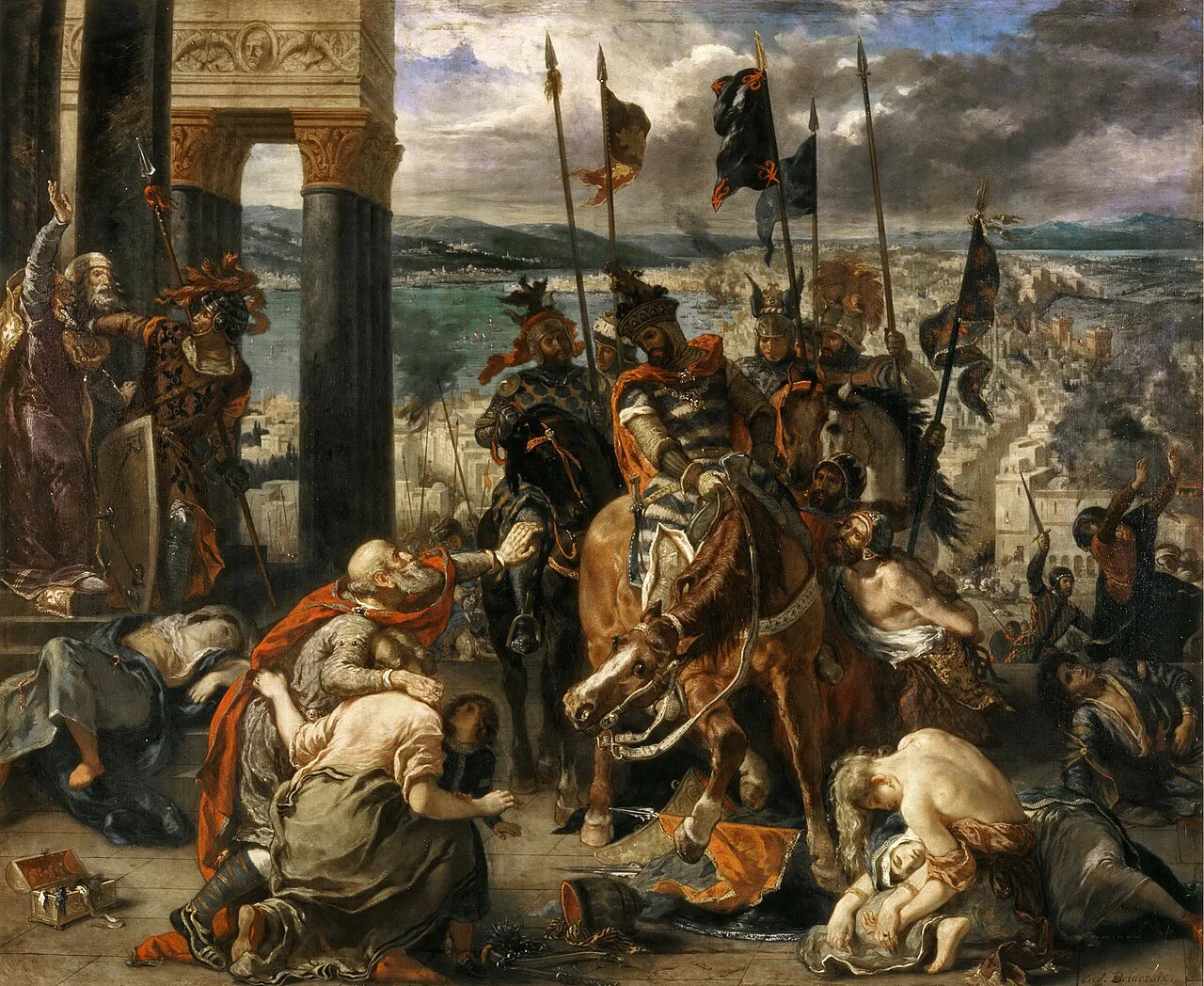
In July 1203 the fleet reached Constantinople, stormed the city walls (for the first time since the city's foundation in the 4th century — Constantinople's walls had been broken only once before), and the young Alexius was crowned co-emperor. He could not keep his promises — the people rose against him, he was deposed and killed in January 1204. The crusaders then realised that there would be neither money nor Egypt. On 12 April 1204 they stormed Constantinople a second time — and for three days methodically sacked the richest city in the Christian world. They wrecked Hagia Sophia, melted down bronze Hercules and Aphrodites for coin, took the relics of saints, the icons, the four bronze horses (now on the front of San Marco in Venice). The Partitio Romaniae followed: Baldwin of Flanders was crowned as the first emperor of the Latin Empire, Venice took a quarter of the city and all the strategic islands, the Greek lords took what was left.
Phase 5. The late Crusades and decline (1217—1291)
After the catastrophe of 1204 the idea of a Crusade was never as fresh as it had been in the days of Urban II. But the Crusades continued: five main expeditions in 75 years. Some of them (like the Sixth) succeeded without a single battle; others (like the Seventh and the Eighth) ended in total disaster. By the end of the 13th century there was no Christian territory left in the Holy Land.
The Fifth Crusade in Egypt, 1217—1221
Pope Innocent III tried once more to bring the idea of the Crusade back to its original plan — a blow against Egypt. He died a year before the start, but Honorius III saw it through. In 1218 crusaders led by the Hungarian king Andrew II, and later by the papal legate Pelagius, landed in the Nile Delta and laid siege to Damietta — the chief port of the country. The siege lasted sixteen months; in November 1219 the city fell.
Then something strange happened: Sultan al-Kamil, Saladin's nephew, proposed a peace — he would hand over to the crusaders the whole of Jerusalem, Bethlehem and the towns of Galilee in return for Damietta and the evacuation of Egypt. The relics of ninety years of war were offered on a plate. All the lay leaders urged that the offer be accepted. But the papal legate Pelagius categorically refused: he was convinced that the army would conquer the whole of Egypt, and that the Holy Land would come on top. In the summer of 1221 the crusaders moved up the Nile against Cairo — and walked into a trap: the Nile flood made retreat impossible, and the Arab armies cut their supply lines. In August 1221 Pelagius surrendered and gave back Damietta in return for free passage of the army home. The most stupid diplomatic defeat of the whole Crusader movement: Jerusalem was in their hands, and the papal fool could not take it.
The Sixth Crusade — the diploma of Frederick II, 1228—1229
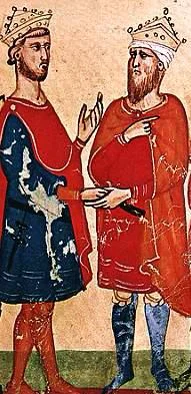
Seven years later, what a papal legate could not do, a single king did without a battle. Frederick II Hohenstaufen, Holy Roman Emperor and king of Sicily, was a unique man: he spoke six languages (including Arabic), wrote a treatise on falconry, kept Muslim astronomers at his court, and in 1225 had married Yolanda — heiress of the Kingdom of Jerusalem. Pope Gregory IX, who hated Frederick, excommunicated him for postponing the Crusade — and it was an excommunicated emperor who in fact led it.
In September 1228 Frederick reached Acre with a small army and at once began negotiations with Sultan al-Kamil — the same man who seven years earlier had offered Jerusalem. Al-Kamil was at the time fighting family wars with a Sultan-cousin in Damascus and needed quiet to the south. In February 1229, at Jaffa, they signed a treaty: Frederick received Jerusalem, Bethlehem and Nazareth for ten years and six months; the Dome of the Rock and the al-Aqsa mosque remained Muslim; pilgrims of both faiths had free passage. On 17 March 1229 Frederick entered Jerusalem and placed the gold crown on his own head in the Church of the Holy Sepulchre, because no churchman would crown an excommunicate. The pope raged and declared Jerusalem won by infidel methods. The greatest diplomatic success of the whole Crusading movement — and nobody rejoiced over it.
The Seventh and Eighth Crusades of Louis IX, 1248—1254 and 1270
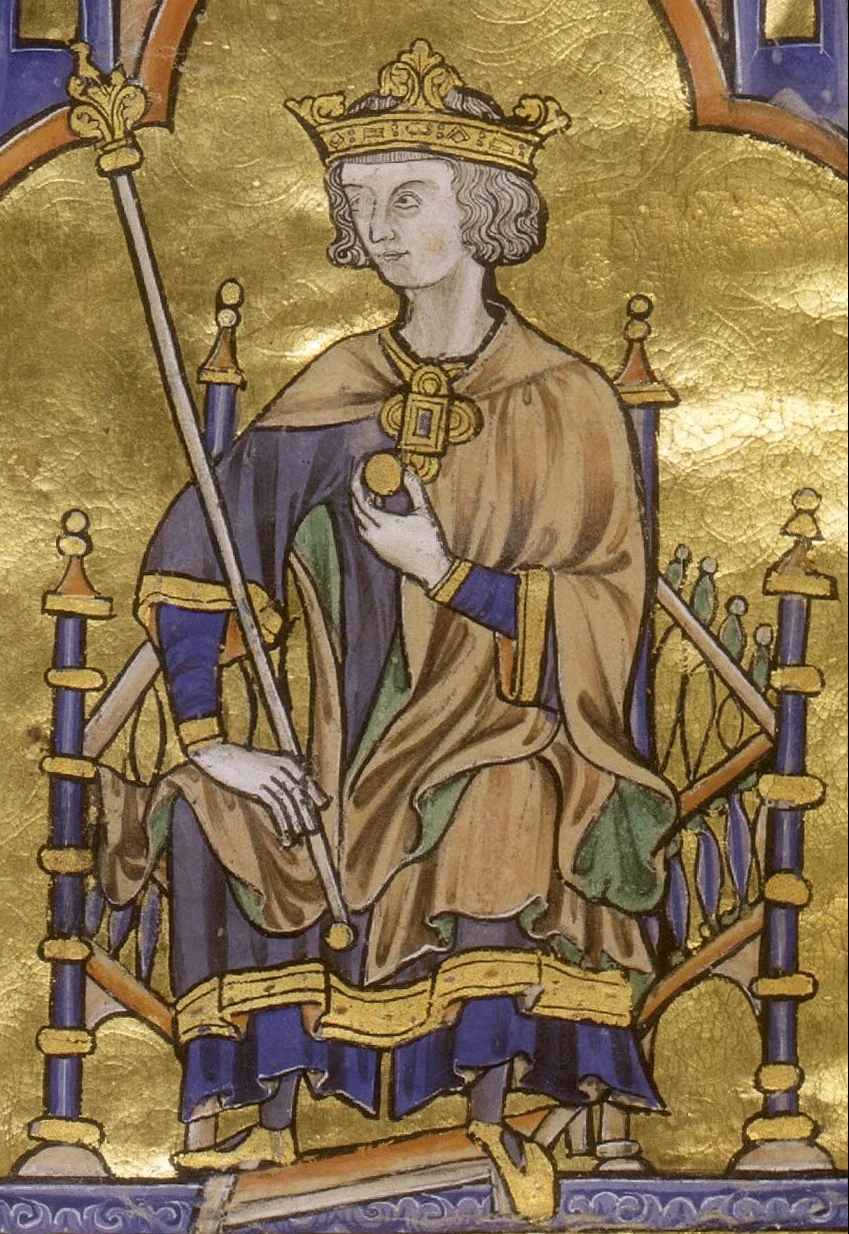
Frederick's truce ended in 1239, and in 1244 Khwarezmian mercenaries seized Jerusalem again — this time for good. King Louis IX of France (later Saint Louis) had vowed to win back the Holy Land when he fell gravely ill in 1244, and he kept the vow to the letter. In 1248, with an army of 25,000 and at a cost that ruined the French treasury, he landed in Egypt. As in the Fifth Crusade — they took Damietta, marched on Cairo, and were trapped near al-Mansura in April 1250. Half the army died of dysentery and arrows, the king himself was taken prisoner and ransomed for 400,000 livres. He spent four more years in the Holy Land fortifying Acre and Sidon, but he could not retake Jerusalem. This was the Seventh Crusade.
In 1270 Louis was already 56, in poor health, but he set out again — this time to Tunis: according to rumour, its sultan wished to become Christian. The rumour was false. A month after landing, on 25 August 1270, Louis died in his camp before Tunis — almost certainly of dysentery. This was the Eighth Crusade. The king died on a bed of ashes strewn in the form of a cross, repeating the words: "Jerusalem, Jerusalem." He was canonised in 1297 — the only king of France ever made a saint. His death set a symbolic full stop: in the 14th century not a single European monarch went on a Crusade any more.
Baibars and the fall of Acre, 1291
In 1250 a coup took place in Egypt: the Mamluk guard — a caste of slave-soldiers of Turkic and Circassian origin, whom the Ayyubids had bought as children, converted to Islam and brought up as the elite of the army — rose up and killed the sultan. Power passed to the Mamluk sultanate, which would rule Egypt for 267 years. The first great Mamluk sultan, Baibars (1260—1277), was a military genius: in 1260 he stopped a Mongol army at the battle of Ain Jalut — the only time in history that the Mongols were stopped in a pitched battle. He then turned on the Crusader states.
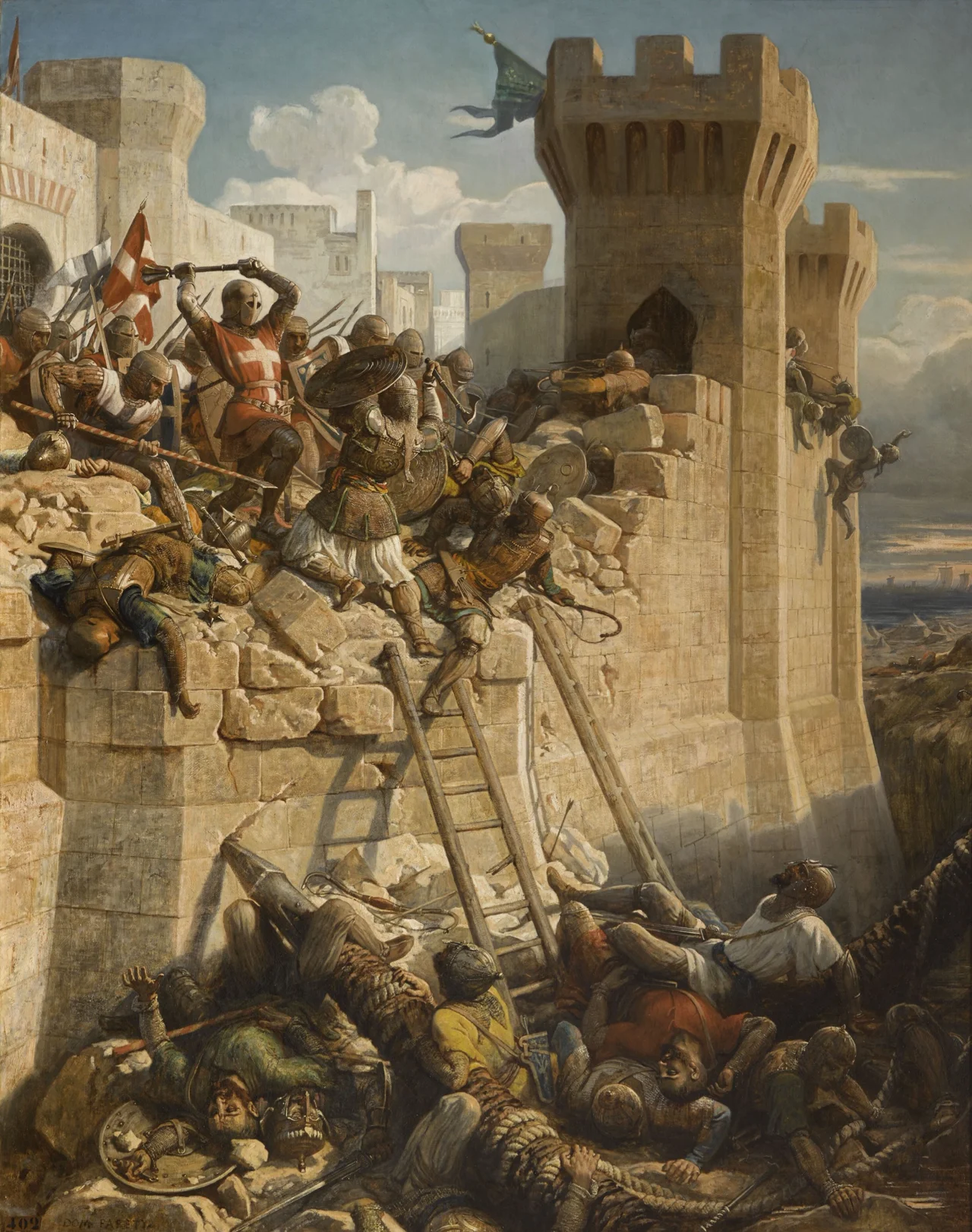
Baibars and his successors Qalawun and al-Ashraf Khalil methodically, fortress by fortress, cut Outremer down. Antioch fell in 1268, Krak des Chevaliers in 1271, Tripoli in 1289. Only Acre was left — the last Crusader capital, a great, rich city of 40,000 souls, the chief port of the East. On 5 April 1291 Sultan al-Ashraf Khalil with 200,000 men and 100 siege engines began the siege. The defenders numbered about 14,000, including 1,000 Templars, Hospitallers and Teutonic Knights — the last professionals of Outremer. The siege lasted forty-four days. On 18 May the Mamluks broke into the city; the slaughter went on for a week. The last Templars died in the main tower of the Order, which collapsed on top of them and their attackers. On 28 May 1291 Acre fell. In a few weeks the last minor fortresses surrendered. It was the end of Outremer: 196 years of Crusading in the East ended in total and final ruin.
The legacy of the Crusades
On the battlefield the Crusades ended in total defeat — the Holy Land was not recovered, the Latin East vanished from the map. But as two centuries of contact between Europe and the Muslim world they left a far deeper mark. The military orders, born in the Holy Land, became powerful European institutions: the Templars, for their wealth and their secrecy, were destroyed in 1307 by the French king Philip IV (whence the old myth of "the curse of the Templars"); the Hospitallers moved to Rhodes, then to Malta, and survive to this day as the Order of Malta; the Teutonic Knights founded their own state in Prussia, out of which modern Germany would later grow. The Italian cities — Venice, Genoa, Pisa — through the logistics of the Crusades became the maritime superpowers of the Mediterranean and the most financially developed cities in Europe; from the banks of Genoa would later grow the capitalist economy of the Renaissance.
At a material level the crusaders brought back to Europe things without which European life today is hard to imagine: sugar, buckwheat, apricots, lemons, citrus, cotton, silk, spices — two ships a day put in at Venice from the Levant. They brought Arabic numerals, algebra, the medical treatises of Avicenna, the works of Aristotle in Latin translation (through Toledo and Sicily), the Metaphysics among them — and it was on this basis that the European universities of the 12th—13th centuries grew up. They brought new types of water-mill, glass windows, mirrors, perfumes. The relics looted at Constantinople and in the Holy Land settled in the churches of Europe for centuries — from the Crown of Thorns in Paris to the Shroud of Turin. The scar in the relations between Christianity and Islam is the direct legacy of 1099 and 1187. The split between Rome and Constantinople, which had happened in 1054, after 1204 became final and has not healed to this day.
Why it still matters
The Crusades were the first attempt by humanity to wage an intercontinental ideological war: tens of thousands of people from different peoples gathered into a single military body for an abstract religious goal, not at the order of a particular king and not for plunder. In this sense the whole modern vocabulary of "holy war," "jihad" and "ideological crusade" (from the language of George W. Bush after 9/11 to the rhetoric of al-Qaeda) directly continues what was proclaimed at Clermont in 1095. Richard the Lionheart and Saladin in 1191—1192 became the first example of a "chivalric" dialogue between civilisations: they fought each other, but they exchanged gifts, treated each other's wounded, and did not allow their soldiers to kill children. All later traditions of cross-cultural respect for the enemy — from the European code of honour of the 18th century to the Geneva Conventions of the 20th — rest on that precedent.
On the other side, the Crusades are also the first great example of mass religious fanaticism turned inwards. The first victims of the First Crusade were not Turks but the Jews of the Rhineland: in Speyer, Worms, Mainz and Cologne in the summer of 1096 whole communities perished that had lived there since Roman times. This was the prototype of the Jewish pogroms of later ages — from the "Jewish questions" of the 19th century to the Holocaust. Today in Arab culture the word "crusaders" (al-Salibiyyun) is still used for any European intervention — from the colonial era of the 19th and 20th centuries to the American invasion of Iraq in 2003. In modern jihadist rhetoric, "crusade" is a clear cipher for everything Western. So on one side — chivalry, universities and the Holy Crown of Thorns; on the other — pogroms, fanaticism and a hundred-year-long scar in relations with a neighbouring civilisational world. The Crusades are the mirror in which Europe has been looking for 900 years, and each generation sees its own face there.